SURTITLED THEATRICALITY. WHAT LANGUAGE DO ARTISTS EXPORT?

SURTITLED THEATRICALITY. WHAT LANGUAGE DO ARTISTS EXPORT?

If certain theatre artists decide to leave their country and start a career elsewhere, reshaping their style to the peculiarities of a foreign audience, others export their work as samples of the kind of theatre that these artists have learned to extract. So what is the essence of their artistic choices? And to what degree does it depend on the addressees’ environment?

© István Biró
© István Biró

Traveling Europe to see theatre—as the Young European Journalists on Performing Arts are doing in the context of the UTE “Conflict Zones” programme—always comes down to the question of “exportability”, especially regarding those performances presented in so-called “international events”.
It goes without saying that dance and music have the extraordinary ability to be really universal, because they are not based on fixed codes of language: the absence of the spoken word—or the challenge presented to its supremacy—brings the semiotics of performance to a more physical, empathic and immediate level.

The question is: how and why does an artist choose to export one show or another? Is he/she aware of the level of engagement that is needed in order for it to be fully received by a foreign audience?

Sample #1. On the 1st of December, the Main Hall opened the curtain for the Ukrainian stage director Andriy Zholdak’s staging of Electra, produced by the National Theatre of Macedonia, a very dark adaptation of the Greek classic “based on Aeschylus, Sophocles and Euripides”. In the first act, a giant container, with windows and sliding doors, frames four different spaces: a studio/bedroom, a corridor, a bathroom, a kitchen. On the top of the structure, two lateral screens project live feed video of the actors’ close-ups and details of the scene. Thus, the spectators are invited to switch their attention from one side to the other, chasing a very complex montage of actions and emotions. Separated from the narrative—and yet crucial for the understanding—hanged to the ceiling there are two more screens that play the surtitles: English, Romanian and Hungarian on the centre, Macedonian on the side. Then the audience’s attention must be split in at least one more way, depending on the mother tongue of the spectator, who at the same time is listening to a text spoken in a foreign language. Fortunately, the general taste of the performance doesn’t lean much on words, but rather on impressive images and deeply emotional acting style, not without a generous touch of Grand-Guignol in the killing scenes.

Sample #2. The next day, the same venue hosted Andrei Șerban’s staging of Bertolt Brecht’s The Good Person of Szechwan for the Bulandra Theatre, Romania. The actors, with faces painted in white, mingle up text and songs on a simple but colourful set, trying to recreate a “genuine” Brechtian imagery. In this case, the fact that the plot is quiet familiar to anybody interested in modern and contemporary theatre was of great help, since once again it wasn’t always easy to follow the surtitles (in Hungarian and English).

Sample #3. December the 2nd was also the night of the Sfumato Theatre Laboratory from Sofia, Bulgaria. OOOO – The Dream of Gogol is a very well crafted journey into Nikolai Gogol’s imagery, with excerpts from different short stories, carried out by a tight-knit group of performers. The mood is always halfway between humourous, ironic, dark and desperate; with only a platform and a backwall as a set, some hatches, well designed lights, simple props and an impressive acting talent fully entertaining the audience. The rhythm of the spoken word—frequently delivered by at least three performers simultaneously—is the key to organize such a rigorous physical theatre on stage. Once again, flooded by such a copious river of words in Bulgarian, the attention goes through some hard times in trying to follow the written text, which is streaming on the screen in very dense and quick bicoloured slides.

Sample # 4. December 3rd, back in the Main Hall. The festival hosts the great talent and South-Korean storyteller Jaram Lee (here directed by Ji Hye Park). Her pansori (this is the name of the traditional form of musical storytelling performed by a vocalist and a drummer) The Stranger’s Song needs nothing more than some space to move, a fan and two musicians (playing buk and guitar). In this adaptation of Gabiel Garcia Marquez’s novella Bon Voyage, Mr. President (published in 1993 in The New Yorker), the surtitles are still there, up on the screen doing their translating job into three languages. And yet, the whole performance is so much attached to body language and meticulously built on the relationship between performer and spectator, that one no longer needs to read the text word by word. Thanks to Lee’s clever attitude in putting the audience at ease, and certainly to a simple but powerful story, we manage to follow the path from pantomime to poetry, without worrying too much about the exact sentences.

Since these four samples cannot exhaustively give an account of all the performances the audience of the Interferences Festival was invited to see, what’s the purpose of such a selection?

In the samples we demonstrate how crucial it can be to put great attention to visual dramaturgy in order to stay lively and challenging for the spectator’s eye. Every artist is perhaps aware that the surtitles are the only way to convey the basic meaning of a plot (when there is one); but not all of them are making use of all the numerous other communication elements in an equally successful way.
Margarita Mladenova and Ivan Dobchev’s attempt (sample number 3) is outstanding since it shapes a great part of the narrative on the performers’ physical features, on their gestures, their position under lights and a sharp management of proxemics. Appointed to lead the attention, during the choral parts, is not really the meaning of the single sentences (that still are very accurately edited), but rather those inflections, accents, accelerations and slowdowns that colour the speech. Ultimately, a subtle mastery of the space that lights up different corners of the stage with different tones helps the plot to change set and ferries the text from one novella to the other. We are overlooking Gogol’s Russia and Ukraine and reading on a digital screen fragments of a rambling discourse, similar to the one of Diary of a Madman, that, as the last excerpt offered, surprisingly ends up sounding as the most coherent one, only because Mladenova and Dobchev provided us in advance with a handbook to their language.

The difficulties a foreign audience might have found in Șerban’s The Good Person of Szechwan are perhaps rooted in a too static management of the space and the choreographic patterns: the wide stage—two side wings providing all the entries and a crèche-like scale model of the city on the backwall, where the musician plays and sings—is almost empty and crossed by all the characters who walk in and out covering almost the same diagonals. If one lowered down the volume of the words and songs, the visual parade would appear to retrace similar schemes over and over, detaching the attention from the hues of the (very dense) text, and without offering any other handhold to the spectator.

Stepping back to more general considerations, even in an all so familiar Western society such as Europe, trying to cross the language barrier is always a hard mission.
Though here and there exaggerated in summing input to input and yet cleverly evoking disturbing sequences that in some ways catch the glance, sample number 1, Elektra, manages to export an intense theatrical experience because it goes beyond the plain delivery of a text.
Still, the solution found by Jaram Lee remains the most successful. Gently (yet smartly) tickling the fascination for exoticism, The Stranger’s Song accepts a basic compromise to export its language: to knead together a secular national tradition with certain easy communication tricks.
The storytelling itself is not only performed but discussed in front of the audience: Lee frequently steps outside the performance to explain why she uses the fan, why she needs a specific quality of attention and concentration, why she chose that single “very Western” story. If this style needs neither justification nor any special knowledge about Oriental cultures in order to be understood, it is perhaps because its communication elements were accurately prepared before exportation; their selection is already clear in the form and in the attitude of the performer, who cheerfully shares it with the audience.

In other words, a good strategy for an artist to attract and keep the foreign audience’s attention is to put all the elements to the test before exporting a play. As seen during the Young Journalists on Performing Arts think tank—where every topic had a different impact depending on the country—one needs to be extra careful when it comes to talking to a group of foreign colleagues: we don’t want to talk over people; it’s about listening and learning from one another.


Published on 22 December 2017 (Article originally written in Italian)

Festivals As States Of Culture Within Nation States

Festivals As States Of Culture Within Nation States

From 24 November 4 to December in Cluj (Romania) the fifth edition of the Interferences International Theatre Festival took place. “OOOO – The Dream Of Gogol” (based on “Nevsky Prospect”, “Marriage”, “Ivan Fiodorovich Shponka and his Aunt” and “Diary of a Madman” by Nikolai Vasilievich Gogol, written and directed by Margarita Mladenova and Ivan Dobchev) by the Sfumato Theatre Laboratory (Bulgaria) was one of the 22 performances, coming from 14 different countries in 13 languages, all of which constituted the rich programme of the event. That was the second participation of the troupe in the ten-year history of the festival, following their visit with “Jean, Julie and Kristine” (after “Miss Julie” by August Strindberg, directed by Margarita Mladenova) in 2012. The Sfumato, UTE member since 2011, is a theatre-laboratory, aiming at in-depth theatrical research through long-term programmes, masterclasses, workshops and parallel programmes.

Prof. Margarita Mladenova - © Simon Varsano
Prof. Margarita Mladenova – © Simon Varsano

Prof. Margarita Mladenova, a theatre director and a cofounder of the Sfumato (together with Prof. Ivan Dobchev), tells us more about her immediate impressions of the festival from the perspective of a participant in two of its editions; the role and the meaning of festivals in the contemporary cultural situation; and the place of festivals in the own artistic perceptions of the troupe:

The Sfumato Theatre Laboratory regularly participates in festivals worldwide. In your opinion, what is the role of festivals in our current cultural and theatrical context and where on this map would you place the Interferences International Theatre Festival?

The Sfumato is a festival theatre. Not because we deliberately create works meant exclusively for festivals, but because, especially in our contemporary context, festivals are those cultural and artistic spaces that are interested in the quest for a more unusual language, innovative methodologies, creative techniques and processes. They are “states of culture within nation states”, which insist that theatre as a living form of art should remain a form of art.
For us, Interferences is one of the major theatre festivals in this part of Europe. We have long-term contacts and partnerships with about forty festivals. We have participated at many of them several times — in Avignon (France), Essen (Germany) and Nancy (France), for instance. We have been to Japan, Korea, and we have visited festivals in Central Europe many times. But for Ivan Dobchev and me, and for our actors, the participation at the Interferences Festival brings a sense of completeness and satisfaction due to the high levels of consideration, implementation, nurture and accomplishment of this festival space. Beginning with the minor details, through the team and it’s the attendance to the forums envisioned in the programme — I have in mind the follow-up meetings and the discussion instead of simply showing the performances. And the audiences; because this festival has one very thoughtful and knowledgeable audience, which has been nurtured. All encounters with them seem to me as if one were attending a music concert, where everyone in the audience knows the notes and the scores.
For example, we had a very powerful discussion after our performances. And there we talked about how different “OOOO – The Dream Of Gogol” is from “Jean, Julie and Kristine”. The spectators were able not only to distinguish them, but also to reason on those differences in an analytical and artistic perspective. That means that there we encounter a developed, watchful and sensitive gaze, echoing our own processes and intentions. For us this is significant in terms of having a future instead of simply having a full house, a nice performance, applause, and then return home. The real effect, the efficiency of those meetings, goes beyond our stay there.

And is there something that can make the whole experience even more fruitful?

There is one wish of the troupes that is always present when they are invited to a festival: to have the chance to stay longer than the time needed for their participation in order to be able to see other performances of the programme and to meet with colleagues. Fundamentally, this is in the meaning of festivals: for artists to gather in the first place, and to sojourn in a community. But, particularly since 2010 and since the enforcement of the logic that the performance needs to be placed as a commodity on the market, this notion has changed its pathos. Now festivals are more for the audiences than for artistic encounters. Yet, in my opinion, theatre should not give up on this. It is exactly in this situation that festivals need to want and quest for possibilities to open up spaces for artistic collaborations. Because there is no other place where artists can meet other artists outside these special festival territories. We have discussed that with the Interferences Theatre Festival’s organizers and this is their will, too; but the limitations are many.
However it is through those reverberations among us that the system opens up and chain reactions and theatrical collaborations occur. And they can become as a relay through time. Some things might end, and some might last or bring into the world their natural continuations. And when we, the theatre makers, have this way of thinking and need, no one can avert us from gathering together in such communities.
Look at UTE masterclasses, for example. We send interesting young people, open to learning through experience. Since 2011, when the Sfumato became a member, up till now we have sent more than ten participants. Two of them, who attended Lev Dodin’s masterclass in Saint Petersburg, met other people there and together they decided to form the ISO Theatre in the frame of the UTE that is now striving to create its own, permanent existence.

Etymologically speaking, “festival” derives from the Latin “fēstīvus”, meaning festive, merry, joyful. We know that ancient theatre is also tightly related to the feast, the ecstatic, the interruption of the everyday, linear time and opening up space for vertical connection with the transcendental. In this sense a theatre festival has to multiply the festivity, to make it a feast of the feast within the feast. Is that what contemporary theatre festivals do?

This is the pathos of every festival and it remains there. No matter what its priorities, themes, own pain and subject of curiosity of the given edition are. Theatre itself, the nature of the encounter, occurs in a greater reality; on the borderline between truth as “we all know it”, as a daily routine, and the extraordinary, the exceptional, the festive, the complete existence of art. The two are merged together intensively and not at all mechanically, but exactly through this edge, where the performance itself exists as a greater reality.

And the polygon that appears as a result of adding together all the “edges” of the performances, included in the festival’s programme—

—lifts up this entire existence vertically and does not conform to the horizontality of daily life. It is extraordinary.

Earlier you mentioned festival audiences. In this logic, they are different than the ones regularly entering the building where a troupe performs and where the performance is created. In that sense, the chance of meeting with them is singular. Does that intensify this encounter, and how does it alter it?

A festival participation, with its specific presence, voltage and concentration, makes the troupe and the whole crew hungry and long for a higher encounter. That is also valid for the audience, seeing a performance that cannot be seen outside of the festival’s programme. This singularity of the encounter gives it exceptionality and intensity. The festival performances are always more inspired.
Even though when I say “more” and I begin to think about how in the Sfumato, for the tenth year now, two of our performances of the “Strindberg” programme — “Jean, Julie and Kristine” and “Dance of Death” — that have been all around the world, are still on stage. They have had extremely powerful vertical motions in their encounters with audiences. And they have preserved that spirit. The performance absorbs, creates memory of exceptionality, which is later stored and reenacted; because, in principle, every single night the encounter with the audience is an exceptional experience; for the performance, and for the spectators. This is how we should think of it. The other is inertia.

And this exceptionality, transitory, and yet endurance; the live encounter with its high risk, vulnerability, but at the same time its resilience: the coexistence of all those entities is partly what makes each theatre performance a unique experience.

It begins now, it develops now and it happens again. It is fragile but at the same time it is vigorous. It fights for the higher encounter. In that sense festival participation accumulates and charges the performances not only with self-esteem, but also they generate energy that allows them to endure harder and harsher situations later on, for example, to handle more indifferent encounters.

We talked about what festival participations generate and add up. But is there something that gets lost and worn out?

Of course. The Sfumato Theatre has been travelling for thirty years now. And the encounter of the foreign spectators with our fervent performance is significantly more responsible and difficult, especially through the language barrier and the surtitles. The spectator’s perception is divided. He or she needs to read above what the actor is saying and at the same time to embark on a journey with the performance; to enter into it through his or her senses.
In our meetings with audiences throughout the world we have discussed that many times. It is a delight that there is a group of spectators who claim that — even if they do not know the text beforehand, as there are people who are familiar with the plays and the communication with them is much more straightforward — they just leave off reading the surtitles and enter into the performance. They take a look only when it is crucial and in context they understand. Senses tune to a level of expression that is above or underneath the linguistics, which is purely theatrical. This is where the encounter happens. And within it both sides mature. Language is not the only “track”. What is being said does not clarify what is being done. That happens through the energies, scores, choreography of living, gesture, which is also a text, movement, that is a text and a message.

And, if we are to bring this conversation back to the chronological notion of linear time, we have to admit that this extraordinary encounter with the audience happens for a limited number of hours. “OOOO – The Dream Of Gogol” had two performances at the Interferences International Theatre Festival in one day, each of them lasting about two hours. In this light, in order to take a look at festivals from a more practical perspective, could you tell us how much time, effort, travelling, preparation, etc. goes into it for everyone involved — from the actors to the technical crew?

I can answer that immediately. The participation took us four days. On the first day we left early in the morning and arrived late at night. The next day we began adapting the performance in the late afternoon until sometime late at night. On the day of the two performances we continued working on the adaptation. Those are the complex, uneasy, hidden from the sight of the spectators’ hours of adapting each part of the performance. Of course, everything is already arranged in a long correspondence on the technicalities beforehand. And yet, no matter the preliminary preparation, for everything to happen — to place the scenography in slightly different scales, to adapt everything, to involve the actors, to check the surtitles, and everything to match each other and the two performances to begin — takes time. Afterwards we had performances at 4 p.m. and at 10 p.m.
The next day we had a discussion at 10 a.m. We were back in the bus at noon and arrived in Sofia around midnight. It is challenging, but we love to travel. We have always wanted it to be that way. Our actors and our crew do not complain, no matter how heavy the journeys are. Actually there is this spirit of travelling, it is pleasing that we spend those hours together and can say unspoken words about the performance or something else. Other times they just play “word association” games, listen to music, and we stop wherever we want to. This is a continuation of our coexistence. And everyone who is involved in theatre is prepared for this.
The nomadic code of living is fundamentally inherent to theatre. Many theatres nowadays have settled and do it rarely. And when they do it, it is difficult for them. Whereas we have adopted this model from the very start. When we created the Sfumato as a theatre laboratory, questing for new expressions and contents, we very much wanted not to “look down” on our feet but to be able to verify our quests through encounters; through formats such as the workshops. They precede all our bigger processes and are a basic model of the Sfumato’s existence. And when we have a work as a result of that, we want to test it through demanding festival participation or responsible tours, in front of other audiences and measures.
We insisted to be like this from the very start and that is the reason why since the beginning we have organized the “Sfumato Reviews”. There we invite our partners to come to Sofia. They come and see what we do and invite us. We go, and other festival curators see our performances there, and later invite us. When we attended the festival in Avignon (France) with “The Black Fleece” (author’s performance, co-directed with Ivan Dobchev and created as part of “Archetypes” programme, 1997 –2000), for example, Shizuoka Performing Arts Center (Japan) had sent their curators. They saw the performance and immediately after it ended invited us to their festival.
And this is the most natural and unyielding way that things work. That is why we organize these formats, where someone who is curious about the Sfumato’s work can come and see it. We prefer not to rely on recorded performances, because they cannot substitute the live gaze and the live encounter. And this live experience is there and will continue to be there. And the Sfumato will exist as long as the live experience exists. If, for any reason, we settled down and embraced the existence of a theatre that simply struggles to survive, the Sfumato will become extinct.


Published on 21 December 2016 (Article originally written in Bulgarian)

In the stranger, I recognize myself

In the stranger, I recognize myself

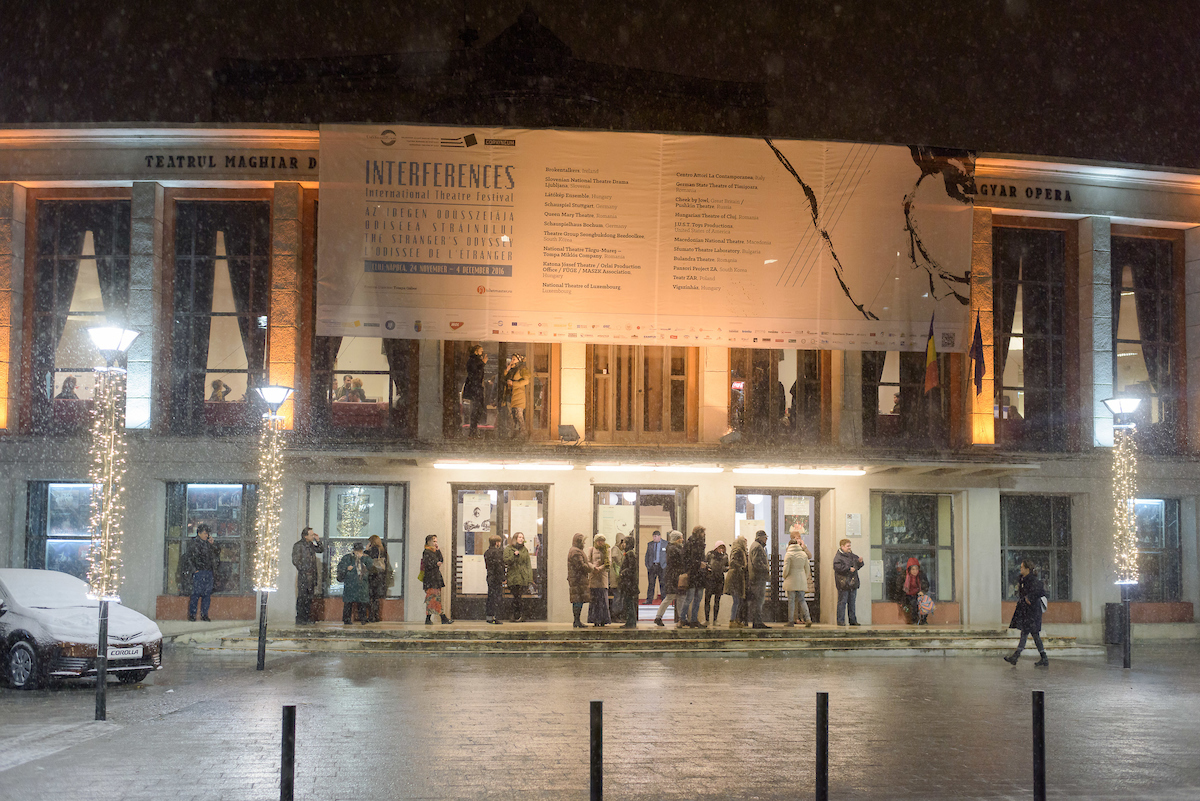
“Az idegen Odüsszeiája” — “The Stranger’s Odyssey” is the title of this year’s “Interferences” Festival at the Hungarian Theatre of Cluj that wishes to explore the theme of strangeness.

2016 Interferences Festival
© István Biró

It is my conviction that most of the performances (aiming at the creation of aesthetic value) can be easily interpreted in the conceptual framework of strangeness. Moreover, the festival itself as a border context — whether at home or abroad — makes this topic intensely thought-provoking.
In other words, the topic of strangeness is perhaps a bit too self-evident to discuss in relation to theatrical performances — and yet it proved to be an intriguing intellectual “carrot” for me after spending three or four days at the festival: and not only through the performances, but also in connection with my unique and special position. Theatrical writers in Hungary try to follow Hungarian theatre events in Romania (even if not with the desirable and necessary intensity, which is mainly due to financial reasons), so I run into a lot of colleagues. But this time, I’m standing out a bit from this somewhat complex and conflictual Hungarian/transborder Hungarian relation: since I’m attending the festival in the framework of a meeting organized by the UTE (Union des Théâtres de l’Europe) for journalists, I mostly walk the streets with Italian, Czech, Greek, or Bulgarian colleagues, talking about performances and theatrical structures. Perhaps never have I ever attached nationalities to names so firmly as now when the explanation of my “Hungarianness” calls for interesting supplements, when I am halfway between the guest and the host, the strangers and the locals..
Maybe partly due to that, I am a bit more restrained: I feel less tempted to hold “informal” introductions before the Hungarian-language performances as I would usually do. (That is how it could happen that I had already discussed all the bits and pieces of a performance with a colleague when he suddenly had a revelation: but of course, the piece was played in my mother tongue.) It is hard to decide whether this restraint is caused by a sort of laziness, or that I would like to see the performances, my opinion as a critic, the theatre I can associate with weighed without the “active involvement” of my Hungarianness.

The performance I was referring to above was Hullámtörés (“Breaking of the Waves”) by the troop of Cluj-Napoca: it was a pleasant mixture of the familiar and the alien.
I feel at ease in the language, but I must admit that even after so many years’ of working as a critic, the “transborderness” of a performance still has a special flavour to me. (I do not think it is simply the paternalistic goodwill of those coming from the mother-country; on the contrary, sometimes it is in the light of transborder performances that I see the theatre of Hungary as provincial.) The play’s antecedents, a film by Lars von Trier is also familiar to me, so I can easily lose myself in the interpretation of the actors (Anikó Pethő and Ervin Szűcs, the two protagonists are the equals of Emily Watson and Stellan Skarsgård, but fortunately they do not want to compete with them; one cannot smell the sweat of the effort.) I also find it exciting that the performance itself reflects on the fact of adaptation: how inspiring the differences between the two media can actually be. For instance, in the scene when Bess is brutally raped, it is a male actor who plays the female protagonist’s role, using utterly exaggerated and ridiculous gestures imitating a woman’s whining — as an indication that while this kind of episode goes down well in a film, it simply would not work in a realistic theatrical framework. It is all the more frightening when the same male actor starts howling in a manly way — trying to stop the game and the sailors —; it is only then that I suddenly become aware of Bess’s vulnerability. Later on, the performance “re-enacts” this scene impressively: this time with Bess, seen from a distance, with darkness, camera and music.
My colleagues (with one exception) did not like this performance. Strangely enough, we cite the same arguments in favour of the performance as against it; we forgive the same nuances or consider them unforgivable. It is not for the first time that the idea haunts me that first an impression is formed within the critic, and it is only then that we look for arguments to support that; not that I have ever thought that being a critic has anything to do with being objective and exact.
We all agree about the performance of Vígszínház from Budapest (Jó embert keresünk – The Good Man of Seciuan): none of us considers it especially exciting, but rather as a series of sensationalist theatrical solutions at the most. I must confess this is the first time that I have seen this performance, and my “suspicion” regarding the big stage and the people’s theatre efforts of Vígszínház in general cannot be washed out, not even by the enthusiasm of the public celebrating Enikő Eszenyi, the renowned actress.
It is the Stranger’s Song, a performance by the South Korean Pansori Project ZA that convinces me that we are watching a theatre here and now that starts out with similar chances for everyone, without having to overcome any prejudice. This performance adapts a short story by Márquez about immigrants from the Caribbean who live in Geneva; and what is more, it is embedded in the tradition of phansori, the Korean folk opera. In other words, it is the western narrative tradition that renders softer and more digestible whatever is strange or exotic in the Stranger’s Song. If there is a performance that is suitable for an international festival, it is this one.
While I enjoy every minute of it, perhaps I also resent that something should meet my expectations to such an extent even though one cannot feel the rigidity of the compulsion to conform — but it is undeniable that the strangeness and the familiarity are weighed out on precision scales. Isn’t it self-deception that makes this performance work? That it lulls us into believing that we are getting to know something new, distant and beautiful while whatever is strange in it reaches us to the smallest extent? Am I not more pleased by recognizing myself in it (as a European, as a Westerner) than by watching the strange (which is much less strange due to the above)? Do we pay attention and if yes, how much, to the drummer (Hyang Ha Lee), who can play her simple-looking instrument in a multitude of ways, and who seems to be expressing her disbelief or disapproval, or highlighting key sentences with cries?
I ask Patrice Pavis: is it globalization or universal humanness that cements this performance? I want the latter to be true, and Lee Jaram is a performer who makes me believe that, indeed; just like she can make me believe that there is some kind of universal humanness in theatre in general.


Published on 19 December 2017 (Article originally written in Hungarian)

The Stranger’s Odyssey. Who am I, really?

The Stranger’s Odyssey. Who am I, really?

The fifth edition of the Interferences international theatre festival (for the fourth time in cooperation with the UTE), which was held over 11 days at the end of November and the beginning of December at the Hungarian Theatre in Cluj, staged productions from 14 countries, by means of which the organizers aimed to present contemporary trends in drama. In addition to the predominantly Eastern European works, the audience had the opportunity to see a performance given by South Korea’s Jaram Lee, who had appeared at the festival in previous years, and the J.U.S.T. Toys Production from the USA.

Interferences Internation Theatre Festival
© István Biró

Since the first edition, in 2007, primarily focused on establishing an inter-culture dialogue over the long term, the festival programmes have centred on clearly formulated themes.
Following the seeking of the common roots of theatre and music, the phenomenon of the body and physicality, this year the organizers concentrated on a current social issue – difference, or diversity.
Even though the festival’s secondary title, The Stranger’s Odyssey, obviously alluded to the ongoing migration wave, the programme directors’ intention was to view otherness in a variety of forms and contexts.
The word strange harbours several meanings. It may refer to an individual’s visual or personal distinctions, which make him/her surpass the standard. Connected with this is the individual’s position among and relationship to the majority society. Irrespective of the person’s particular qualities being regarded positively or negatively, and his/her being spurned or, vice versa, put on the pedestal of the recognised values, the person’s social status explicitly differs from that of the others.

A prime example of the ambivalence contained in the word strange is the character of Shen Teh in Bertold Brecht’s play The Good Person of Szechwan. First, the young prostitute is ejected to the margins of society because of her profession; later on, owing to her moral purity. Although spurned by the gods and people alike, Shen Teh represents an exception confirming the strength of the human spirit. Perhaps that was the reason why Brecht’s play featured in the festival in Cluj twice – first in a production directed by Romania’s Andrei Șerban (Teatrul Bulandra in Bucharest), and then in an adaptation by Michal Dočekal, the current President of the Union des Théâtres de l’Europe (UTE), Director of Drama at the National Theatre in Prague and a freelance director.

Dočekal’s piece of theatre, staged with the actors of the Vígszínház theatre in Budapest, was heralded as being the apex of this year’s festival programme. The three-hour-long performance abounded with theatrical ideas and scenographic effects, which incessantly assaulted the audience’s attention and maintained tension, yet in the final form were actually wearisome. Martin Chocholoušek’s sets, dominated by a movable interior with a projection screen, fiercely transformed with every new scene. Similarly varying were Kateřina Štefková’s costumes, which the actors continuously changed, as the roles were taking turns. The scaffolding, conveyor belts, dining tables, shooting cannons and suspended desks with lamps, splashing real water, served to demonstrate the maximum utilisation of stage technology, straddling purposeless self-presentation. For all that, the spectacular setting did not lack visual uniformity and integrated form, which, however, was not the case of the dramatic means. The creators wittingly employed Brechtian cutting and distinguishing between the character forming and the actor’s critical commentary, yet they failed to adhere to the chosen principle throughout the performance. Accordingly, the individual scenes were abandoned and returned to the play without evident logic. The inconsistent differentiation of the roles was the most palpable in the case of Enikő Eszenyi, who portrayed Shen Teh. The actress let herself be carried away by her own energetic involvement, which reflected in overexposed gesture and lack of co-ordinated motion. As a result, Shen Teh did not come across as a moral example, but a caricature of herself. In the final analysis, the performance oscillated between epic theatre, an ironised version of the original play, and a scenic spectacle devoid of a clear-cut staging vision.

Totally different in form was the production Stranger’s Song, based on Gabriel García Márquez’s Bon Voyage, Mr. President. The tale of a poor married couple and a dying statesman was depicted using pansori, the traditional Korean genre of musical storytelling. The narrative nature of Asian theatre and its blending of playfulness and specific technical execution inspired the European avant-garde, including Brecht’s epic theatre. In the case of Stranger’s Song, the audience’s experience entirely depended on Jaram Lee’s precise work with her voice and movement co-ordination. The performer stylised herself into several personages, expressed by means of effective gestural contraction (a hunched pose, erect or cautious gait), without forfeiting observational distance or the awareness of her being in the role of the narrator. Jaram Lee was accompanied on the almost empty stage by two musicians, whose aim was to provide rhythmic underpinning to the drift of the narration.

In my opinion, Stranger’s Song was the zenith of the final third of the festival programme. Owing to its minimalistic, precisely built theatrical form, as well as its title, it most closely expressed the festival motto – otherness was viewed through the lens of a forlorn young couple who, notwithstanding their poverty and low social status, retain a high degree of morality, and through the eyes of a privileged politician, who rediscovers his humanness in the twilight of his days. The two seemingly incompatible parties are forced to find a common parlance, by means of which they duly succeed in breaking down the established barriers. The fact that the Colombian author’s work was staged by Korean artists with regard to Western European theatre conventions represented another parallel, fulfilling the theme.
The programme selected for the fifth edition of Interferences entirely complied with the set theme. The final third of the festival agenda was dominated by productions of plays by Beckett, Gogol, Ionesco, Brecht and a theatrical remake of Lars von Trier’s Breaking the Waves, whose characters are generally perceived as embodiments of otherness, external and personal deformation, the individualised (and problematical) self. The organisers’ endeavour to place the festival within the context of the current society-wide processes, whereby the meaning of the word strange must be constantly redefined, was more than welcomed. All the more striking, however, was the mediocre quality of some of the selected productions, which many a time only superficially illustrated the original literary or film work, instead of seeking a peculiar theatrical key.

(Days reviewed: 2 – 4 December 2016)

Translated by Hilda Hearne


Published on 16 December 2016 (Article originally written in Czech)

“Our theatre, such as this festival wants to belong to the whole city”

“Our theatre, such as this festival wants to belong to the whole city”

In the most central position of the Hungarian Theatre of Cluj, next to the main entrance, hangs the portrait of Gábor Tompa, artistic director of the theatre for the past 26 years. He also founded and runs the ‘Interferences International Theatre Festival’, for the 5th edition of which (24th November-4th December) we – the Journalists of UTE´s Online-Magazine Conflict Zones.Reviews – visited the second largest city in Romania, the picturesque Cluj, 324 kilometres north of Bucharest.

01_interferences_bi-4042
© István Biró

After receiving the first snow of the season, the city is frozen and decorated with numerous flags due to the Romanian National day (every 1st of December they celebrate the unification of Valahia, Transylvania and Moldavia in 1918). The atmosphere inside the Hungarian Theatre of Cluj – member of the «Union des Théâtres de l Europe» since 2008 – is definitely much warmer. Dozens of volunteers joyously take care of every single detail and the theatre lovers of the city enjoy discovering performances from all over the world.

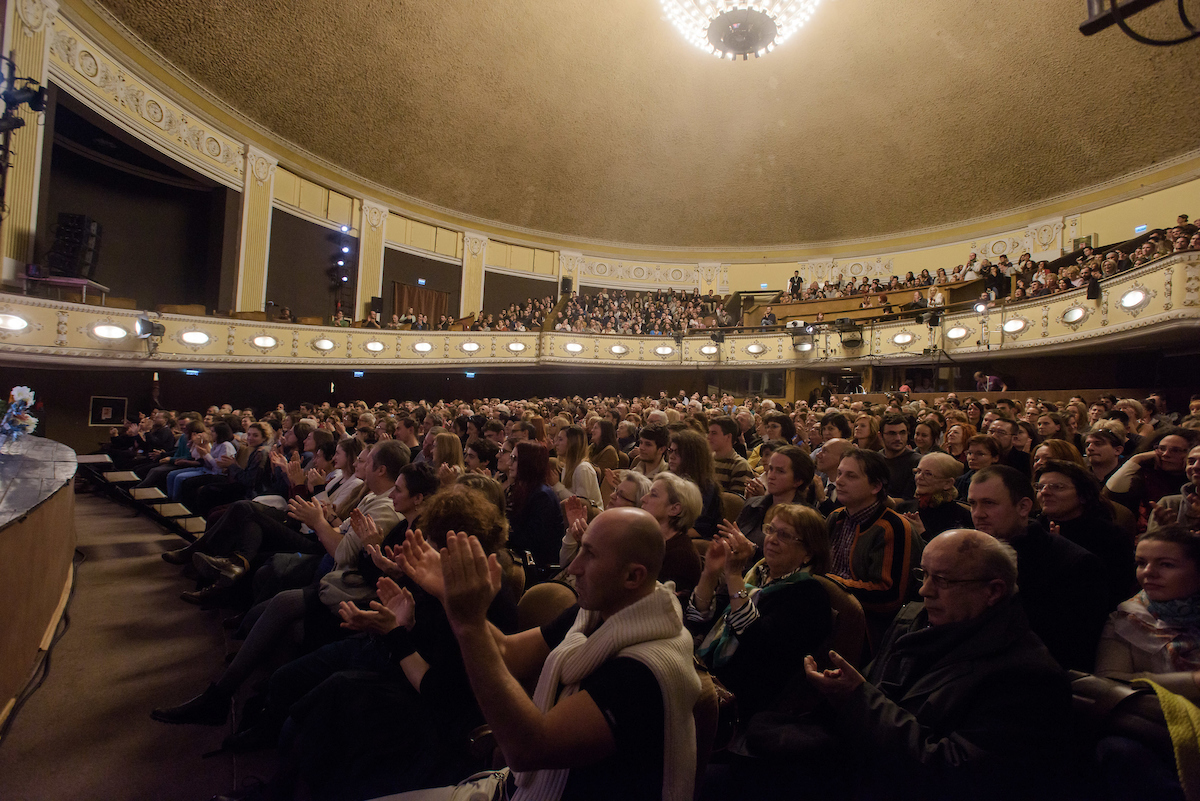
Such as the Korean performance, the curtain of which has just fallen, receiving the warmest rhythmic applause from the audience. It naturally takes the artistic director of the theatre and the festival, Gabor Tompa, longer than usual to cover the distance from the stalls to the main entrance, as he is constantly engaged in greeting friends and in brief conversations.

What if governments change at the speed of light in this idiosyncratic city of the Southeast Europe? Gabor Tompa remains in the same position. “We often happen to have three different Ministers in a year. This is one of the obstacles we have to overcome in our work, which I have always considered as a long-term project” he explains as we cross the stage, where some technicians are occupied with removing the set of the performance which has just finished, and preparing for tomorrow morning’s rehearsal. A busy beehive.

A staircase at the back of the stage leads up to his office. The walls are decorated with mementos and awards of a journey that started in 1990 and still goes on. “We had to modify contracts, build a team, a 36-actor ensemble and a repertory. But we also had to be international, build a ‘studio’ and a team of young actors. I always feel all this is too fragile to be abandoned. Of course, the administrative issues are far too many, so I am deprived of a significant part of my energy. I always try to find the pleasure in what I am doing” he says and carries on.

“Where I do locate the source of pleasure, I would say that it is basically found in the team of young people who work with me and who are quite independent, since they can make their own decisions without having to get my approval all the time.

“This helps me a lot since I have to spend a lot of time in Los Angeles where I teach acting, as well as in other countries where I direct. Then, pleasure lies within the opportunity I am given to invite directors I admire to come and work with us. Not few artistic directors choose to invite weaker artists than themselves. On the contrary, not only do I want to invite people whose work I admire, but who I also believe to happen to know something about the theatre which I ignore.

“I see that as a supplementary procedure” he explains. As for whether he would miss the office in which he has spent almost a lifetime: the answer is astounding! “I most certainly believe the reason I am still here is because I don’t actually care about the position as such”.

We are one step away from the closing of this year’s festival and he confesses having gained this: “The pleasure of having almost doubled our audience and of beginning to succeed in what we had really wanted in the first place: uniting the people of Cluj.”

And he explains: “There is this pretty common phenomenon here that has to do with the division of communities in everyday life: Romanians, Hungarians, Germans, Jews, but also people of different religions or social backgrounds.

“This theatre, founded 224 years ago, in 1792, is the oldest Hungarian theatre in the world. But we really want it to belong to the whole city and to people who gather here in order to encounter one another. This is why, not only now during the festival, but all year-round, we translate our performances into at least two more languages: Romanian and English, as our company performs in Hungarian. This helps win the trust of the Romanian community, so the proportions are now 65%-35% or 70%-30%. Moreover, there are seventy thousand students in Cluj who are the best audience.”

So if the goal set is so big, with what criteria does one choose the performances that are to be included in a two-year international theatre festival?

«First of all, we begin by choosing the subject, which this year was “The Odysseys of a Foreigner”. We have already found the subject of the next festival, two years from now. It is going to be “War Memories” since it will take place 100 years after the end of World War I. Among others we are thinking of inviting Ivo Van Hove, the new artistic director of the Comédie-Française.

“The performances I select approach the subject from different aspects, so as to complement one another. Of course, it is impossible to have only masterpieces. And actually, this is not the objective. Yes, there are performances which happen to be enthusiastically received by the audience and others which shape it. My experience has proved to me that the audience can be educated. The most important thing is to move on and take risks.

“We try to invite all kinds of performances: from well established companies to small independent ones. For instance, this year we invited a performance called ‘It’s Not the Time of My Life’, which was the first adaptation of a film that won this year’s award in Karlovy Vary. An utterly independent performance with absolutely no budget.”
He insists that he does not believe in the separation between independent and repertory theatre. “This is a plain nonsense for obsessionals and critics. In this case, we are rather concerned with ourselves than with the theatre as such. No, we need to let ourselves out of the picture.”
What about his personal point of view as far as this year’s subject, the Foreigner, is concerned? “It is not restricted to the immigration and refugee issues which are pretty hot. There is a more philosophical approach to it. What does it mean to be a foreigner? What does it mean to belong? What is the European identity? Which us, the East-Europeans almost have or believe to have? I think that solidarity nowadays is not powerful enough. Although the world is becoming smaller and smaller. For example, something happens here as we speak and people all over the planet find out about it in a few minutes. However, we still believe we are not affected by it. This is wrong. Everything that goes on involves us. We are to be found in every story. On the other hand, of course, we live in a period of a completely hypocritical political correctness and you can see the result. We witnessed it recently in the US elections. We ought to analyse what brings this about” he says.

Our conversation carries on about the qualities of the renowned Romanian directing school, which as he explains to us “puts forward the concepts, proposing each time a strong choice of play and a strong directing approach, from which are derived all the supplementary elements” and ends up to the Greek theatre as a plentiful source.

“What is very important is that the ancient audience did not use to go to the theatre to listen to stories. They were all acquainted with the story of Antigone or Medea. They did so in order to taste the actual experience. Nonetheless, it’s not just the drama itself that teaches us a lot” as he says. “The Dionysia was the first festival ever. A celebration in which the whole city took part. And this is something we always need to keep in mind.
“Max Reinhardt, who re-invented the festivals in Europe, wanted the Salzburg Festival to be a celebration of the whole city, like in ancient times. When everyone would take part.”


Published on 15 December 2016 (Article originally written in Greek)

Art, Economy, Europe. Strategies against dystopia

Art, Economy, Europe.
Strategies against dystopia

In the magnificent hall of the Mosteiro de São Bento da Vitória in Porto, the Teatro Nacional São João (TNSJ) and the Union des Théâtres de l’Europe (UTE) called a roundtable conference on the theme “Economics, Art and Europe”.
In the context of the three-year project Conflict Zones, the conference — among the side events of the UTE General Assembly, together with a showcase — was opened in front of the delegates from all the 18 member theatres, an opportunity to put up a more and more urgent reflection in the context of an international setting.

The speakers’ table dug the pathway to a complex and compelling discussion, able to cross different and yet complementary areas of work. The researcher Tomáš Sedláček (Czech Republic) is a man of science in the first place; the artistic wing was represented by the director of the Piccolo Teatro di Milano – Teatro d’Europa, Sergio Escobar (Italy) and the artistic director of the TNSJ, Nuno Carinhas (Portugal); the political realm was represented by the mayor of Porto, Rui Moreira. The president of the administrative board of directors of the TNSJ, Francisca Carneiro Fernandes, moderated the discussion.

When one tries to establish a link between the three topics, an immediate response comes from the fact that economics and arts have always been closely tied to one another, with artists’ lives fed to rich patrons, the whole artistic expression at the mercy of public or private funds, or the cartel of the collectors reigning over this or that trend in visual arts. One of the questions raised by such a conference could easily be: which kind of influence can derive from Europe as a political and socio-economical environment?

In the words of Francisca Carneiro Fernandes, and of the all three speakers, “Europe” is almost always paired with terms such as “in crisis”, “shifting” or “under threat”, and the major question is most likely how culture and arts can or cannot lend a helping hand in such a scenario.
The Czech essayist and lecturer Tomáš Sedláček, author of the bestseller book Economics of Good and Evil, is saluted as one of the most groundbreaking voices in contemporary economics, especially because of his inspiring ideas about “economics as a cultural phenomenon.” Far from considering stock markets and indexes a mere system of an addiction to numbers, Sedláček’s conception promotes a reconceptualization of the whole ratio about macro-economics, leading to a realm where economics is the endemic factor of societies, closely attached to the collective production of myths, religions and philosophies.

THE INVISIBLE HAND OF THE SOCIETY

Showing a fundamentally positive attitude, Tomáš Sedláček admits that certain “regulatory mechanisms” might not be perfect — still incapable to avoid bloodsheds and wars — but they are in fact guaranteeing a stable situation. And yet, in such a view, the relatively stable situation of societies is not regulated by the “invisible hand” of economics: that presumed eminence grise, silent and mysterious, is in fact the result of a complex net of material relations, it’s a product of our own culture. The society itself reacts almost spontaneously to certain drifts of economics, giving birth to “a generation of hippies” that counteracts a too profit-oriented economy or to a Kafka that stood up against an excessive fascination of the Austro-Hungarian Empire towards bureaucracy. Another bright example comes from Sedláček’s homeland, with the “Velvet Revolution” in which arts saved politics from a total collapse.
The key to this mysterious balance seems to then lie in the awareness of such interconnections between areas that react to one another following a subterranean turmoil of an action-reaction process. The Czech economist poses the core of such turmoil in cultural movements, stating that the actual role of intellectuals and thinkers is “to keep these channels clean for communication.”
“European / American civilization is based on democracy and capitalism”, Sedláček continues, “two things that, so we were taught, are supposed to go hand in hand. And yet, the Western world has managed to export capitalism but not democracy”. This turns out to be a huge failure. Even Karl Marx argued that “capitalism is the strongest machine to make nations rich”, but the mere act of exporting capitalism is not enough to bring wealth, and can be extremely dangerous when it doesn’t come with the “handbook” of democracy.

THE RELIGION OF ECONOMICS

One should not trust a totally deterministic definition of economics as “a technical analytic science/physics-oriented area”, while it is in fact “ideology covered in disguise of mathematics.” Those very ideologies end up autonomously defining the good and the evil of certain attitudes in administrative and governmental policies.
One of Sedláček’s powerful examples is corruption, which historically used to be considered bad practice because of being directly associated with the act of stealing. Today, instead, it needs an economic reasoning to be seen as wrong. This is because — and here is the other major statement of Sedláček’s above-quoted book — the greatest part of our evaluations on economic phenomena is nowadays confronted with GDP growth.
Quite evidently, the most dangerous risk is to use GDP growth as a touchstone for all socio-cultural manifestations. As the speaker underlines, arts were never supposed to speed up the economy of a nation, but they can slow down the pace of a profit-driven society and give people the extraordinary opportunity of a pause, a hiatus that favours the blooming of thought and knowledge, of emotions and understanding.
In other words, while Gross Domestic Product measures the material growth or decline, arts and culture mark the time of a spiritual florescence. As a matter of fact, the explosion of totalitarian and anti-democratic regimes as foreseen by dystopian literature found its root in the ban of arts and culture, which are to be considered as a barometer for the integrity of societies; a function which is very hard to visualize, because art in some ways escapes the responsibility of being directly useful. Nevertheless, it holds the innate ability to produce meaning, when confronted with the effective expectations of growth claimed by the individuals and, consequently, by the social structures that they compose.
Sedláček’s point is that we are living in a world that is totally based on the act of producing. Nothing around us can be called “natural”, everything is “artificial”, everything was built by humans: even the possibility to travel the world is submitted to artificial material processes (technology and identity regulations).“Our work”, Sedláček says, “is never done, it keeps on growing and growing with no reaching a point.” Finding its way through this chain-reaction of implementing reality, art may be a sort of bell that announces a ceasefire.

SUBJECT-OBJECT REVERSAL

An example from contemporary mythology is brought up to explain this process. In J. R. R. Tolkien’s The Lord of the Rings, Mordor, the villain, created the ring putting “so much power in it that its destruction brings destruction to Mordor himself: the Lord of the Rings is the ring itself” This is very similar to what has happened with economics: we have defined our lives by economic standards, so much so that they have taken complete control over our lives; essentially, economics has become the master of humans. In this sense, putting one’s faith and, more importantly, one’s mind on the things that can face and balance this absolute power is crucial: in a crisis such as the one we had in 2008 and 2009, “if a certain help hadn’t arrived from the area of politics, finance would have destroyed our civilization, exactly because it is based on it.”

POLITICS AND CULTURAL MANAGEMENT

After such a prolific theoretical introduction, it’s perhaps interesting to compare the contributions of the Mayor of Porto, Rui Moreira, on one side and the Director of a national theatre such as the Piccolo Teatro, Sergio Escobar, on the other, to understand some of the strategies carried out by two crucial actors in this scenario.
Escobar introduces the concept of the “improbable” to focus on the role of the arts. Quoting the French composer, writer and programmer Pierre Boulez: “Culture is that human activity that makes inevitable what is highly improbable.” In Escobar’s view, a reply to the refrain that “art is useless” is that “criteria for usefulness are self-referential towards economics”, while the role of culture is namely to put in crisis certainties and stable knowledge, “which are able to freeze the probable”. It was Edgar Morin who said: “The unexpected is possible, the metamorphosis is possible. Hope is the possible not the certain.”
Culture seemed to be at the center of mayor Moreira’s project when he was running for the elections in 2012, and it’s his concern to underline how finances have been growing through the current mandate, not without completing some important tasks as the creation of the Rivoli Municipal Theatre, a playhouse of and for the city.
In Moreira’s political perspective, culture has to be put next to two other accesses: economics and social cohesion, capable to “free the genie from the lamp and lead to a rebirth of the city.” The key seems to be in a basic change of attitude, from being mere “spectators” to becoming “actors in the change”, not following individual agendas, but rather acting as a collective, as a community of individuals. If Moreira says that “the city itself can be an actor”, Escobar talks about the “sensibility of citizens”, a very subtle category to take care of.
For both speakers, and referring to Sedláček’s talk, the question of bureaucracy is certainly crucial, because all contemporary democracies are going through hard times in terms of the functionality of an institution and a deep crisis of political representation, two themes that are responsible for a civic application of cultural conscience.
Escobar doesn’t believe that bureaucracy is the cause of the faults of the EU, most likely a sort of closure towards international relationships that produced “fear, then egoism, then nationalism”, a situation that is also reflected in domestic affairs and particularly in cultural management. Moreira still looks at bureaucracy as a barrier towards a healthy and correct perception of democracy, and he argues that a better understanding of the current media and communication environment might be a key to at least locate the centre of the problem. “With the end of traditional forms of communication (newspaper, TV, radio) and the advent of social networks, we are hitting disinformation. Using devices that can execute everything we want exactly in the way we expect it, we no longer need representative democracy.” And here’s the most dangerous obstacle to social cohesion.
“Culture is then going to replace what was served to us through the media and information.” Moreira underlines how Europe, no matter what the GDP states, still can boast leadership in the cultural production and heritage: a collective act of preservation should be the starting point to prove to the rest of the world that this record doesn’t come from a false perception.

THEATRE IS AN ART OF TIME, LET’S GET TO WORK!

If before “the business of business was business”, according to Tomáš Sedláček, the role of economics is changing. If one wants to sell beer, a brewery won’t be enough: the business of a brewery is now most likely “to harvest beer culture.” Culture is free to produce beauty and richness for the soul when one realizes that it’s first of all an act of harvesting.
Nuno Carinhas’s quiet and discrete voice brings up a strong allure of passion, that in some ways introduces his latest production of Karl Kraus’s The Last Days of Mankind, when it presents theatre as “a space for the free movement of people’s ideas and meanings”, “a democratic taste for sharing in opposition of the fashionable representation of unanimity of taste.”
Thus, theatre can become a useful instrument against a neglected memory, to organize a more aware idea of the future. But, as an “art of time”, it must represent the opportunity for a change of pace, a moment of reflection that injects a different time in such a voraciously rapidity-oriented everyday life. “When the world is nothing but silence, there will be narratives for clandestine listening”, but we need to awake our needed time, a special momentum entirely dedicated to listening, instead of a frenzy search for permanent virtual connection. In a media-filtered reality, Carinhas invites everyone to remember the Europe of the Rome Treaties, signed 60 years ago, “before fear” and suspicion of the other.
One might argue that looking at the past as an era with no fears is dangerous: the tensions were profound also at the dawn of Europe. However, Carinhas’s talk goes beyond that; it is a quest for a contemporary model based on the power of free speech in the first place, in these very months where we feel a certain threat by certain politics of repression.
“My Europe”, he argues, “is the Europe of authors, because it is through them that I can perceive the present time. And then, how can we accept that authors are still censored and persecuted in Europe? How can we admit that the other, the different, the foreigner is put into question and negated? We know that negation will haunt us in coming times as a labyrinthian network of walls supported by the complacency of the cynics. So, let’s get to work: Europe is a favourable ground to built communion and usury, fanaticism and freedom of thought, destruction and remorse, populist rhetoric and poetic indignation. We will all have to understand how to live together before a series of collapses defeat us.”


Published on 13 December 2016 (Article originally written in Italian)

Voices at the Crossroads … or the Soul after Victory II

Voices at the Crossroads…
or the Soul after Victory II

© Herwig Lewy
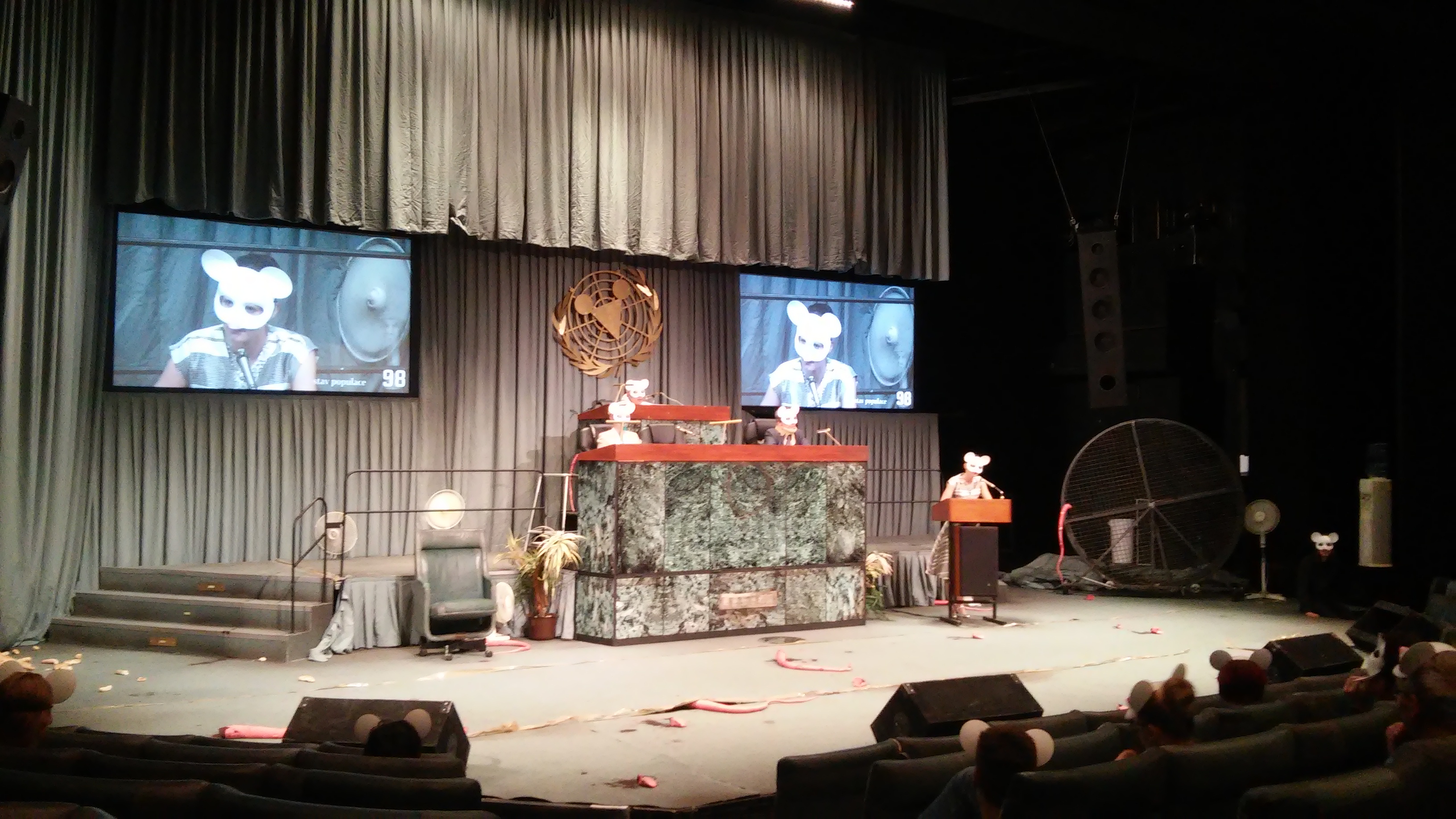
The Mouse Paradise Experiment, directed by Jiri Havelka. Národní divadlo, Prague. Photo © Herwig Lewy

A love letter at Národní divadlo: To Havel with love. In honor of Václav Havel, the Prague National Theatre’s festival Prazské krizovatky / Prague Crossroads (October 4th to 9th) presented 80 hours to celebrate the late theatre-maker and President of the Czech Republic’s 80th birthday, 27 years after the start of the Velvet Revolution: 22 events over the course of seven days; winner of the Nobel Prize for literature Svetlana Alexievich in a discussion with Jáchym Topol; the theatre’s own production of The Mouse Paradise Experiment; guest performances from Belarus, Russia, and the Ukraine.

Built between 1977 and 1983, next to the National Theatre on the banks of the Vltava hangs the glass encased Nová Scéna, dark and cubic on four cement stilts. Inside are the green slabs of marble across four floors that create, strangely enough, a sacred atmosphere. The Crossroads Festival took place in the courtyard in front of the theatre (Piazzeta), in the mezzanine, in Café Nova, and in the foyer, which leads to the main hall, and which also serves as home court for the world famous avant-garde theatre group Laterna magika. The festival honoring Václav Havel felt in a symbolic way like a crossroad, at which many spirited voices proclaim their doubts about the present.

The Mountain Giants

For Luigi Pirandello it’s the rejects of society that meet a company of actors in the villa “Misadventure” and who, without props, attempt to perform the piece with the help of their imagination. Václav Havel brings together both sides of this coin and an exhibit in the mezzanine pointed it out. On the walls hang posters with documents from Amnesty International. In the case of Jirina Siklóva, Petr Uhl, Ivan Martin Jirous and Václav Havel, human rights offences were made public. The date on all of the posters: 1989. It is important to know that Václav Havel could not follow his classmate Miloš Forman (One Flew Over the Cuckoo’s Nest, 1975) to film school because he did not meet the requirements for his secondary school examinations after finishing his compulsory education in 1951.
He worked as a taxi driver in order to pay for his night classes, completed two years of military service and in 1954 he began working as a stagehand at the ABC Theatre and at the Theatre on the Balustrade. He began to write plays in the absurdist style, including The Garden Party, The Memorandum, and The Increased Difficulty of Concentration.
Culturally and politically, Havel appeared at the 9th Writers’ Congress in Prague and openly criticized the censorship of the communist party. As head of the “Club of Independent Writers” he supported the reforms initiated by Alexander Dubček in 1968 which were repealed during the Prague Spring. In 1977 Havel was one of the three main initiators of the Charter 77 manifesto. Because of this, he was arrested three times and spent a total of five years in prison. After international protest in the early 80s he was released, but in January 1989 was jailed again for nine months for “disturbing the peace.” As candidate for the Civic Forum Občanské fórum (OF) Václav Havel was elected President of Czechoslovakia on December 29, 1989.

In light of this background, we have to ask this question: Which form of language is attached to this exhibit? It’s too naïve for “(Anti-)Communism in Museums”; much too concerned about facts for an artistic installation; the sounds from the foyer make their way into the exhibit. There, Marek Hejduk’s adaptation of the production of Protest, one of Havel’s best known pieces around the world, Protest/Rest (Theater Švandovo, Director: Daniel Hrbek) is being played. The sounds are evocative of a chorus and one floor further probably call to mind a tradition of collective passion in the Stalinist papal state. A sonorous illustration of the heartfelt matter in the mezzanine, it takes on a perspective of hero worship. As if to confirm this, a TV documentary with and about the man in his mid-fifties, with a rather anti-hero-like impression: “Go Havel! Go Havel!” can be read in the surtitles on the screen showing a mass rally. Above the screen, pictures flash of Havel in his robe (yawning) with his morning coffee, Havel in a suit (formal) performing a bodyguard’s salute. Pictures that show him with friends and artistic colleagues and companions, how they opened the locks of the atomic bunker left from his predecessor, Gustáv Husák, deep underneath the palace. “They really were afraid that war could break out as they stood in the reception and toasted; that someone would say, ‘The war has started!’ and they would push a button and ride down eleven stories!”, Havel recalled laughing, only “The elevator wasn’t ready!”

The atomic bunker was the most expensive investment in the history of the “Villa”, the Prague Castle on Castle Hill. The abys of the Cold War is sometimes considered the inheritance left from World War I, when Woodrow Wilson and Lenin tried to outdo each other concerning which political system was best able to help the people get back on their feet: With private ownership of resources or without. How should we go about shaking off the chasm?
Here it’s also important to know that Czechoslovakia came out of WWI as an independent state from the Habsburg Monarchy and existed until the Munich Agreement in 1938, with which Hitler-Germany took over the parts of Czechoslovakia containing ethnic German speakers and made them a part of the “Greater German Reich”, hereby creating the Protectorate of Bohemia and Moravia. The first president was the philosopher and writer Tomáš Garrigue Masaryk who served until 1935 and later died in Lány.
At this point, Havel’s life as a theatre person is required, as the TV documentary asks about his skills as master of ceremony and Havel responds: “If the first elements of a market economy should decisively and lawfully enter into our lives today, then we will also have to keep in mind in the following days, that a nation is an entity also made up of a spiritual component.” Borrowing from radio broadcasts with Woodrow Wilson, the Talks from Lány were born. The president needed a channel of direct communication. The idea came from the former ambassador in Washington and London, Havel biographer, and current director of the Václav Havel Library in Prague, Michael Žantovský.

The Space-Time in Secondhand Societies

A foray into the festival programme reveals a central focus on current events and present aptness in East European bordering countries. Voices questioning the present came to honor Václav Havel from Belarus (Belarus Free Theatre, Time of Women, Director: Nikolai Khalezin), from the Ukraine (DAKH Theater Kiev, Dreams of Lost Roads, Director: Vladyslav Troitskiy), and from the Russian Federation (Teatro di Capua, A Life for the Tsar, Director: Giuliano Di Capua). These productions show that the “happy fracking” that Lev Dodin started in Gaudemaus has since differentiated itself in the last 27 years. A wider attention for these works would be desirable, attention which recognizes their formal language and content related characteristics in relation to social coherency in their respective societies.

Maybe a guest performance from Poland could have added something to this central focus. Current developments in Poland show perhaps symbolically, through the hero worship for General Józef Piłsudski, political objectives diametrically opposed to those of the artist-president Havel.
The situation in the Baltic States is similar. It doesn’t hurt to know about the constant conflict zone in the space-time continuum of spiritual border conflicts in the eastern part of the European Union: Created in the inheritance of the Romanov Monarchy — because in 1918 the Bolsheviks were supposedly waiting on a socialist revolution in Germany — these countries were united in their search for “identity” following the fall of their shared past in the Stalinist Papal State.
One doesn’t have to be surprised about the extreme nationalism that has taken hold since changes in 1989/1992, the sometimes racial and Christian fundamentalist tones. The German Heer (military) went forward with its regime on Romanov territory — despite the peace treaties of Brest-Litowsk (March 1918) — and capitulated on the western front (failed spring offensive), and Woodrow Wilson must have forgotten to negotiate a border by the end of the First World War (November 1918). This led to a civil war against Soviet Russia (1919 – 1921) after the start of General Piłsudski’s “preventative war”, supported by Great Britain and France.
The arrival of the Cavalier Budjonnyjs led to the complete recapture of the Ukraine (1920) but also to Crossing the River Zbrucz in the first chapter of Red Cavalry by Issak Babel, the literary man from Odessa, as if paying homage to Caesar’s crossing of the Rubicon.

On the other hand, in literature, like in theater, it’s the interpersonal relationships in this space-time continuum that counts, not the dates or schemes of political or historical developments. In her novel Second-hand Time, Nobel Prize winner Svetlana Alexievich traces this axis of conflict. Like Issak Babel once did, she lends a voice to stories that have been ground down somewhere between Raison d’Etat and individual emotions, wishes and hopes.
On the stage of the sold-out theatre hall of the Nová Scéna, she spoke with the iconic Czech author Jáchym Topol, famous for his theatre piece The Journey to Bugulma. In this piece Topol deals with the open secret of Czech literary history, according to which The Good Soldier Švejk by Jaroslav Hašek has to do with his activities as a political officer without a weapon on behalf of the Red Army in Bugulma during the civil war. Topol makes Bugulma into the iconic embodiment of the Stalinist gulag system where any thoughts of a communist utopia crumble into a dystopia and end in a pile of corpses. Alexievich deals with the past, the effects of which are still felt today, in a similar way. She once stated that she has now been working for nearly forty years on a single book, a kind of Russian-Soviet chronicle: Revolution, gulag, war, Chernobyl, and the fall of the “Red Imperium.”

After a short but heartfelt greeting Topol leads us through the period of the Soviet Union, the time of Glasnost and Perestroika, through the time of a reconstruction of society. Excerpts from Second-hand Time are read. It is a panorama of fates after the collapse of the Stalinist structure. At one point Jáchym Topol speaks about being Czech in Prague. He expresses his surprise at the Russian, Slavic patriotism, which for him was no issue. Topol asks where this love of the Fatherland comes from, which allows one to die for Stalin (meaning Iosseb Dschughaschwili) although he stands for the destruction of culture?
Alexievich answers him in two respects: on the one hand, she is interested in literature and not in patriotism. She is interested in the mentality, for cultural codes that are hidden behind people’s fates. She is not interested in people as a part of a contemporary process, but instead in concrete individuals in space, who exist in the world. On the other hand, one could examine Stalin in this way. The people who lived in Stalin’s time were dependent upon him. And, Alexievich adds, Russia was always a totalitarian country and the Russian people had again and again attempted to free themselves from this totalitarian chain, but always in vain. This is the movement that defines Russian culture, which is also frustrating, because it never brings its ideal to fruition. Alexievich gives an example from her first book, The Unwomanly Face of War, and also mentioned that it will soon be available in Czech. In the book there is a woman who knows she is going to die soon. Fascism is the enemy. The woman didn’t really want to die in the spring. Suddenly she hears bird singing. She starts to see everything around her. She sees a flower blossoming. She sees colors. This woman begins to cry, in spite of her fate that she cannot change. And this is where literature is created, according to Alexievich.

As if there were no nationalism in the Czech Republic, which was familiar with the category of “ethnic purity”, someone in the audience whether it wasn’t an ethnical question of whether or not nations exist “that have a tendency towards totalitarianism, where the people themselves wish to be dominated” — She wouldn’t know, Alexievich answers. One could not say that the Germans are a country with fascist tendencies. There is however a moment of tendencies in which a mind forms opinions that might lead to totalitarianism. When she reads in newspaper about how Lukashenko is a dictator or how Putin is a dictator, she sees just the tip of an iceberg, under which a whole people is hidden, a whole nation. And these words are raised up in each of her books in order to test what is stable and what is not. Second-Hand Time is a collage of everyday voices, separate from the banalities of a political search for confrontation, which Alexievich attempts to give a metaphysical outlet.

Her books follow an aesthetic which she has perfected over time. First she wrote I’ve Left My Village which was not published in 1976 and which Alexievich herself considered too journalistic. She tried again, wrote short stories and essays, traced the voices around her. These are the voices at the crossroads which fascinate her. She met with a Belarusian writer Ales Adamovitch. He was dealing with a new literary model which he called “Collective Novella.” The two were brought together by a desire for the greatest possible convergence with real life. While receiving the Peace Prize of the German Book Trade in 2013 she gave the audience this message: “Flaubert called himself ‘a man of the quill’. I can say for myself: I am a person of the ear.”

Should the Numbers Count?

The humor and biting play on words in the theatre pieces of Václav Havel could be found all throughout the festival. Under an open sky the Theatre Husa na provázku gave a guest performance of Havel’s piece The Pig (Director: Vladimir Morávek) on the Piazzeta. The piece Redevelopment resonated in two different interpretations in the theatre hall, the guest performance from Hradec Králové (Director: Andrej Krob) and the guest performance of the Ivana Franka Theatre (Director: Břetislav Rychlík). Two different performances of Unveiling were interpreted in the foyer by Studenti DAMU (Director: Miroslava Pleštilová) and by První část projektu (Director: Ivan Buraj). Comparable to a reenactment, the Petra Bezruče Theatre attempted Audience (Director: Stepán Pácl) in the style of socialist realism. The inclination to stay true to the originals was obvious in a few pieces, as well as a conscious decision, which protected the absurdities put there by Havel. Twenty-seven years later the communist-bashing is however still funny, but also somehow boring as a spectator.

Looking for contemporary dissonance, the theatre’s own production of The Mouse Paradise Experiment by Jiri Havelka (Director), Martina Slukova (Script), and Marta Ljubkova (Dramaturg) stood out. It handled totalitarian world relations in contemporary scientism and thereby fit better into the central focus of the programme. Going into the theatre, the audience members were each given a mouse mask made of PVC. Taking part in a scientific conference, the theatre is rearranged into a meeting room. On the stage lie half-visible disembodied mice tails at the edges of the carpet. A lectern on the right, behind it an oversized mouse wheel. In the middle there is a green marble conference lectern for three scientists: sociologist, psychologist, biologist. Directly behind them the same conference lectern for just one scientist: the philosopher. A chair on the left, stairs, and a feeding trough, out of which fall croissants. Behind the trough hangs a curtain, to the left and to the right of which monitors have been attached. Visible between them and authoritative for all: the UN symbol, with the addition of a mouse head. We are now part of a mouse society, that seems to be clear. The basics of life together are going to be examined, based on numerical values: birth rates and demographic changes, social behaviour and suicide rates, social stress levels and freedom, how younger and older members of society interact with one another …

The conference starts with an excerpt from a documentary [view here] about the Mouse Utopia Experiments performed by American ethnologist and behaviourist John B. Calhoun. Back in the 60s the National Institute of Mental Health recruited Calhoun to place a few mice in a habitat which provided the perfect conditions for their survival. The result was simple: the greater the security for providing basic needs thanks to external factors, the faster the population lost their social competencies, became violent towards one another, or removed themselves from society, until the population reached a maximum for demographic expansion and finally died out. These characteristics from the mouse species have been compared to the human species. The scene is set.

We mouse-scientists know about the dramatic situation of our species and attempt at this conference to together figure out how much happiness is required to motivate us to live a life of purpose. Amusingly, qualitative questions are posed in a dialogue between the audience and the stage, which are then quantitatively evaluated. It makes for a fantastic parody of views from surveys, studies or even think tanks that operate on the basis of numerical values, often also containing recommendations for political developments and which are spread through radio and TV.
The cynical climax unfurls with a chorus of We Shall Overcome, the classic hymn of the American Civil Rights Movement, which also found its place in the repertoire of symbolic forms in the Czech Republic, the spiritual consequence of building a nation since 1989. However, the performance doesn’t go beyond this cynical commentary. But: the last representative of our species to die is the philosopher and president of the conference. An homage to artist-president Václav Havel, maybe? No one thinks to take a look at the trough. Would that be sacrosanct? Just one misadventure remains. It doesn’t get more humorous than that, at the crossroads between ideal and reality. Czech culture is known for such sharp-witted details, it’s a certain lightness of being. Havel would have been pleased!


Published on 28 October 2016 (Article originally written in German)

Václav Havel. A history of mentalities?

Václav Havel. A history of mentalities?

In their work on the revolutionary magazine of “microhistory” Annales, Marc Bloch and Lucien Febvre outlined the principles of the Nouvelle Histoire movement, demanding that a historian collects the facts of the past society, trying to draw a “history of mentalities”. The current European set-up seems to challenge a cultural journalist in the very same way: after many discussions, the most successful approach in exploring the notion of “international theatre” is proved not to consider this as a static concept, but rather like a complex maze made out of fragments of different imageries.

We spent three days in Prague for a sort of “pilot edition” of the Crossroads Festival, created by stage director Michal Dočekal, director of the Czech National Theatre Drama and UTE President. As written in the booklet, the festival is dedicated to Václav Havel: “As an intellectual and politician, he strove to tell apart the fair from the foul and stood firm, espousing his knowledge of the fair.” Crossroads is a very sharp curatorial action: alongside a series of stagings of Havel’s plays, the first part of the festival invited theatre groups from countries which are dealing with severe political shiftings: Belarus (Belarus Free Theatre, Yuri Khaschevatsky), Ukraine (Dakhabrakha, Theatre for Displaced People or a debate with Nobel Prize laureate Svetlana Alexievich) and Russia (Teatro Di Capua, Viktor Shenderovich).
We attended some of the performances, but above all discussed the very aim of any networking programme in Europe, and how important it is to gather a group of people with different national backgrounds in order to, first of all, tackle different topics from different points of view.
When one tries to engage in a discussion on issues of global interest, it’s evident how often certain positions come from a perspective which is not always shared. This is because the history of a nation shapes the history of the thought of its people.
On the one hand, the very same topic can be addressed from a radically distant perspective from country to country—not all of them easy to understand for a foreign point of view—, on the other hand it’s evident how a vision of “international theatre” would be merely composed of a selection of few “samples” of national aesthetics and artistic trends, out of a much longer list of groups, artists and theatre companies.
This is in fact the basic strategy of the Conflict Zones Reviews editorial project: to keep its writers on the move both in metaphoric and actual terms, to let them visit foreign countries in search of those particular traces of a common thought around major topics. A key might be to look at them using comparative tools, each writer being aware of his/her own background and, at the same time, finding a way to put it to the test.
Amongst the most urgent questions in the nowadays shifting trans-national panorama is the one of national identity, a virtual umbrella which is very hard to keep on everyone’s head. The Crossroads Festival, hosted by the Czech National Theatre in Prague at the Nová Scéna playhouse, was held in the name of Václav Havel. It’s hard to detect at what point Havel’s devotion and talent for drama and his political career met, as hard as it is to define the nature of his status as an intellectual, his strong political activism and the extent of his power in the changing landscape of a Europe in the second half of the 20th century. The decision to dedicate the whole programme “to Havel, with love” is a statement by itself, it demonstrates the profound gratitude of the Czech people to their compatriot playwright and essayist, who had also been the ninth and last President of Czechoslovakia and the first of the Czech Republic, and who passed away in December 2011.
After a selection of eight plays (Havel authored a total of 22), the festival also presented Velvet Havel, a production by Divadlo Na zábradlí company, written by Miloš Orson Štědroň and directed by Jan Frič.
This performance can be used as a tool to shape out some considerations on the role of Havel in drawing a national identity.

Štědroň’s staging (Best Performance of the Year in 2013) is a vaudeville-like pastiche of humour and satire most likely serving as a very subtle tool to praise and, at the same time, to criticize such an extraordinarily charismatic and influential political figure. In absence of a coherent plot, the performance devises a crazy cabaret in which Havel—portrayed as a young man with rockabilly hair cut—is brought to life in a sort of purgatory, where he is asked to revise some of the key events of his private life in front of his uncle Miloš Havel, a very well known film producer.
Life is a cabaret!; In kino veritas!”. Dialogues, monologues, dance, songs and live music mingle up on stage creating a colourful variety show, really hard to follow for those who are not familiar with trivia about the former president’s life as a writer, lover and incurable smoker, always dividing his time between the responsibility of his  political engagement and his artistic career .

It must indeed be remembered how unique the journey to independence from the Czechoslovakian communist regime was; that “Velvet Revolution” which also finds its echo in the title of the play. In only a month (November 17 to December 29, 1989), the former sovereign state of the Soviet bloc gave birth to a parliamentary republic, with absolutely no violent resistance opposed by the Communist Party, whose top leadership resigned after only one week of demonstrations and a general strike. Václav Havel, as one of the nine founder members of the text of civic initiative Charta77, played a key role in gathering the consensus around the independence from the Soviet Union, and a deeper attention to human rights. His service as President of the Czech Republic, although widely supported by the people, didn’t fail in receiving also some harsh criticism, especially with respect to certain foreign policy decisions.

Talking with some members of the audience after Velvet Havel, the impression is that such a humorous attitude in describing a popular figure and its influence on people is quite typical of the Czech. Jakub, a Slovak young professional based in Prague, tells a curious story: Největší Čech (The Greatest Czech) is the name of a television poll lunched in 2005 by the national broadcaster Česká televize through which the populace was asked to name the greatest Czech personality in history. The winner was Jára Cimrman, who couldn’t actually accept the prize; this anecdote perfectly captures the Czech sense of humour since Cimrman is actually a fictional character. Created by Jiří Šebánek, Ladislav Smoljak and Zdeněk Svěrák for the radio programme Nealkoholická vinárna U Pavouka in 1966 as a caricature of the Czech people, Cimrman ended up being recognized as one of the strongest Czech symbols, with books, plays and movies featuring him as main character or even as “putative author”.
Jakub’s opinion is that Czechs are not very politically involved and that the sense of humour shown in Velvet Havel is a trustful representation of a sort of national spirit, that—focusing more on the form than on the content—in Frič/Štědroň’s play finds a very subtle and respectful balance between criticism and apology.
In 2011 in Riga, the major Latvian director Alvis Hermanis presented Ziedonis and the Universe, a play which was both a homage and a critical response to the intellectual and political activity of Imants Ziedonis, the “national poet” who died not long after, universally recognized as the most representative icon of Latvian culture throughout the Soviet Union period and beyond. Here too, the play conveyed a mixture between revealing someone’s social influence and praising it. In both cases, the act of unveiling the contradictions of a society resulted in awakening a socio-political conscience. Facts and figures from the past (in the case of Czech Republic and Latvia: the Soviet political and economical influence, as well as the following cultural revolutions) appear to play a crucial role in terms of how people carve out the tools to tell their own collective history. As a matter of fact, such kind of satirical use of performing arts is strictly connected to the sense of community that reunites the conscience of the individuals.

Going back in 2016 Prague, a reflection that challenges this discourse can be found in the preface texts that introduced the Crossroads Festival booklet. The one by Michael Žantovský—director of the Václav Havel Library—summarizes Havel’s thought in a distinctive way: “Unlike all the other politicians, [Václav Havel’s] philosophy did not bear on an ideological doctrine and the necessity of power to apply it, but on the essential need of individuals to live an authentic, meaningful life, part of which is the awareness of being co-responsible for that which is around them and for the fates of other human beings.”
From this perspective, Havel wanted to engage the Czech people’s interest not so much through a strictly political propaganda able to foster an active intervention, but rather through conveying a sense of community based on a shared imagery able to make sense out of living as a collective of individuals. In other words: some ideas that proactively create an identity rather than an ideology that imposes one. This comparison with Havel may be accounted as good material for this little experiment of “microhistory”, which used performing arts to cast a light on the mentality of a country. And, once again, challenge a simplistic conception of “international theatre”.


Published on 21 October 2016 (Article originally written in Italian)

(A)LIVE

(A)LIVE

An Introduction to issues facing the performing arts in France.

It would be a difficult task to cover the entire range of issues facing the performing arts in France in just one article. If we were to pretend, one thousand pages might not even suffice. This article does not attempt to be exhaustive, but rather would like to offer a first look into the material and serve as an introduction to issues facing the performing arts in France today.

First of all, we will look at how the state, at the end of WWII, designated theatre as the heart of its cultural public service. We will conjure up the origins as well as the functional principles of a model of cultural policy which was founded with the objective of decentralisation and the ideal of a cultural democracy.

We will then look at how current cultural policies are responding to the challenges of today, taking into consideration a gloomy economic climate, the rise of populism, aggravated tensions within communities, and the triumph of commercial discourse in the artistic sector.

Finally, we will mention some of the artists and companies whose works are considered among the most remarkable today. Again, our goal is not to create an exhaustive list of “the most talented” current French artists, but rather to convey – by evoking certain names and practices – a certain image of the French artistic landscape, caught in its youthfulness and inventiveness.

I. Theatre, the heart of French cultural public service

After the liberation of Europe, the topic of “culture for all” imposed itself as a way of fostering reconciliation on a national level. Theatre, considered to be the art form most apt at celebrating the intelligence and the civic spirit of the people, saw itself therefore assigned with a mission of “public service”. Spearhead of this new government policy were the first “Centres Dramatiques Nationaux”, which were created in 1946 for the purpose of ending Paris’s monopoly over culture and to permeate the entire French territory with a quality artistic offering. “Make the greatest works of humanity available to the most people,” is what André Malraux proposed in his speech before taking over his duties as Minister of Cultural Affairs on July 24, 1959.
We are of course talking about “public theatre” in the sense of “popular theatre”, a theatre “in service of the people” where the ideal of celebration, ceremony, and social communion resounds. Breaking the codes of a bourgeois theatre accused of elitism, this new theatre intends to conquer a popular public through experimentation with new techniques and research into new aesthetics. At the Théâtre National Populaire, run by Jean Vilar, balls, apéro-concert, and student matinees are organised. In order to attract an audience of labourers and low-wage employees, some changes are made: lowering prices, removing gratuity, programme and cloakroom free of cost, canvassing the employee representative committees, and changes in timetables which allow suburbanites to return on public transit. Brecht’s theatre is on a roll, defended by such emblematic figures as Bernard Dort. This theatre which speaks of the people and to the people and depicts them through monumental representations. The scene opens to the outside and the amateur actors join professional players, like in the Théâtre du Peuple in Bussang, where Maurice Pottecher intended to offer “a theatre within reach of all audiences, amusement made to bring men closer together and erase social and cultural divides.”

Identified as a pivotal moment in the history of French theatre, this era also created the basis of the current model of production and distribution for the performing arts in France. This model, which intends to reconcile artistic quality and cultural democratisation, developed over the years through a complex mesh of diverse competence structures spread out over the entire territory of France. In 2015, this network consists of the following: 15 state operators, which include the five national theatres (establishments whose public funding comes exclusively from the ministry of culture), which come with a dense network of structures for creation and distribution financed in partnership with the regional communities (35 Centres Dramatiques Nationaux, 70 National Stages, 19 Centres Chorégraphiques Nationaux, 12 Pôles Nationaux des Art du Cirque, 13 Centres Nationaux des Art de la Rue…)
These “accredited” establishments have distinct missions and competencies: some are dedicated exclusively to just one discipline, genre, or aesthetic, while others present a multi-disciplinary programme; some are directed by artists, others by programmers; some are producing and distributing at the same time, while others are only authorised to distribute performances that have already been created. Different from the model of repertory theatre, the prevailing model in France is the theatre “en suite”: the productions do not change over the course of the season, but are instead presented continuously one after the other over a period which can sometimes encompass several months (although the current trend is a reduction in the duration). Theatres are therefore associated with companies, whose works they produce, co-produce and/or distribute. Less numerous are theatres that function in a different way. A rare example is the Comédie-Française, which hosts a permanent troupe and possesses a repertoire of all the plays played by the theatre’s actors on the main stage. The shows are nonetheless rarely repeated after one season. Other examples include: Humain trop humain (CDN de Montpellier) directed by Rodrigo Garcia, which is equipped with a permanent troupe consisting of four actors. In regards to the Comédie de Reims directed by Ludovic Lagarde, its programme includes the works of “an artistic permanence”, including an associate author, actors, and three young creative directors in residence.

In this system, which is based on an association between performance venues and companies, the latter consists of key decision makers. Numerous funding programmes exist thus with the purpose of allowing for the economic viability of these privately held organisations. But on the difficult road to economic and symbolic recognition the success of a company is measured above all by its ability to invade the most famous venues in the profession (in particular the accredited establishments), all while securing production capacities thanks to long-term public financing (most importantly multi-year subsidies). The centralisation of the French system, which wants Paris to remain the inevitable stop for any artist who wants to become well known on the national stage (and eventually internationally), seems to be a proving ground for those who want to succeed. In this context, only a handful of artists today are able to take advantage of comfortable work conditions, since the large majority of such artists work in a state that is much more precarious, marked by increasing competition, fragmentation of work contracts, and a decline in the unit price of performances.

II. Cultural policies faced with crisis

In spite of the famous “cultural exception” which designates in France the principle with which culture may be excused from the ordinary logic of the economic market, the economic crisis in France did not make any exceptions in reaching the cultural sector. In fact, if the state’s culture budget had been augmented in such a way between 2006 and 2015, this change did not keep pace with inflation. Thus, apart from “regional operas”, the means allocated to all the different accredited establishments have diminished at constant exchange rates. Yet, this policy has benefited to a larger fairness in regards to regions and disciplines. For example, the creation of three new accredited establishments in 2010 allowed for better visibility and recognition for contemporary circus and street arts. Nevertheless, from the side of the regional governments, affected by the reduction of their donation from the state, the mobilisation of financial means necessary for the ambitions of their cultural policies is proving itself more and more challenging. Many organisations have therefore announced a significant reduction in their public subsidies: the Ferme de Buisson and the Théâtre Sénart in Seine-et-Marne, the TJP/CDN of Alsace in the Bas-Rhin region, the Théâtre du Nord in Tourcoing …

If the alleged justifications for a reduction in funding are often economic, they are sometimes political, like at Blanc-Mesnil is the Paris region, where the municipal council voted in November 2014 for the closure of the Forum du Blanc-Mesnil, renouncing at the same time funding coming from the department, region, and Department for Culture. This closing, decided by the justification that “the people of Blanc-Mesnil do not recognise themselves in the programme [of the theatre],” conveys the rising power of a populist discourse whose main target is a supposed elitism of an artistic sphere considered distant from the populace because of its arrogance and decadence. What’s more, as the extreme political right grows in France the tensions between elected officials of the extreme right and cultural venues, festivals, or artists are multiplying. For example, in Orange, where the general director of the Chorégies d’Orange Raymond Duffaut resigned in March 2016 after an assistant to a mayor of the extreme right took a position as a festival chairman, his aim being to take control of the programme of the festival. The situation, regarded as a “power grab”, led to an intervention by the Minister for Culture and the president of the PACA region with the threat to withdraw their funding from the festival. How many more times will French political representatives rise up to condemn such political meddling and defend artistic freedom, considering that the norm of “economic benefits of culture” is the supreme principle of cultural policies?

Symbolic of the many tensions between the artistic world and the public powers, the debate over the statue of intermittency conveys the crisis of a cultural policy model that France prides itself on, but judges nevertheless to be too costly. Intermittency is a system of financial compensation which was created with the intent of bringing financial stability to artists and technicians of the performing arts, cinema, and audio-visual sectors. In effect, intermittent employment reflects the rhythm of artistic jobs, characterised by a collection of short contracts (maybe even just a day) and a rotation of busy periods of time offset by times without much income. In order to be eligible for unemployment insurance, the intermittent worker must declare a minimum number of hours within a certain time period (507 hours over 12 months, according to the last agreement from the 28th of April 2016). A difficult requirement, which only 38% of intermittent workers are able to fulfil, and the remaining 62% will not be compensated due to an insufficient number of hours. Crucially, this system of compensation is described by its critics as a privilege which benefits only a handful of individuals and greatly contributes to the global unemployment insurance deficit. In fact, up to 75% of this deficit is said to be attributable to the 3% of subsidized intermittent workers. However, this advanced number is pretty much contested, insofar as this method of calculating disregards the principle of interprofessional solidarity which is the basis for the system of unemployment insurance. In a purely budgetary context, this special calculation serves no purpose but to overwhelm a profession alongside public opinion and allow the passage of a reform known for economising “on the backs of intermittent workers.”
The question of reform for intermittent employment regulation is often brought to the table, with familiar consequences: strikes, cancellations of performances, cancellations of festivals, and more recently, as part of the “Nuit Debout” rallies, occupations of theatres. The violence of these movements expresses the anger and restlessness of intermittent workers whose working conditions are deteriorating, while it proliferates a discourse of disdain towards performing arts professionals, often accused of being “privileged”, and “deadbeats.” Behind the bitterness of these debates over the regulation of intermittent work is the breakdown of an ideal and the end to a certain idea about the mission of the state and the role of thinkers and artists within society.

III. Panorama

Without assuming to be an exhaustive piece, we will attempt to develop here — by mentioning certain names and describing certain practices — an image, subjective of course, of the artistic landscape in France, caught in its youthfulness and creativity.

At the origin of some of the most singular works of the last few years, the “collectives” have signalled their return with the success of young collectives like the “Chiens de Navarre”, the “Collectif La Vie Brève”, the “Collectif L’Avantage du doute”, the “Collectif In Vitro”, and the collective for documentary theatre “Berlin”. Representative of a certain return to the politics at the very heart of creative work, the collectives are critical of the production system, they refuse traditional hierarchies, they advocate a more democratic relationship to creation and they develop new scene writing. The collectives devise models of production based on mutual funds and the sharing of skills. They emancipate themselves from directors and celebrate the triumph of actors/authors. They play with the codes of performance and do not hesitate to bring real life onto the stage. Thanks to their freedom of acting, their scenic inventiveness, and a certain informal tone radically contrasting with the solemnity of traditional theatrical works, they brought a breath of fresh air into the French scenes, contributing to a lasting change in the relationship between actors and spectators. Among the most notable collectives, the “Chiens de Navarre”, founded in 2005 by the director Jean-Christophe Meurisse, has quickly become the most ferocious and wacky collective of their generation in France. With a dark irony, the performances of the “Chiens de Navarre” paint a portrait of a humanity torn between a dumbing social conformity and irrepressible savage impulses. Disaster is never far, hidden somewhere in the restlessness of “writing in real time” which favours improvisation. With huge visual power, their performances and shows — including Une raclette (2008), Nous avon les machines (2012), Quand je pense qu’on va vieillir ensemble (2013) and Les Armoires normandes (2014) — are presented on the most important stages in France.

The director — although his power has been a bit stripped by the success of collectives and the development of theories around “postdramatic theatre” — is still a vital figure of the theatrical landscape in France. The last few years have been witness to the emergence of a new generation of thirty-something directors whose shows are rapidly making a name for themselves due to their audacity and uniqueness. Most notably the young and newsworthy Vincent Macaigne, director of all of the racket and outbursts; or Sylvain Creuzevault and his deconstructive political theatre; or Julien Gosselin and his dizzying adaptation of novels; or even Jean Bellorini, author of musical performances and current director of the Théatre Gérard Philipe in Saint-Denis at just 35 years old… Younger, but no less interesting, Jean-François Sivadier and his extravagant baroque pieces (accompanied by his favourite actor, the explosive Nicolas Bouchaud); Philippe Quesne who directs the Théâtre Nanterre-Amandiers; but also Arthur Nauzyciel, who directs the Théâtre National de Bretagne; Stanislas Nordey, director of the Théâtre National de Strasbourg; Olivier Py, the director of the Festival d’Avignon; Joël Pommerat… The heart of the revival of French theatre in the 1950s and 60s, the Festival d’Avignon is today a vital event in French theatrical life: a place of recognition for experienced artists as well as the perfect start for young directors hoping to see their careers take off. It is the place where the success of many works is decided, before their premiere outside of the festival.

Although instrumental in the programmes of accredited establishments, this theatre of directors and actors does not cover all that is offered in French theatre. Another scene shines in its vitality and creativity, a hybrid theatre combining circus arts, street arts, storytelling, dance, and music in their different forms, sometimes close to performance art. We should mention Joris Lacoste, his work with orality and his limited experiences with hypnosis theatre; Sébastian Barrier and his staggering onslaught of language; the storyteller Yannik Jaulin and his intrepid explorations of language; Phia Ménard and her object theatre with a rare visual power; Johann Le Guillerm, the alchemist, but also equilibrist, visual artist, and inventor; or the magician Yann Frisch and his amusing depressed clown character… These forms follow parallel distribution channels: they invade museums, abandoned spaces, the famous “workshops of artistic factories”, for which the Department for Culture announced the creation of unprecedented budgetary support in 2016, or even certain street art festivals more open to diversity in artistic expression. Yet, these singular forms can also find themselves on the stages of theatres with more traditional programmes, this is the case for the artists listed above, whose performances tour in the circuits of accredited establishments.

Finally, contemporary circus and street arts attract today the attention of many, not only because this sector gives birth to some of the most interesting experiences in the world of performing arts, but also because of a recent announcement made by the Department for Culture that these disciplines will receive increased support. We should mention two street art festivals: the “Festival international de théâtre de rue” in Aurillac and “Chalon dans la rue”. Guests can discover, among many others, “Generik Vapeur” from Marseille and “Royal de Luxe” from Nantes, as well as “Groupe Zur”, “Compagnie Carabosse”, “Kumulus”, and the zany “Trois points de suspension”. The world of contemporary French circus arts, which meets each year in Auch at the CIRCA festival, owes its dynamism to the presence in France of the two most important European schools for circus arts: the CNAC and the Lido. Johann Le Guillerm, Mathurin Bolze, Aurélien Bory, the company “Cirque inextermiste” and the collective “La Scabreuse” (among others) are all, in one way or another, products of these institutions.


Published 6 October 2016 (Article originally written in French)
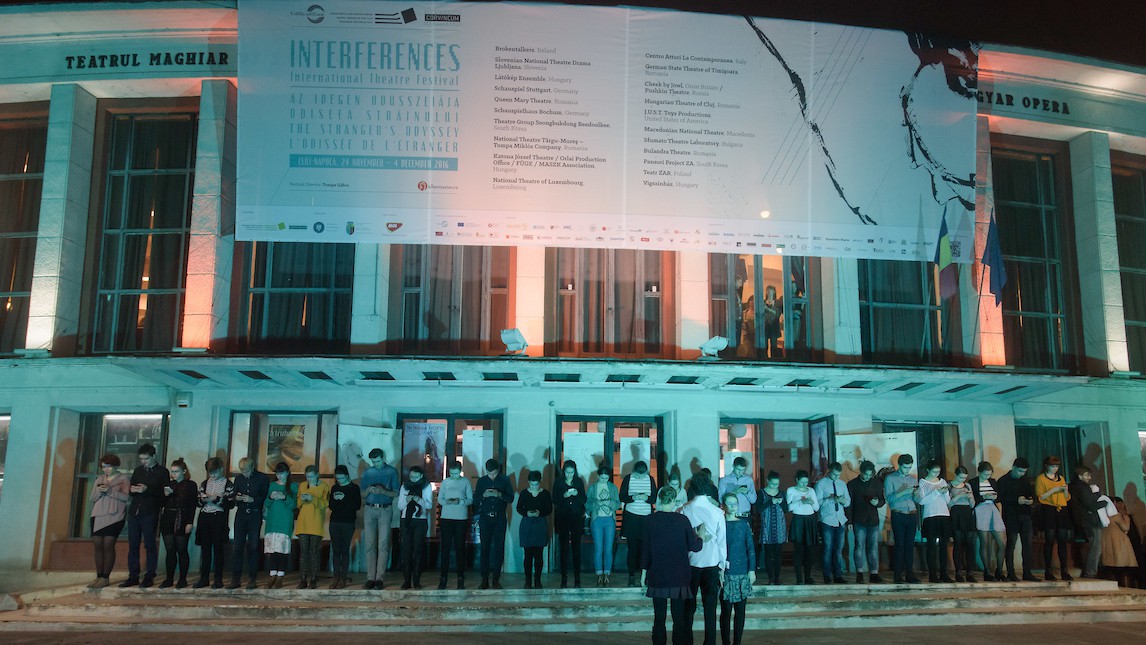
Harbour 40. On the docks of Europe

Harbour 40. On the docks of Europe

In the context of the 11th Short Theatre festival in Rome, four out of five playwrights involved in the UTE project Harbour40 were invited to read extracts from their new texts dealing with harbours and the people associated with them. Here’s a short report about such a multilingual and multicultural event.

Playwriting has never stopped evolving. From country to country, the art of writing for the stage holds a diversified relevance, depending on tradition and, at the same time, on cultural borders continuously pushing and shoving, on the ferment of certain themes, on emerging urgencies in a changing world. Because changing is the word—with its grammar, syntax and semantics—but, first of all, is the imagery; as if from century to century the need for representation had refused too fixed a structure in search of a model always able to reassess the live presence of the spectator, which is to be considered as an ungovernable cell of an organic process.

And that’s how writing acquires temporal and territorial peculiarities, that’s how the “classics” are born, that’s why a text might turn out “old-fashioned” or “out of context” rather than “revolutionary” or “suitable” for a certain time or place or audience. Most of such dynamics change as soon as the paradigm of the “lonely writer” is subverted.

Harbour40 is the title of a project developed through a schedule of meetings and think tanks held in the context of the “Conflict Zones / Zones de Conflits” project by the UTE in Rome and Vienna. Playwrights from Bulgaria (Stefan Ivanov), Greece (Angeliki Darlasi), Italy (Roberto Scarpetti), Palestine (Amir Nizar Zuabi) and Syria (Ibrahim Amir) have been discussing burning global issues, and how those relate to their societies. The brain-storming generated the idea of writing collectively, while on the other hand trying not to drop the fundamental specificities attached to each political and cultural background.
With the technical support of the Teatro di Roma and thanks to a very enthusiastic participation of the staff of the Short Theatre festival—directed by Italian director Fabrizio Arcuri since 2006—the first outcome of Harbour40 was a public reading at La Pelanda, a former slaughterhouse converted into a cultural venue in Rome. The excerpts presented by Angeliki Darlasi, Stefan Ivanov, Roberto Scarpetti and Amir Nizar Zuabi, though read in five different languages, had many things in common, and a shared leading image: the harbour, imagined as a “non-place” where people leave and return; where they meet and exchange goods and words, even lives and destinies. The further steps of the project would aim to collect the four texts and mix them into a comprehensive structure, letting the story fly from Jaffa to Piraeus, from Genoa to the Black Sea, but also through markets in the Syrian desert, Turkey and Tunisia.

On a bare stage, the four authors sit on a black couch under a dimmed light; crossing a delicate fog, each of them takes turn at the microphones placed on the front stage. When one rests the pages on the bookstand and starts reading, it’s like being left alone in another world.
Ivanov murmurs his Bulgarian lines keeping his body perfectly still, the surtitles stream on the screen and tell about a grandson and a grandfather, they talk about the channel that links Sofia and the Black Sea, that cost 22 thousand deaths among the prisoners from the Gulag.
In Darlasi’s fragment, Iliana walks back and forth on a dock of Piraeus, waiting for somebody; Natasha is fishing: the tragedy of the refugee flows is narrated from the point of view of the passengers, while the fate remains uncertain even when the boats touch land, and a life might change in unpredictable and painful ways.
Scarpetti’s monologue is the account of a trip to Genoa, where a Tunisian man is sent by the family to sell the house of a dead uncle who had left Tunisia many years ago: the infernal Italian bureaucracy will swallow him, scaling down any expectation about a fortune to be made in a foreign country to which many compatriots would love to escape.
Nizar Zuabi imagines the interview between different port-authority officers with Miss Queen, who is in search of her disappeared father. Beyond obstructionism and the suspect of an intentional code of silence, the father himself appears as a sort of Shakespearian vision, speaking Arab and whispering some chilling details about his—most likely deadly—trip.

More than any other form of writing, a play lets the characters speak up with their own voices, and the main task of playwriting should indeed be to deal with actual facts, bringing the inner feelings to the surface.
Just before the reading, the festival organized a public meeting held by the journalist Graziano Graziani, in which the four authors sit with Italian and French colleagues (Erika Z. Galli, Martina Ruggeri, Lorenzo Garozzo, Alessandra Di Lernia and Sonia Chiambretto), members of Fabulamundi Playwriting Europe, a networking programme for translating and diffusion of European plays. The discussion focused on the question of language and what kind of audience a playwright might (or should) fancy. Although attempting very different approaches, the quasi totality of the writers does not want to imagine an ideal spectator, in order not to feel too comfortable and rather drag the audience into a realm as uneasy as the contemporary issues they deal with.

When asking questions to the spectators of Harbour40, the strongest feedback was of course on the themes, on how Europe and the Mediterranean mirror the contemporary social-political contradictions. But for such a project it’s also important to take note of some other comments that expressed how fascinating it was to listen to multilingual texts without the mediation of the actors, but rather facing the very presence of the author. Also because of the fact that the audience was largely composed of professionals, a great part of the attention was focused on the body, on how the absence of the mise-en-scène brought the very essence of the words (with their peculiarities in linguistics and spelling) on the top of any form of theatrical interpretation. Thus, Ivanov’s firm and polite immobility could be confronted with a more animated and “acted” performance delivered by Nizar Zuabi, deriving from different professional backgrounds but also from cultural specificities in terms of language and expressiveness.
If, on the one hand, the term “collective” indicates something that is done together, its roots go down to the act of “collecting”, as to say to grasp bits and pieces of identity, displaying them in front of an active and diversified audience, that shapes a myriad of, both personal and universal, meanings.


Published on 22 September 2016 (Article originally written in Italian)