Is Athens ready for take-off?

Is Athens ready for take-off?

“Can Athens become Europe’s new arts capital?” wonders the BBC in a recent article on the documenta14 in Athens. A “poor yet sexy city”, according to the correspondent who reported on the creative enthusiasm currently prevailing in the city.

This is only one of the several articles pointing out that despite the deep economic crisis the artistic production in Greece has increased. Especially with respect to theatre, everyone seems to take part in it, either as a creator or as member of the audience. The numbers are revealing; there have been more than 800 premieres since the beginning of the season in October. Besides, during 2016 there were 1,490 performances in the 308 officially registered theatres.

© Irina Klyuev

But before we rush into referring to a reinvention of Athens, we ought to consider the conditions on which such a theatrical plethora appears. Because above all rises the issue of survival, as Irene Mountraki, dramaturg and head of international relations at the National Theatre of Greece, accurately commented in her article published a year ago under the title “Can Greece, home of drama, survive a state of emergency?”

It seems like a tragic irony. Yet the theatrical explosion has occurred with zero state support. Grants have been frozen since 2012 and it was not until March when the new Minister of Culture, Lydia Koniordou, one of the most prominent Greek actresses, announced their reinstatement in the forthcoming theatrical season.

In most cases actors work without contracts; they are not paid for the rehearsals (unless they work for State Theatres or some serious private companies), and often there is no prearranged payment for them besides the commission from the box-office. It is not rare at all for young actors to accept to perform for free, in the hopes of better working conditions in the future. Quite often there is a contribution box instead of tickets, and the money collected is split every night among the participants. Hardship does not discourage the Greek actors with a sweeping 95% unemployment rate, and they often have to do two or three (non-)theatre related jobs in order to make ends meet. There is a lot of flexibility—as long as they can find a way to make theatre.

All Athens is a stage

Due to the freezing of grants, many theatres have been closed. Where there used to be theatre Amore, a point of reference in the most productive theatrical life of the 90s, now stands a supermarket. Not to mention historical Amphi-theatro in Plaka, which is now a souvenir shop.

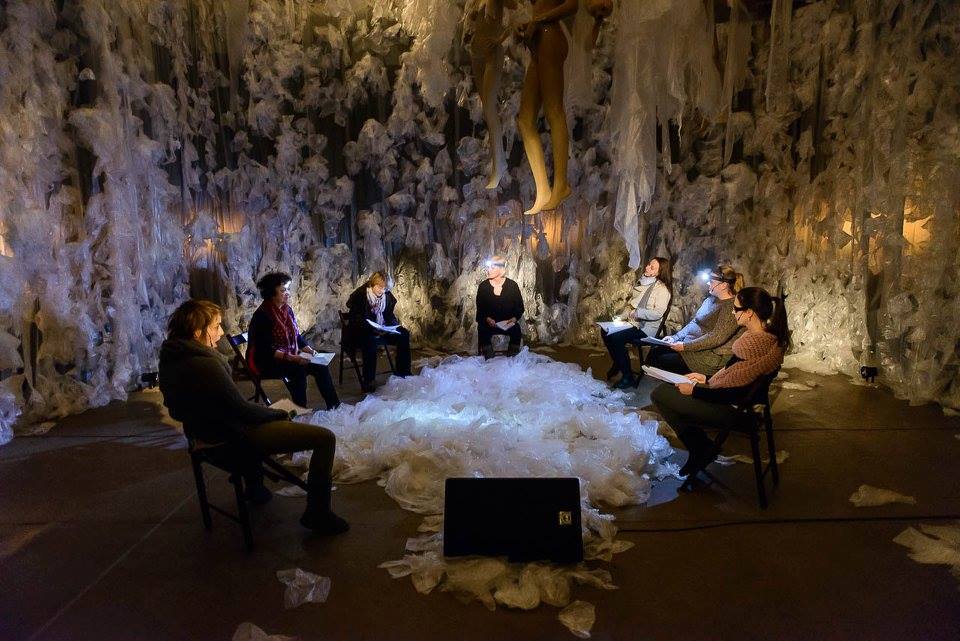
The need for expression though is huge and the Greek artist becomes a resourceful Ulysses coming up with inventive solutions. Thus, beside the properly equipped regular theatres, appear several other venues which either serve the needs of the performance or serve as a last resort. Over the past years we have watched performances in all kinds of warehouses and former industrial buildings; in bars and traditional coffee shops; in museums, galleries, even old byzantine churches; theatre in bedsits and apartments; in old patios of the city; in the public slaughterhouses; in old wagons and even in moving vehicles. We have even watched a performance in the bathrooms of the Bios multi-purpose venue.

It is significant that many stages on the theatrical map of the city have been named after the function the buildings originally served: Vyrsodepseio (tannery), Synergyo (garage), Fournos (bakery), to mention but a few.

Another current trend are the walking performances, which invite the audience to become familiar with unknown aspects of the city. So you could say that “all Athens is a stage”, paraphrasing Shakespeare’s famous quote.

There is something very attractive in all this; however, there are problems too. How many of these places are appropriate for the specific use? A few years ago the Municipality of Athens attempted to check whether safety protocols are followed, enforcing an antiquated law which could hardly be applied nowadays. The attempt came to nothing.

Festivals within and outside

It is also due to the state’s indifference that the 16 municipality regional theatres cannot function properly and gradually vegetate. This is why when we refer to the contemporary Greek theatrical production, we mainly focus on Athens.

In Thesaloniki there is even more limited potential, since apart from the National Theatre of Northern Greece there are 20 more stages which mainly put on productions from Athens.

The various festivals, which are radically increasing all over Greece, are quite in the same condition. They mainly take place during the summer months, they all share the same programme with a few alterations. One of the most brilliant exceptions is the Philippi Festival in Kavala and Thasos, which selects a specific topic every year and orders new plays based on it.

Nevertheless, when we discuss performing art festivals in Greece, we automatically think about one of the most ancient ones in Europe, the Greek festival, known as Athens & Epidaurus Festival, which during the period 2005–2015 and under the leadership of Yorgos Loukos, clearly succeeded in renewing the scene; there was both an opening to non-Greek productions and a boost to important local voices. This task seems to have been successfully undertaken by the current artistic director of the festival, Vangelis Theodoropoulos, who last year initiated a series of fruitful conversations over the kind of festival we would like to have.

A question that had already been answered over the previous years by innovative choices, such as Beckett’s “Happy Days” with Fiona Shaw in the Ancient Theatre of Epidaurus, which usually hosts Ancient drama performances. Several conservative voices considered this choice to be incompatible with this ancient theatre. It was a big success, though. And so was the presence of Pina Bausch, Thomas Ostermaier, Kevin Spacy and even the Noh Theatre from Japan.

Innovation and conservatism: two opposite forces

Indeed not only a few times have the conservative voices in Greece frustrated creative enthusiasm. Last year, Stathis Livathinos, the current artistic director of the National Theatre who keeps active international contacts such as with the Vakhtangov, had to cancel the performance of the Nash Equilibrium both due to political and social reactions, as the play included excerpts from a terrorist’s book. In the case of the Corpus Christi performance in Chytirio, the performance was reproached for religious reasons. While in the famous case of Jan Fabre’s startling resignation from the leadership of the Athens Festival, it was the artists themselves who objected to a Belgium oriented programme.

The Greek Theatre seems to be fighting two opposite forces. All these cases are very significant yet they coexist in the general context of renewal that had been prevailing in the past few years, since Yorgos Loukos’s decade of running the festival coincided with Yannis Houvardas’s leadership of the National Theatre (2007-2013). Houvardas was also a director who showed great interest in international productions, with its high being the Odyssey directed by Bob Wilson, in a co-production with the Piccolo Teatro.

Moreover, in 2010 a new powerful player joined the field and advanced became a catalyst for the whole Greek theatre scene. The Onassis Cultural Centre (Stegi) invites famous artists to Greece, while at the same time it finances Greek theatre tours abroad.

Over the past few years, this private organisation has been the only one to make an important effort to promote the contemporary Greek civilization abroad, especially in the field of performing arts, which normally ought to be carried out by the state. As a result, the work of the experimental Blitz company or the very young Dimitris Karantzas, has travelled and participated in important festivals and theatres of the world.

Exclusively based on his own powers, Thodoros Terzopoulos, the only truly international Greek director, has worked hard during the past thirty years to finally become internationally acclaimed, and has increased the fame of both his method and his theatre, Attis.

In search of a cultural policy

As mentioned earlier, the lack of cultural policy is tangible not only with respect to the promotion of the Greek artistic product abroad, but also with respect to national policy as such, as in the case of the grants. However we can also see it elsewhere; in the field of education.

there is not even a stage directing school in Greece. Nevertheless, there are 26 recognised drama schools (two of which are national) offering a four-year programme; 24 in Athens, four in Thessaloniki and one in Patras. Every year dozens of young actors graduate from these schools and enter this open job market, trying to find an outlet for their creativity.

This uncontrollable desire to create is definitely quite impressive, but it also entails some major risks. The improvisational and spontaneous way in which things usually happen often lowers the standards; only few out of the 1,500 performances of the season stand out. Very often poorly prepared performances are presented as avant-garde works, or bad imitations of foreign performances lead to disappointing results. It rarely reaches the poetic depth anymore that could be found in performances by artists, such as Lefteris Vogiatzis, one of the most influential directors of the modern Greek theatre world, who died four years ago.

In conclusion, the prevailing creative enthusiasm provides the ideal conditions for something very fresh and interesting to emerge. , in the context of the financial crisis, the wind blows fair for the Greek theatre. Yet, the take-off cannot succeed if the plain is not on the runway and doesn’t get support from a control tower—in other words, theatre cannot thrive in the absence of national cultural policy.


Published on 15 June 2017 (Article originally written in Greek)

German Theatre: Behind the Scenes of its Structures

German Theatre: Behind the Scenes of its Structures

The structure of theatres in the Federal Republic of Germany is characterized by a great number of theatres with a wide range of names: national theatre, state theatre, regional theatre, people’s stage, people’s theatre, residency theatre, municipal theatre, or also regional stages and open-air stages. These are ambivalent testimonies to past conditions in German history. Structurally speaking, the former court theatres have mostly become state theatres, where today’s state has taken over the responsibilities of the erstwhile court. The people’s stages movement is closely tied to the history of the workers’ movement. Today’s open-air stages not uncommonly had their origin as ‘thingspiel’ locations during the times of Hitler fascism. — This is a general overview of today’s constitution of the Federal Republic of Germany’s theatre structure.
Analogous to the different genres these theatres can have different branches, depending on size. We then talk about “multi-branch theatres” (Mehrspartentheater). These generally comprise ballet, opera and drama. In some cases, puppet theatre or children’s and youth theatre are also part of it. Oftentimes, the branches are also situated in independent theatres whose function is hinted at in the title, as in, for example, the Oper Köln (Cologne Opera), the Schauspiel Frankfurt (Frankfurt Theatre), the Schauspielhaus Bochum (Bochum Theatre), the Puppentheater Magdebug (Magdeburg Puppet Theatre), the Theater der Jungen Welt Leipzig (Leipzig Theatre of the Young World). From time to time, you can also find the names of the architects in the names of the theatre, as is the case of the Semperoper in Dresden. Frequently the former use is hidden in the name of production companies, which are needed by theatre collectives of the independent scene for artistic processes, as in Kampnagel in Hamburg; or its current purpose as a place of reunion immediately stands out, as in Forum Freies Theater (Free Theatre Forum) in Düsseldorf (FFT).

Positions

We may be confused by the Theater am Gendarmenmarkt in Berlin. A classicistic building by the architect Karl Friedrich Schinkel, it was opened in 1821 as Royal Theatre, and was used as a Prussian state theatre between 1919 and 1945; today, however, it is a concert hall and can be rented for major events. Nevertheless there are still orchestras with their own concert halls, such as the Gewandhausorchester in Leipzig or the Berliner Philharmonie. As opposed to straight theatre, the infrastructure of music is widely ramified; even smaller cities have small orchestras, such as, for example, the Mitteldeutsche Kammerphilharmonie in Schönebeck an der Elbe. To simplify matters, they agreed on the label Theater- und Orchesterlandschaft (theatre and orchestra landscape), in other places its labelled municipal theatre system. The theatre and orchestra landscape as such was added to the state-wide directory of intangible cultural heritage in 2014 on the initiative of the Deutsche Bühnenverein and the Deutsche Musikrat (German Stage Union and the German Music Council).

Independent from the name-giving, theatres differ with respect to public funding, so-called subsidies. These benefits are either granted exclusively by the city, the municipality or the community, or are supplemented by state funds, or are exclusively supported by state funding, respectively. The contentions between theatre makers in the cultural field for a fair allocation of these funds have been going on for around 60 years. On the side of the artists, discussions are ostensibly held around the emancipative relevance of a specific aesthetic form; on the side of the politicians, the numbers regarding the occupancy rate are brought up for discussion; audience members themselves have diversified, which, in the sense of the concept of a theatre for everyone brought up in the 60s, means the inclusion of all societal groups. The latter development increasingly also comprehends stage operations as such, of which the post-migrant ensemble at the Gorki Theater or the RambaZamba theatre by people with intellectual disabilities are not the only examples.

In the background, however, fiscal parameters create facts that force theatres into a transformation due to their structural establishment. The black zero is of central relevance in this context. This term is a metaphor for the debt brake that has been effective since 2009, and which dictates a constitutional limit to new debt for public budgets. In the so-called “new states”, where spending on the Reunification have increased the debt mountain, austerity plans have yielded specific consequences. We have furthermore observed that the legal form of a theatre has been changed, or that they are changing from cameralistics to double-entry bookkeeping, in the matter of accounting. Management companies like VG-Wort or GEMA are currently subject to a deep change as well. During this discussion about cultural diversity theatre makers insinuate that, in the name of cultural and creative industries, a connectivity to a global market governance is being created, which would cancel out means of production grounded in tradition. The current dispute about the Volksbühne in Berlin, during which a cultural secretary of state replaced the stage director and artistic director, Frank Castorf, with a Belgian curator and museum manager, is a textbook case for this discussion. Theatre makers speak of an enemy takeover and protest openly in order to protect their interest in the preservation of artistic freedom.

Basic Parameters

With the expansion of the EU domestic market in the 90s, which favours the Europe-wide call for open assignments, cities, communities and municipalities have begun competing with one another. This fact becomes clear with simple train rides. Signs and announcements in train stations treat cultural heritage often as a characteristic of the city: there is Bach-city, Luther-city, and many more. Theatre and orchestra are intensively included in the new marketing of a city. On the other hand, theatres have been closed, including the famous example of the Schillertheater in Berlin. After the reunification of the German Democratic Republic (DDR) with the Federal Republic, some 40 theatres were affected by closings in the so-called “new states”. A first understanding of the current make-up of the theatre and orchestra landscape requires a look into the responsibility for culture, both the financial basics and some central reference numbers.

a) Culture as a task for the states

The Federal Republic of Germany is a federal state in its borders from 3 October 1990, consisting of 16 states, whereby the city-states of Berlin, Bremen, and Hamburg are considered states. The jurisdiction for culture comes from Article 30 of the German constitution. Legislation and administration fall under the domain of state culture. Since the federal government is not competent in this case, the term cultural sovereignty of the states is used. Likewise, the states are bound to the principle of subsidiarity. This means that the lower administrative units like cities, communities, or municipalities must give way when it comes to the resolution of state responsibilities and can only help in a complementary way. Performing arts belongs to a department of culture in a city, community, or municipality. There is a ministry of culture at the state level—as there was for example until the federal state elections in 2016 in Saxony-Anhalt—or culture is part of the ministry for family, children, youth, culture, and sport, like is the case for the state of North Rhine-Westphalia.

 b) Federal Cultural Politics

During the government of Chancellor Gerhard Schröder (1998 to 2005), the office of the Federal Commissioner for Cultural and Media Affairs (BKM) was created in the Federal Chancellery with the goal of bringing together cultural policy responsibilities that were previously carried out by different ministries. The current Federal Commissioner for Cultural and Media Affairs is Federal Minister of State, Monika Grütters. The federal government is directly involved in project advancement due to the founding in 2002 of the German Federal Cultural Foundation (Kulturstiftung des Bundes), which is located in Halle (Saale). The artistic director of this institution is Hortensia Völckers. One of the goals of this institution is the advancement of innovative programmes and projects in international contexts and to drive the cooperation with the Cultural Foundation of the German Federal States (Kulturstiftung der Länder). The general project funding and programme funding are directly responsible for project advancement in the area of performing arts. For project funding there is currently the program 360° – Fund for New City Cultures, with which institutions of all kinds are supported in order to diversify their programme, audience, or personnel and to promote the inclusion of immigrants and following generations. Furthermore, the programme TURN – Fund for artistic cooperation between Germany and African countries and the Doppelpass Fund, which supports the cooperation of independent groups and established dance and theatre houses. These existing cooperations can be expanded for a third partner, a theatre, or production house, even when they are located abroad.

 c) The Financial Basics

For theatres there exist what are known as “theatre contracts”. They do not have the same weight as treaties, such as those with Christian churches and public broadcast (TV, radio). Churches can cite land they mortgaged to the government in the 19th century when they wish to secure an important source of income. The public broadcasting channels (with the exception of the Deutsche Welle) can rely on a broadcast fee treaty as well as a broadcasting financing treaty for the security of their financial needs. Since 2013, these treaties allow for the charge of 17,50 € each month per apartment, based on population and living space, which can hurt, even for independent theatre critics. The broadcasting companies were able to take 8.1 billion euros in 2015, with the help of various compulsory enforcements. This sum is almost equal to the total amount that was spent on art and culture in Germany, including monument conservation, national libraries in Leipzig and Frankfurt, performing arts and much more. In 2011, they took in around 9.4 billion, or 0.36 % of the gross domestic product. Theatres in Germany are unable to compete with churches and broadcasting companies when it comes to finances; although in terms of cultural policy, traditionally the theatre is also intended for sacral tasks in the sense of beauty, truth, and goodness, and thus has a certain spiritual responsibility. The artistic direction—also known as Intendanz in German—changes on average every four years, and the financial needs of the theatre must then be renegotiated, which the German Stage Union (Deutsche Bühnenverein) does on behalf of the theatre. Financial subsidies are pitted against an intangible cultural heritage whose production costs are covered by the administrative term public services. Theatres in Germany are equal to other public services like education, sanitation, hospitals, cemeteries, or interstates, hence the talk of “cultural care”, which, much like educational institutions, would govern the reach of theatres and orchestras based on a commuter belt and demographic statistics. In general, the financial contributions are voluntary services from the public authorities, which, unlike for churches and broadcasting companies, can be disposed of at any time.

 d) Benchmarking Data

Indicators of a theatre are a permanent ensemble and a repertoire, which is why this is also called ensemble and repertoire theatre. The density of theatres and orchestras in Germany is characterized by 140 publicly funded theatres and 220 private theatres with 130 opera, symphony, and chamber orchestras, around 70 festivals, approx. 150 theatres and venues without permanent ensembles, and around 100 tour and guest performance stages, as well as many shows by independent groups. It is interesting to note that not one of these enterprises would survive without public funding. Yearly, 35 million spectators of all ages visit the approx. 126,000 theatre shows and 9,000 concerts. The German UNESCO commission in Bonn reported on this in its announcement from 19 December 2016, and made known that this theatre and orchestra landscape is nominated for the international UNESCO list of intangible cultural heritage.

Associations

The Federal Republic of Germany is an area state in which unions are the central form of organization for groups that share a particular interest. The theatre and orchestra landscape is split into two large groups that are closely related to the post-war history of the Federal Republic of Germany in its borders before 3 October 1990. On the one side there are the so-called institutionalized forms of theatre work in the field of cultural policy, and on the other side are the so-called emancipated forms of theatre work. The original confrontation came about because of the student protests of the 60s, which dealt with the adoption of forms of aesthetic representation and its reformation. After an era of liberation of aesthetic limits between emancipation approaches and their subsequent institutionalization—that is, the broad integration of independent and in their own self-image emancipatory projects during the processes of metropolitan theatres in the 90s and the first decade of the new century—the conflicts of recent years have been postponed. This postponement is most noticeable in relation to the confrontation of the public sector with the debt limit, with the establishment of an EU domestic market, and the accompanying integration into city marketing, as well as with the novelty of the free trade agreements GATS, TISA, CETA in publications and thematic series. The social partnership that was established after the war is experiencing depreciation as a feature of the Rhine capitalism (Michel Albert) in the old states. Nevertheless, the two large groups define themselves based on their organizational structure to this day. On the one side there is the historic heritage, which precedes the social partnership: labour associations and unions. On the other side are the organizational forms of the independent scene.

a) Deutscher Bühnenverein (German Stage Union)

The largest interest group and at the same time employer’s association for theatres and orchestras in Germany is the Deutsche Bühnenverein, founded in 1846. It currently accounts for 214 theatres (34 national theatres, 84 municipal theatres, 24 state stages, and 72 private theatres) and 31 independent symphony orchestras (7 state orchestras, 23 municipal orchestras, 1 national orchestra) as well as 129 personally active members. Its responsibilities include: to discuss all artistic, organizational, and cultural policy questions, audience development, the formation of legal frameworks, and the social position of artists. Ulrich Khuon serves as president of the German Stage Union since 24 January 2017. Since 2017, Marc Grandmontagne is the managing director. Together they form the management. There are six groups within the union, which form the executive committee, represented by the chairman of each group: private theatre group (Christina Seeler, director of the Ohnsorg Theatre), directors group (Hasko Weber, general director of the German National Theatre & Staatskapelle Weimar), state theatre group (Hans Heinrich Bethge, senate director, Cultural Office of the Free and Hanseatic City of Hamburg), state stage group (Kay Metzger, director of the State Theatre Detmold), metropolitan theatre group (Gabriel Engert, cultural advisor of the city of Ingolstadt), exceptional members (Charlotte Sieben, managing director of the Berliner Festspiele). The German Stage Union publishes theatre statistics, work statistics, books, brochures, and papers on cultural policy. It is a member of the Performing Arts Employers Associations League Europe (PEARLE*).

 b) Genossenschaft Deutscher Bühnenangehöriger (The Guild of the German Stage)

A second large interest group is the Guild of the German Stage (Genossenschaft Deutscher Bühnenangehöriger, GDBA), which was founded in 1871 and whose current president is Jörg Löwer. This organization represents members of the artistic and artistic-technical sector. Organized into seven state unions, the GDBA covers the career fields of solo, dance, opera chorus, and equipment, technology, and management (ATuV). Specific types of contracts for workers rights in theatre can be traced back to them. Their members receive legal protection and consulting free of cost. Together with the German Stage Union, it upholds the stage court jurisdiction, meaning the trade court for the stage. An improvement in retirement arrangements is a goal. Responsibilities include pay scale policy and cultural policy, especially the definition of work and wage conditions for those associated with the stage. The GDBA publishes, among others, the German Stage Yearbook, the Journal of Set Designers (Fachblatt “bühnenbildgenossenschaft”), an updated copy of the normal contract (for the stage) and a commentary to the normal contract (for the stage). It is a member of the International Federation of Actors (FIA).

c) Further union representation

The Fachgruppe darstellende Kunst der Vereinten Dienstleistungsgewerkschaft (Occupational Group Performing Arts of the United Services Union) (Verdi) also offers union representation. Heinrich Bleicher-Nagelsmann is the unit manager. It offers legal advice and legal protection regarding work and social court lawsuits, civil service law, and job-related contract and copyright law, as well as consultation on employment references and test cases on work, social and administrative court in all courts, as well as strike support. Furthermore, there is the Vereinigung deutscher Opernchöre und Bühnentänzer e.V. (Union of German Opera Choirs and Stage Dancers) (VdO). It is both a professional association and union of the members of the opera choirs and dance groups of the German stages, Stefan Moser being the federal chairman.

d) Organizational Structure of the independent scene

Whoever is not employed by a theatre is considered to be independent. As far as social insurance coverage, this circumstance means that the Künstlersozialkasse (KSK) (Artists Social Security Benefits Office) is responsible instead of the Bayrische Versorgungskammer (Bavarian Provision Association). In addition to the Bund Deutscher Amateurtheater (Association of German Amateur Theatre), the so-called independent scene has an umbrella organization of all 16 state associations, mainly also due to the Bundesverband Freie Darstellende Künste (Federal Association of Independent Performing Arts), founded in 1990; it represents the interests of the approximately 2,000 independent theatres in Germany, amongst which solo theatres, troupes and theatre companies. Amongst other things, its responsibilities include consulting the cultural and social policy makers on matters regarding the independent performing arts, as well as effectively representing them. Members and interested parties receive information regarding tenders, performance locations, festivals, (advanced) education and technical questions via the regular information centre OFF-Informationen. The Federal Association considers the social and economic state of the dance and theatre creators one of the central themes. Janina Benduski (State Association Independent Performing Arts Berlin), Anne-Chathrin Lessel (State Association Independent Theatres Saxony), Tom Wolter (State Centre Acting & Theatre Saxony-Anhalt), Harald Redmer (State Office Independent Performing Arts North-Rhine Westphalia), Susanne Reifenrath (Umbrella Association Performing Arts Hamburg), Ulrike Seybold (State Assocaition Independent Theatres in Lower Saxony) and Axel Tangerding (Association Independent Performing Arts Bavaria) are its board members. The Federal Association Independent Performing Arts campaigns for a stable social security benefits office for artists and a good income for all of their colleagues. It fights for fair and transparent funding conditions. Another purpose is consulting public and private sponsors on the development and work of the scene. Last year, in cooperation with the Kulturpolitische Gesellschaft (Cultural Policy Society), Ulrike Blumenreich’s study “Aktuelle Förderstrukturen der freien Darstellenden Künste in Deutschland. Ergebnisse der Befragung von Kommunen und Ländern” (“Current Funding Structures of the Independent Performing Arts in Germany. Results of A Survey of Municipalities and States”) was published on this key subject. The first comprehensive study on the economic, social and labour-law related state of independent theatre makers in Germany was already published in 2010 in the “Report Performing Arts”, which the Federal Association Independent Performing Arts, together with the Fonds Darstellende Künste (Performing Arts Fund), got off the ground. The latter has been funding projects of all branches of performing arts since 1988. In the past 30 years, the fund has awarded approx. 16 million euros for approximately 3,000 individual projects and project conceptions in all federal states, and in more than 300 municipalities. The fund receives a yearly subsidy of currently 1.1 million euros by the federal commissioner for Culture and Media. Wolfgang Schneider (director of the Department of Cultural Policy at the University of Hildesheim), Ilka Schmalbauch (lawyer and advisor of the board of the German Stage Union) and Wolfang Kaup-Wellfonder (independent puppeteer) are its board members.

Lobbying, Representation, Networking

The Republic of Germany establishes a free and democratic basic order in its constitution, and this is demonstrated practically with the help of democratic principles. Due to the fact that interest groups organize in unions and that there is a pluralism in the landscape of political parties that allows each party a speaker for cultural policy, the Deutsche Kulturrat (German Cultural Council) is an umbrella union that represents all cultural associations and political contact persons for politics in matters of cultural policy since its founding in 1981. One of the main characteristics of the field of cultural policy is the caucus work, during which it works towards a balancing of interests and, when needed, a consensus decision. Furthermore, the media representation that builds an important basis for discussion and networking of theatre makers was and is a defining factor, leading to differentiation in the field of cultural policy, which in turn can bring about the creation of new forms of organizations.

a) Deutscher Kulturrat

The German Cultural Council serves as a contact in politics and administration in the states, at a national level and in the European Union. Its stated goal is to encourage discussions on cultural policy at all levels of politics and to defend the freedom of art, publications, and information. Central issues of the last years include the protection of cultural goods, copyright, free trade agreements, gender equality, cultural integration, economic and social questions or the issue of threatened cultural institutions by introducing a Red List. The managing board includes Christian Höppner (president), Regine Möbius (vice-president), and Andreas Kämpf (vice-president). The administration consists of Olaf Zimmermann (director) and Gabriele Schulz (deputy director). Members include the Deutscher Musikrat (German Music Council), the Rat für darstellende Kunst und Tanz (Council for Performing Arts and Dance), the Deutsche Literaturkonferenz (German Literature Conference), the Deutscher Kunstrat (German Art Council), the Rat für Baukultur und Denkmalkultur (Council for Building Culture and Monument Culture), the Deutscher Designtag (German Design Group), the Deutscher Medienrat für Film, Rundfunk und Audiovisuelle Medien (German Media Council for Film, Broadcasting and Audio-visual Media) as well as the Rat für Soziokultur und kulturelle Bildung (Council for Socio-culture and Cultural Education). Some of the associations mentioned are also members of the Council for Performing Arts and Dance and Ilka Schmalbauch is their contact person. The Deutsches Zentrum des Internationalen Theaterinstituts (German Centre of the International Theatre Institute) is also a member, and has made the mutual understanding of theatre cultures of the world its goal. Along with books, dossiers, addenda, and studies, the German Cultural Council publishes the journal “politik & kultur” quarterly. They also produce a free newsletter, with subscription via their website.

b) Representation in the Media

Beyond professional reports, local and cross-regional daily newspapers and magazines carry out reporting on theatre, in print as well as online. The Deutscher Bühnenverein publishes a monthly magazine, Die Deutsche Bühne. Theater der Zeit, theater heute, and nachtkritik.de occupy the space of theatre-specific publications. Along with magazines, Theater der Zeit also has a book publishing house which produces a yearly workbook dedicated to a certain artist or issue and includes academic essays (research series) or books on theatre architectures, copies of theatre pieces (dialogue series) or books about a certain theatre. The Alexander Verlag is one of the most important publishing houses among the theatre branches of the large publishing companies (Suhrkamp, Fischer, Hanser). Theatre publishers are important to theatrical distribution less for their image towards the outside and more for their internal representation, for example the Verlag der Autoren, Henschel Schauspiel Theaterverlag Berlin, Drei Masken Verlag, or Felix Bloch Erben. Last but not least is the Theateralmanach from Bernd Steets, which offers a short and manageable overview of updated questions on the topography of the German-speaking theatre landscape in the field of cultural policy.

c) Networking

Fusion and the closing of venues have characterized the changes to the German theatre and orchestra scene since 3 October 1990. Until 3 October 2003 alone, one in eight jobs at German theatre or operas were done away with, which equals five and a half thousand from forty-five thousand jobs. This broad fusion of theatres into theatre clusters in large swathes of land has led to a further loss of jobs and to the introduction of even more artists into the independent scene. This change in cultural policy has an effect on the labour agreements and finally on the net income and workload. Actors are worst protected from changes, a condition that has structural reasons. Even their interest representation is nowhere near as well positioned as that of musicians. Due to this dismantling of the German theatre and orchestra scene, actors have joined together against the poor labour conditions, against the low wages, and to fight for humane treatment. The newest example is the artbutfair initiative and the Ensemble-Netzwerk. Artbutfair works for fair labour conditions as well as appropriate wages in performing arts and music. The Ensemble-Netzwerk is a movement connecting theatre makers with one another and fighting for their labour conditions in metropolitan theatre and their artistic future. “Freiheit der Kunst, bedeutet nicht Knechtschaft der Künstler*innen” (“Freedom of art does not mean servitude for artists“) is the motto that inspires an overwhelmingly young generation to work together with unions, the Deutscher Bühnenverein, directors’ groups, politics, artists, and associated professional organizations. Their goal is to push for good occupational conditions for artists in public theatres.


Published on 6 June 2017 (Article originally written in German)
Theatre in the UK: Politics, poetics and resistance

Theatre in the UK: Politics, poetics and resistance

On Fire

In 2015, I found myself in the Dorfman Theatre at the National Theatre for the closing of the Spill Festival of Performance, watching a transgender artist (https://heathercassils.com/) perform a dangerous act of self-immolation in Inextinguishable Fire, as part of the Spill Festival of Performance. The piece saw the artist, following extensive training with professional stuntmen, burn themselves on stage in a controlled performance inspired by Harun Farocki’s film with the same name, exploring the impossibility of representing trauma. The event was a two-part piece: the live, one-off performance in the Dorfman, and a follow-on film projected outdoors, on the side of the Southbank Centre’s Royal Festival Hall.

The burn itself lasted fourteen seconds, preceded by extensive physical preparation involving fire-resistant materials. This body is drenched in cooling gel, ready to undergo a temporary state of hypothermia and needs to avoid any breathing in for the period of the burn. The lights on the stage and in the auditorium never go down, and there’s an underpinning, uncomfortable drone sound coming from the speakers, just enough to create a sense of anticipation, but not to support any spectacle.

This feels momentous: watching a gender fluid, non-British body on a National Theatre stage, speaking of trauma, undertaking a performance that is in equal measure theatricalised and de-theatricalised. The audience is silent, and I watch in anticipation, knowing that this will not culminate, it might simply end; knowing the resonances are both poetic and formal; knowing that I am a witness, not a spectator.

It’s surprising, not only because the National Theatre has, for the past decade, under the directorship of Sir Trevor Nunn (1997-2003) and Sir Nicholas Hytner (2003-2015) created a distinct identity that favours adaptations, and a particular British-European canon that excludes the kind of performance work that the theatre world has embraced elsewhere. It’s a notably gendered space too—the National Theatre has yet to see an Artistic Director who is not a white British male—although there is promise of a shift under the tenure of Rufus Norris. In what direction, and under what circumstances, perhaps it’s too soon to tell. Cassils’s event, with its explicit interest in the architecture of the theatre, but resistant to theatricality itself, marked a moment of politicisation ahead of the era of Donald Trump and Brexit.

Cultural Policy (The Politics)

In 2016, Ed Vaizey, then Minister for Culture, Communications and Creative Industries published the first White Paper on the government’s approach to culture in over fifty years. It foregrounds the move towards patronage and private sponsorship model for the arts, and places increased pressure on the economic sustainability of culture (in terms of profitability and re-investment). It also emphasises culture’s ability to increase soft power and to provide measurable community engagement. The outcome indicators stipulate economic growth, reduction of poverty and unemployment rates and ‘improved subjective well-being’, in the promise for culture to deliver successful communities.

It’s no surprise that theatre plays a key part in this vision; despite the West End’s relative economic success, much of the pressures come down to the subsidised theatre sector—from major to local institutions. Yet this reorientation of the cultural agenda has its roots in the Conservative Government’s austerity measures, which, in 2010, resulted in a 30% cut to the Arts Council England budget, the main funding body. This was followed by cuts across Wales, Scotland and Northern Ireland, although these played out differently in each of the devolved administrations. Despite local governments having some autonomy over austerity measures, Westminster remains a powerful lead in overseeing the agenda for cultural policy and funding. And it is precisely this reorientation that has resulted in a notable fracturing of the theatrical ecology, from the point of view of its infrastructure, as well as its artistic factioning.

To speak of the landscape of British theatre in the UK is to speak of a series of intertwined political, social and governmental shifts, at a time of increased desire for sovereignty and a tumultuous relationship to the European Union. Britain’s theatrical landscape is shaped as much by a fluctuating community of immigrants, diasporas and locals, as by major political shifts. Whilst Britain prides itself on the economic profitability and dynamism of its creative industries, it is also structurally a pressurised, neoliberal cultural landscape. There is a powerful conservativisim within British theatre, one that is also resisted by a plural, reactive, shifting community of artists and institutions questioning identities, structural inequality and continuing to explore immaterial questions of generosity, care, community and, of course, dramatic form itself.

There is also a distinct differentiation on the part of its artistic communities between theatre and live art (as developed and championed by The Live Art Development Agency under Lois Keidan and C J Mitchell), with performance as a nomadic network of cultural intersections in between. This is particular to the UK, and has come as a direct result of the inconsistent and sometimes untransparent distribution of public money to support experimental or marginal practices. What becomes part of these categories is constantly shifting. If live art has sought to make space for marginalised debates and dissolve the boundary between art and life, between experiences of marginalisation and their representation, theatre post-Thatcher has been battling a tension between subsidized and commercial sectors, between new writing and adaptations, between British and international work.

Struggles and Poetics

The rise of Conservative government in England as a political stronghold, echoing policies that go all the way back to Margaret Thatcher, has also seen a dynamic theatrical and performance culture. Tate Modern opened its new extension in 2016, providing more space and resourcing to the archiving of theatre, performance and live art, whilst other museums, such as the Victoria & Albert, have seen successful exhibitions and programmes about theatre and performance. Organisations such as the Live Art Development Agency and Artsadmin have invested resources and efforts to create a culture inclusive around questions of gender and sexual identity, race and ability, environment and ecology, as well as questioning ideas surrounding diversity and their systemic undermining. The rise of festivals such as the London International Theatre Festival, Spill Festival of Performance, In Between Time, Buzzcut Festival and many more has provided an alternative network for international work to be circulated beyond cultural strongholds, namely major cities like London, Cardiff, Glasgow or Manchester.

Changes in major institutions, such as London’s Royal Court under Vicky Featherstone, the National Theatre under Rufus Norris, and The Globe under Emma Rice (who, following a dispute with the Shakespeare Globe Trust Board on the use of lighting and sound technology, is now leaving the venue at the end of its 17/18 season) have provided programming that attempts to engage with problems of representation, both in terms of labour and artistic output, notably gender, race and disability, although these are politically limited and embedded in complex questions surrounding theatre as a cultural establishment.

This, at the same time, has given rise to questions surrounding nationhood and sovereignty, identity and borders, at a time of global dispute. The term ‘European’, recently debased by playwright Sir David Hare as ‘infecting’ British theatre – and elevated by critic Michael Billington in his critique about the National Theatre’s season omitting ‘European classics’ evidence a misunderstanding that’s recently regained traction. This is between Europe as a continent, and the European Union itself, as well as the association of the term with radicalism that pertains to the late eighties and early nineties and the rise of Regietheater, or a classicism that excludes cultures at the heart of European Modernism, and ignores the important role postcolonial critiques play in unpacking histories of practice.

David Hare’s remarks attempt to protect the now historicised state of the nation play, giving the example of the successful Jerusalem by Jez Butterworth. At the same time, it derides the rise of devising, collective work and new writing at the heart of much British culture and its international reach—and its mainstream presence, such as The Barbican regularly commissioning collaborations between Simon McBurney’s Complicite and Berlin’s Schaubühne, following the successful controversy of the international co-production Three Kingdoms in 2012 (written by Simon Stephens, directed by Sebastian Nubling, with design by Ene-Liis Semper).

If venues such as the Young Vic, the Barbican and the Royal Court regularly programme works in collaboration with artists across Europe and beyond, there is still a battle between form and topicality, nationhood and internationalism in British theatre. In part, this comes out of a lack of questioning of what is meant by ‘nation’ in post-Empire Britain on its major stages, although some excellent work has been supported by Battersea Arts Centre with London Stories: Made by Migrants, exploring London’s diverse migrant community through the stories of its inhabitants, and Vlatka Horvat’s 15th Extraordinary Congress, which speaks of the dissolution of Yugoslavia through the stories of seven London-based artists born in its different republics. Counted amongst some of the most welcomed productions of 2016 are Oil by Ella Hickson, which speaks to the broad history of oil and its political, social and environmental damage, Annie Barker’s The Flick about a failing Massachusetts movie house and its low paid workers pushed out by the digital, as well as works by black American playwrights like Ma Rainey, Amiri Baraka and Suzan-Lori Parks. These show a wide range of topical engagements, supported by an ongoing interest in European and American revivals (including Tennese William’s Streetcare Named Desire, Federico García Lorca’s Yerma and Henrik Ibsen’s Hedda Gabler).

There remains however, a disparity between agendas for cultural involvement and representation, the language of inclusivity and the infrastructures both cultural and institutional that create such complex problems across the board. In January of this year, Live Art UK launched Diverse Actions, a multi-project initiative that aims to support culturally diverse ‘ambition, excellence and talent’, focused on leadership and new work, with an agenda for embedding more sustainable practices.

Performance (or?)

If the mid 2000s saw a rise of artist-led, independently run spaces, such as performance space, run by Bean and Benjamin Sebastian, and The Yard Theatre, and the development of local projects by major institutions, such as the Royal Court’s work in Peckham, South London and LIFT’s work in Tottenham, North London, following the Olympics in 2012, there is a general sense that DIY models are short lived, but infrastructurally necessary to the development of an experimental scene in London and beyond. Whilst the division between regional performance, and that in major cities remains a problem, particularly in light of the concentration of artists and institutions in places like London, there is an increasingly neoliberal culture that is pushing institutions to rely on philanthropy, and artists to navigate complex systems of fundraising and patronage in order to ensure sustainable cultural activity.

In part, certain institutions like the Tate Modern have attempted to provide spaces of debate on these questions, whilst also harnessing their resources to familiarise a visual art and heritage audience with performance work, particularly with artists like Anne Theresa De Keersmaeker, Suzanne Lacy or Marina Abramovic. On the other hand, Live Art Development Agency has been instrumental in introducing a certain level of ethical debate, drawing a link between the political shift of cultural policy and funding and the development of certain artforms, supporting the work of collectives like Platform, who were behind the protests on Tate’s BP sponsorship which has now ended, as well as engaging in publishing activities, and artist-support networks.

So whilst institutional, there is an apparent porosity between theatre and performance, between historical lineages that emerge from visual art and those at the heart of European modernism, this landscape looks altogether different according to which vantage point you take. It’s a shifting paradigm, one that at times might suggest a spectrum rather than a binary, but under the current guises, there remains much tension to work through.


Published on 19 May 2017

Where do parallel lines meet?

Where do parallel lines meet?

If you want to understand what’s going on in the Hungarian theatres, you have to be aware of the fact that Hungarian culture is politicized to the utmost extent. The party of Viktor Orbán, Fidesz, first won an absolute majority in Parliament in 2010. Since then system of democratic institutions and the financing of culture has become totally different. Simultaneously, the walls between left and right-wingers have become higher and higher.

“Távoli dal”, Vígzsínházs, directed by Mark Eitzel © Daniel Damolky

Left-wingers (creators):
are usually liberal, too
are urban and cosmopolitan
were too subsidized by the political system before 2010, today their subsidies decrease or stagnate
focus on the Western world
would not limit methods of creations
are provocative
think theatre raises problems, enhances critical thinking and triggers debates.

Right-wingers (creators):
are rather conservative
are mainly from the countryside, strongly believes in national values
too subsidized by the present political system
focus on the East
would limit the methods of creation
think provocation is self-important
think theatre should represent values, give answers, enhance a common standpoint.

These are of course stereotypes, some of them being attached to one side by the other side. It is also a characteristic of the cruelty of this divisiveness that related to something even those count as left- or right-wing who would never label themselves so (though might consider themselves as sitting in the opposition). If we want to understand how this condition affects the circumstances of Hungarian theatre, we have to clarify some basic concepts.

Funding of Theaters

Currently, the majority of theaters in Hungary are being sustained through municipal support, which means that performing arts in Hungary largely depend on state subsidies. Examples of patronage exist, but given the small size of the country, the system is rudimentary; sponsors prefer to invest in more “spectacular” projects. Besides financial aid, theater revenues result from seat sales and the so-called TAO [Corporate Income Taxes] which means that national business establishments may offer part of their corporate taxes to theaters, which may receive 80% of their annual seat sales through this method. (This system is rather recent and according to its opponents, it benefits the larger, stronger, high-seat-capacity theaters in addition to facilitating a huge number of abusive practices.) Based on the financing of the different institutions, theatres can be divided into the following groups:

Stone Theaters: Repertory theaters disposing permanent troupes and playgrounds. Partly
subsidized by the municipality, partly subsidized by the state, there are countless such theaters in Budapest, amongst which the most significant are the Katona József Theater, the Örkény István Theater, the Radnóti Miklós Theater and the National Theater (this is a subjective list). In addition, there are stone theaters outside of Budapest, primarily in regional municipalities, specifically in larger cities. There is a significant difference, inasmuch as the theaters in Budapest may easily establish their own identities, whereas this task is more difficult for regional theaters, since it is the same establishment providing operas, musicals, children’s plays, studio theater performances, etc.

Private Theaters: they exist sporadically, generally playing tabloid-type presentations. The most significant among them is the Orlai Produkciós Iroda [Orlai Production Office] and the
Átrium Film-Színház [Atrium Film-Theater]—these also participate occasionally in setting up independent theater performances, or at least act as host establishments.

Independent Theaters: formerly referred to as amateur theaters, later alternative theater troupes that have no sponsors, functioning on project funding from tenders and competitions and usually having no permanent playgrounds. The bulk of dance troupes and numerous children’s theater-and-theater education companies belong in this group. The accomplishments of independent troupes are recognized worldwide, but in Hungary these troupes are forced to work under increasingly harsher conditions. Thus, as a matter of course, part of their presentations automatically takes place in international co-productions. The troupes struggle in different ways with this situation: Viktor Bodó’s company, the Szputnyik, chose to close down due to uncertainty and unpredictability. Béla Pintér’s company resigned from the two annual presentations and raised ticket prices (luckily, they can afford it, having a huge fan base, tickets are sold out for months, within hours of their announced performances on the Internet). Kornél Mundruczó’s company, the Proton, always present their show abroad, the same is true for the productions of Árpád Schilling’s company. (Incidentally, he has completely disconnected his artistic activities from Krétakör, [Chalk Circle] now primarily engaging in projects of social dialogues and responsibility-taking.)

Host Theaters: these present guest performances and productions of troupes without a permanent playground. Their important role is to pave the way for startup troupes. In this regard, the Jurányi Inkubátor Ház [Juranyi Incubator House] is a unique phenomenon, operating out of an old schoolhouse building, which offers a rehearsal room and other infrastructure to “lodger” troupes, serving as well as a host platform for community groups. The Szkéné [Theater of the Budapest University of Technology and Economics] works largely with permanent troupes, the MU Theater concentrates mainly on dance, startup troupes and lately on community presentations. The most significant host theater is Trafó, the only place where foreign guest performances can be seen continuously during the year.

It is important to know what the above concepts mean because, as we will see, divisiveness is not only a political, but a structural question as well.

Two Theatrical Organizations and Two Performing Arts Acts

There are two organisations for authors and young writers—or even history teachers—one is left-wing, the other is right-wing. In some cases, the right-wing organizations came into existence as opposing organisms. This is what happened in the case of the Magyar Színházi Társaság (MszT) and the Magyar Teátrumi Társaság (MTT – both names mean Hungarian Theatre Association with the only difference that ‘színházi’ is the Hungarians version of the word theatre, and ‘teátrumi’ is a less used, Latin version). The MSzT was established in 1997, its purpose was to represent the interests of the Hungarian theater profession and its main ambition was the legislation of the work in performing arts. Parliament finally adopted this law in 2008. In essence, it was the dissatisfaction with this law that gave rise to the MTT, which primarily included regional theaters as members, with Attila Vidnyánszky becoming its leader, who is currently the most influential person in the Hungarian theater world, with numerous positions: director of the National Theater, president of the MTT, and the director of the Kaposvári Egyetem Színházi Intézet [Kaposvár University Theater Institution]. The purpose of the MTT was the enforcement of the interests of regional theaters which,—according to them—have not sufficiently prevailed within the MSzT. They stressed the fact that the law should have included the esthetical and qualitative aspects. This point of view, according to their critics, has not succeeded in the case of theaters clustering in the MTT, as those at the helm were political appointees, presenting mainly tabloid-type plays or shows for entertainment.
In 2011, the 2008 law was finally modified (currently this version is in force), and the MTT has reached another important modification. The 2008 law guaranteed that the independent associations would receive 10% of the subsidies destined for theaters. The modification terminated this guarantee: now the law only states that the Nemzeti Erőforrás Minisztérium [Ministry of National Resources] may grant an aggregate, unspecified support to independents theaters. The Független Előadó-művészeti Szervezet [Independent Performing Arts Association] (then still Független Színházak Szövetsége [Independent Theaters Association]) protested, understandably, against the modification, since, as of this year, the allocation for their support has been considerably reduced.

Festivals

It is due to this bipolarity, i.e., the existence of two theatrical associations, that a rather absurd and a seemingly insolvable situation has surfaced, namely that when the Hungarian theater scene is expressly aspiring to bury the rifts and reach a balanced decision, they summon individuals from “both sides”. The best example for this is the POSzT- Pécsi Országos Színházi Találkozó, [Pécs National Theater Festival], one of the most important festivals, for which a selector nominated by the MSzT and the MTT has been choosing the productions for years, and where the seven-member jury is also carefully chosen to represent people from both sides.
From the outset, a certain kind of indecision is encoded in this situation, since the two associations to this day could never reach a definite agreement regarding the POSzT’s fundamental mission. According to certain opinions, the best productions should be participating in POSzT, while according to others, the nature of the festival is a more important viewpoint, namely, that the greatest possible number of theaters be in attendance. Thus, many hold the inherent situation of the festival as hopeless, and they have been neglecting it for years. The owners (The city of Pécs and the two theater associations) posted a contest for the management of POSzT. Thus, the winner set up a professional advisory board, intended for the reinvention of POSzT, which is currently under way.
For a long time, there was no international festival in Hungary that would also be considered significant in Europe. This is the gap that the MITEM [Madách International Theater Festival] is currently trying to fill, with the festival organized by the National Theater under the direction of Attila Vidnyánszky, for which, for that matter, there is plenty of state support, since Vidnyánszky is favored by the authorities (especially when compared to the former director, Róbert Alföldi, who, even before the Orbán regime, has managed the National Theater with much less funding). According to festival critics, the concept of the selection is not apparent in the program, leaning primarily toward Eastern Europe and Asia, concentrating on major national theaters. In 2017, for example, performances by Silviu Purcărete, Krystian Lupa, Eimuntas Nekrošius and Alvis Hermanis will be coming to the MITEM.
The Magyar Színházak Kisvárdai Fesztiválja [Kisvárda Festival of Hungarian Theaters] is mandated to present Hungarian theaters beyond the border. That is to say, that there is a considerable Hungarian minority living in Slovakia, Ukraine, Romania and Serbia, whose theater professionals had hitherto no chance to meet each other, or those of their homeland. That is why a festival came into existence in a small Eastern Hungarian town, which does not even have its own theater. At the time, this seemed to be a practical solution due to the geographical situation; today, however, the lack of infrastructure makes the organizing quite difficult. Nevertheless, the town is fond of the festival, while their demand for “audience friendly” performances is clearly expressed.
Besides these, a number of smaller festivals are provided with full or partial theatrical profiles and given topics or artistic genres. International audiences take part in limited number in these festivals, an exception is the rhapsodically held Kortárs Dráma Fesztivál [Contemporary Drama Festival] due to financial reasons, and, of course, the showcase-type DunaPart [Duna Banks] festival, specifically organized for foreigners, set up every two years (next in November 2017). These last two festivals are often accused of being biased and of ignoring the achievements of countryside theatres by the right.

Theater Esthetics

There is indeed a striking difference between the regional and the Budapest theaters, especially as regards the characteristically conservative esthetics in the countryside, especially since people appointed by Fidesz [Hungarian Civic Party, i.e. Viktor Orbán’s party] landed in the directors’ chairs. This, of course, is a tendency at best, and does not mean that there are no exciting, good quality performances in the countryside – more and more of what the left-wing press considers to be right-wing theaters and politically appointed managing directors are inviting progressive directors to their associations. Neither does it mean that the fresh, contemporary productions are exclusively in the non-right-wing theaters of Budapest.
However, the observations about esthetics expressed by the directors of the MTT nevertheless show some common traits. The expression “theater of hope”, by now a household phrase, may be linked to these esthetics, according to which theaters must transmit positive messages to the spectators, giving answers to issues raised by the plays in question. According to them, the theater is a tool for the cultivation of the Hungarian language, and there are certain stylistic and dramaturgical solutions that distort the author’s intention. The arts and the theater formerly supported by the cultural/educational policies (prior to the current Orbán regime) shift excessively to the West, copying the German theater, where provocation is the strongest element.
According to the esthetics of the opposition, the most important mission of the theater is the posing of questions, the purpose being collective thinking. A work of art, a production, can only be important if they also have relevance in the present. In an ideal case, theater should educate the spectators for open and inclusive social responsibility, and should basically be political, since in given cases it deals with social issues.
How much emphasis it receives, how these esthetics are carried out and how well they are able to actually address the audience, that is another matter. The opinions of different generations in all likelihood disagree in this respect. We could say, in a somewhat polarizing fashion, that in stone theaters, above all, psychological realism and theater direction still predominate, while the characteristics of the majority of independent theaters are risk-taking experiments, among which several genres, slants and trends may be found. These specifically include documentary-based, physical, community-and-participatory type improvisational and devised theater. We may also state that in stone theaters, in certain constellations (in cooperation with guest directors and associations), where sometimes excursions to unfamiliar territories are made, the “results” of independent theaters certainly are, in many respects, an inspiration to stone theaters as well. Meanwhile, theater-makers of the youngest generation who would like to distance themselves from these battles and from the point of view determining whether people belong to “them” or to “us” are coming forward. They reference all this in their productions and often ostensibly dissociate themselves from politics.

Election of Directors

The present government avows itself to the aesthetics of the right side, and has done a lot for the spreading of it by putting “its own people” in the positions of theatre directors.
In Hungarian theaters, the funder invites tenders for the position of theater director every five years. The applications are judged by a committee (whose members belong to the profession, to the given theatre as well as to the funder), who will read the applications and audition the candidates.
The publication of tenders is not compulsory, but the majority of applicants avail themselves of the opportunity (or the “pirated” copies of a given tender are often diffused). The committee proposes a motion to the funder of who would be considered qualified for the post of director, although the funder is not obliged to take the committee’s opinion in consideration. Thus, it often happens that the powers to be know in advance whom they would want to have as a director of their theater, but nevertheless get to act out the entire charade.
It happened, for instance, in György Dörner’s case, who, in 2011, was nominated to be at the helm of Újszínház [New Theater] by István Tarlós, the mayor of Budapest, despite the objections of the committee and a protesting crowd. György Dörner had applied together with István Csurka, a former president of an extreme right-wing party; he and the artists he likes working with have made several anti-Semitic, homophobic statements. Incidentally, György Dörner was re-elected in 2016, notwithstanding his moderate success even in right-wing circles.
The newest case is related to Tamás Jordán, the founder (!) and current director of Weöres Sándor Theatre in Szombathely. His theatre is very popular and successful, but when Jordán’s mandate ended, the municipality did not choose him as director again despite the fact that he was the only aspirant and that there were demonstrations in his favour. His contract was only extended by a month, and instead the municipality will soon tender his position.. The municipality seems to wait for the “right” aspirant, anyone but Jordán is acceptable for them. Jordán is probably “punished” because he invited directors, namely Róbert Alföldi and János Mohácsi who are considered to be enemies by Attila Vidnyánszky. In the past few years, it even happened a few times that a director was replaced before the end of his mandate. According to recent regulations, the funder is not obliged to publicly justify the removal of the leader, so the reasons for the premature change of directors never came to light.
Thus, to a large extent, theaters depend on the authorities and funders who in the past decade have but rarely been mindful of professional opinions. Barely known people in the wider profession with little experience were being appointed to the helm of well established theaters with a great past.

The Critics

The Hungarian critical discourse is dominated by non-right wing voices. However, Tthere is less and less room in Hungary for professional critics, and nowadays one can no longer make a living from writing reviews or editing. Thus, writing reviews is becoming a hobby; most of the critics have a primary job in some type of earning trade and do their writing on the side. Fees received for articles (40-50 euros) have been stagnant for at least ten years, and some theater segments save precisely on complimentary tickets or tickets sold to professional establishments. According to one part of the critics, the fees received for their articles barely cover the amounts spent on theater tickets. Another problem is that not too many critics can afford to attend small town/countryside performances, as most of them live in Budapest. Employers can no longer afford to pay travel expenses and accommodations, not to mention how time-consuming it is for critics, beside their work, to travel back and forth in order to attend a performance. Hence, criticism is often accused of being centered in Budapest. What is also strange, that some primary jobs held by some critics are linked to theaters, associations or lodgings, which, for the time being, produces uncertain situations. There are also many “career-changer” critics, who decided to abandon the strenuous, amphibious way of life.
The critics have an organization to safeguard their interests, the Színházi Kritikusok Céhe [Hungarian Theatre Critics’ Association] (where the members themselves vote to decide who can be a member). In recent years, the prestige of the organization has grown somewhat, thanks to the Színikritikusok Díja [Theater Critics’ Award]. These awards are given out every season in fifteen categories, based on the voting by the association’s members, in connection of which it has been more and more emphasized that they are judged by an independent corporate body—which is interesting, especially in light of state awards and the often cautious, balancing POSzT-awards. However, the above mentioned crisis in the critic’s profession is also reflected in the awards: according to the rules, only those critics may vote who have seen at least ninety Hungarian-language performances in a given season, which less and less young critics can afford to do (working at other jobs, hence, very busy), so there are more and more older people among the voting members. As a consequence—or at least according to the critics of the critics’ award—the views about the awards are somewhat conservative and rather predictable.
Without the critics’ award, theater critics do not have much prestige; rarely do theater critics decide the fate of a performance.
There are a few (non-professional) theater blogs with comparatively wider readership and numerous critique and cultural portals with a strong theatrical review column (e.g. Revizoronline.com). There are three trade magazines: Színház [Theater], Ellenfény [Backlight] and Criticai Lapok [Critique Pages] (which, for a small country, is no small feat), although even the most popular, the Theater, only prints 1,500 copies, of which a vast number is unsold.
The bulk of the revenue from theater magazines is state sponsored, with considerably smaller proceeds from sold copies and advertisements. Thus, when in 2016, due to the reorganization of the NKA [National Cultural Fund] and the funding system, state subsidizing suddenly decreased substantially, the magazines found themselves in big trouble and could not publish for months. (What will happen in 2017, to this date, is impossible to know). The MTT also has a magazine called Magyar Teátrum [Hungarian Teatrum], but its professionalism is questioned since it is partially subsidized by theaters, and the chief editor was, until recently, the director of a countryside theater. Theatre makers within the MTT often express their dissatisfaction with the Hungarian critics, who are, in their opinion, biased, while they also voice their desire for the need to train a new generation of critics. The success of this effort is yet to be seen.
As a whole, this dialogue between the critics, the creators and the spectators, cannot be considered too lively, nevertheless, more and more attempts are happening toward the animation of this dialogue.


Published on 2 May 2017 (Article originally written in Hungarian)

THEATRE OF DIVERSITY

THEATRE OF DIVERSITY

When it comes to continuous activity, the Czech theatre represents one of the relatively young members of the vast and diverse European theatre structure. Beside a long-lasting tradition of puppet and folk theatre, its beginnings extend to the second half of the 19th century, a period when the first thoughts on constituting the independent Czech State were formed. Since then, professional theatre has gone through major progress depending on geopolitical changes. First, there was the fall of the Austro-Hungarian Empire, followed by the era of Nazi occupation throughout World War II. Then the socialist political turnover, lasting more than four decades, replaced by the long awaited process of democratization and the opening to global multicultural trends. These are significant factors that have influenced and shaped Czech culture into a blend between western and eastern ways of staging and artistic approaches. Now, current alternative theatre freely follows post-dramatic principles, whereas numerous theaters of public service continue to benefit from the classical repertory.

“Manon Lescaut”, National Theatre Prague, directed by Daniel Špinar © Patrik Borecký

Once we leave out qualitative evaluation, the National Theatre in Prague is one of the most frequently discussed theaters in cultural and social areas. This is due to several mutually connected factors: the national-constructive function, which was fulfilled mostly at the begging of the Czech National Revival in 19th century; its complicated history throughout the first half of the 20th century, facing the changes of economic and ideological character; and last but not least, the artistic work of various figures (directors, actors, playwrights, set designers).
Nowadays, the National Theatre is defined in this multifunctional way even by law. It is classified as a symbol of national identity, a holder of national cultural heritage and a space for free artistic
work. Its focus is not just theatrical, but also on exhibitions and educational activities, with a need to succeed in a Czech and a European context alike. Regarding its connections abroad, the National Theatre became part of the Union des Théâtres de l’Europe — the international theatre organization that initiates work partnership among mostly European theatre creators, an exchange of and reflection on contemporary methods of staging, as well as a long-term intercultural dialogue with emphasis on young creators.

From the public’s perspective, the role of the National Theatre is a bit more problematic. It stands for an idea, where many spectators (or even citizens with little theatre experience) can project their frequently distorted visions of the National Theatre’s role. This issue is related to the mythical origin of the theatre in the era of the Czech National Revival. The infamously fixed idea, in which the newly formed Czech nation financed the rebuild of the national symbol (the first building burned out shortly after its opening) contrasts not just with historical facts (the contribution of the common people was merely symbolic, according to one from the emperor or a dominant German nobility), but also with the theatre’s official status itself. In fact, the National Theatre was a private capital company lead by wealthy members of the association who were deciding the repertoire.

Today, the National Theatre is the only Czech theatre financed by the state. It is often mistaken for a traditional platform that is supposed to stage only the classics (that suit the majority).
Looking at this issue of how to perceive and evaluate domestic theatre work, it is crucial to describe Czech theatre structures of the 20th century in general.

“Pride and Prejudice”, National Theatre Prague, directed by Daniel Špinar © Patrik Borecký

Throughout the era of socialism (1948-1989), all theaters were founded, controlled and shut down by the state. Art was censored by two institutions — the Ministry of Culture and Enlightenment and local authorities —, and officially stood for spreading the propaganda and strengthening the socialistic conviction. Fortunately, these restrictions were not manifested consistently in real life, but mostly during certain politically escalated times, especially in the mid-50s, when the socialistic idea was strictly established, and throughout the years of normalization during the 70s that lead back to tightened censorship and reinforced totalitarian regime. The Warsaw Pact Invasion of Czechoslovakia in August 1968 demonstrated violent suppression of the creative expansion in all fields of art during the 60s, as well as paralyzing the multicultural development for another two decades.
1989 brought the long-desired democratization of society, the possibility of private enterprise and of course the logical consequence of restructuring of the Czech theatre system. Most of the existing theaters, aside from the National Theatre, fell under the administration of municipal authorities. Next to these nonprofit theaters with a general cultural and educational mission, entrepreneurial theatre productions and theatre associations (incorrectly labeled as “independent”) started to evolve. They considerably enriched the cultural supply, even though they partly destabilized previous dramaturgical methods and lead to a general audience crisis. The 90s opened up space for experimenting with new forms (that were, at that time, already mainstream in the Western part of Europe; such as site-specific, immersive theatre, performance art, forms combining several genres and narrative methods), brought a commercialized type of theatre production (such as huge musical houses or stand up comedies), and general freedom of creative (self)expression. On the other hand, it also questioned previous methods of staging in the area of drama theatre, based on shared knowledge of togetherness between creators and spectators against the totalitarian regime, common understanding of performance, which was perceived primarily as an interpretation of the theme contained within the play. It was due to this destabilization of current staging principals that the new wave of directors and playwrights (Petr Lébl, Vladimír Morávek, J.A.Pitínský, Jan Nebeský) was enabled to profile themselves. Thanks to these creators, whose work was based on postmodern narrating principles, the ‘new’ vision of theatre started to be acknowledged by the public. Repertory theaters adopted — to a certain degree — alternative methods of staging that were previously typical of theatre studios and experimental stages, where these creators mostly debuted.

During the 90s, a festival network started to establish along with individuals, such as for instance, the Tanec Praha (since 1989), the International Theatre Festival Pilsen (since 1993), the Theatre European Regions (since 1994) or the ‘Prager Theaterfestival deutscher Sprache’(since 2000), with the aim of presenting performances from domestic and foreign creators on an international level. Festivals such as Skupa’s Pilsen or One Flew Over the Puppeteer’s Nest, organized by UNIMA (Union Internationale de la Marionnette), reflect an area of the puppet theatre. There are also shows (Přehlídka ke Světovému dni divadla pro děti a mládež) that are strictly concentrated on a children or adolescent audience of different age, which have been regularly organized since 2001.

“Phrasing the Pain” by 420PEOPLE, choreographed by Ann Van den Broek © Pavel Hejný

Theatre censorship—typical of the years of socialism—ceased to exist once the new democratic government was established. Despite this welcomed turnabout, theatre struggled and still struggles with several limitations, however they no longer have a form of ideological restrictions. For example Ovčáček Čtveráček, an incorrect political satire presented in the city-run theatre Zlín, stands for an example of quite free self-expression on stage. Its creators were explicitly mocking spokesmen of the Czech president by assembling his own statements into a compact scenic form; other real-life political figures and cases were not left out either. Despite its regional background, this particular piece of theatre successfully gained national reputation, thanks to its aim to target contemporary phenomena. The success was so huge (also due to its uncritical support of the media) that the last performance was broadcasted live in selected cinemas.
Today’s creators are facing a different kind of restriction, an economic and financial one.

The transformation of the Czech state from a socialist to democratic one, on the one hand, lead to decentralization of the theatre monopoly and the strengthening of an autonomy of the troupes across cities (Ostrava, Brno, Hradec Králové, Plzeň). On the other hand it also contributed to poor financing conditions and the already problematic maintaining of theaters in low cost regions that were no longer predominantly supported by state budget.
The increasing demands on high-quality art projects—one of the crucial, yet very subjective criteria to grant particular theatre activity from regional or state funds—accentuated the lack of resources through the following years. Nowadays, there is no real law that would clearly define ways of supporting production from public funds.
Nonprofit organizations providing public service (museums, galleries etc.) have to apply for grants in various intervals, mostly every few years. Such processes come with certain difficulties, as long as managing public funding depends on non-objective reviews of committees which consist of experts of various specializations. This wide range of professions guarantees that not only aesthetic criteria are taken into account but also economic ones when it comes to subsidizing the cultural field; however it doesn’t necessarily apply to the impartiality of particular individuals and their personal interests. Only recently, in February 2017, did we see such an example, when the City of Prague decided not to provide a four-year grant to DOX, the Centre for Contemporary Art, one of the most progressive nonprofit institutions outside the historical centre, without providing any reasonable argument.

Nonprofit theaters of public service as well as independent theatre groups are similarly subsidized (systematically/on one-time basis) with public municipal funds, by higher regional units or even European Union institutions. Sponsors also play a significant role in the process of funding since they support public theaters as well as private and independent theaters. In addition, “independent” theatre groups derive their sources from a richly structured grant system. In general, multi sourcing is the most common method of funding, guaranteeing regular theatre activity and all kinds of productions.

“Events Horizon”, Scenic reading in Divadlo Letí, directed by Martina Schlegelová © Alexander Hudeček

Basic framework of the theatre system:
• Theatres established and run by state or self-governing institutions.
• Theatres of public service (mainly former regional theaters consisting of several departments like drama, opera, light opera and ballet: a model adopted from the German speaking area).
• Private theatres.
• Theatre groups (mostly amateurs, although current legislation doesn’t legally differentiate amateur theatre from professional theatre, since both types benefit from nonprofit support. What really distinguishes them is their functions).

The Czech theatre structure is dominated by drama theatre with a permanent casts. Most ensembles consist of permanent employees of various ages, assigned equally in a sense of collectivity. It also provides a chance to regularly or once host visiting creators with no permanent engagement. This kind of freelancing relates mostly to young directors, dramaturgs or actors, who are mostly invited to regional theaters based on their previous school and extracurricular work. These occasional projects enliven the rather traditional repertory of public theaters, oftentimes made of classical pieces with little space to experiment.
Young creators frequently enrich the conservative programme of contemporary drama with unusual interpretation of classics or their own works. The repertory frequently includes plays of team members, mostly by dramaturgs and directors.
The phenomenon of ‘author’ projects, i.e. the staging of texts that are written in the process, is mostly concentrated in Prague where the strong theatre alternative started to evolve throughout the 90s and is still going on. Nevertheless, the term alternative has more than one meaning: the non-profit type of theatre that provides public service and is run by cultural interests; it also relates to innovative, nontraditional theatre methods that go beyond the standard.

Such a structure naturally correlates with a diverse audience taste and therefore different aesthetic demands. In this regard, the Prague theatre network represents an example of great theatre diversity, thanks to its high concentration of productions in one place. Each stage has its own established base of audience that either increases or decreases, depending on specific dramaturgical choices, creators or economical factors.
Stages like Studio Hrdinů, which occupies the vast underground space of The National Gallery, and Divadlo Letí, located in interiors of the Štvanice Vila, are the very inspiring examples of marginally defined dramaturgy, which attracts the attention of a wide audience thanks to their location. The aesthetics of these spaces as such fundamentally influence the final scenic form.
The creative collective of Studio Hrdinů, mainly constituted of directors and set designers Jan Horák, Michal Pěchouček and Kamila Polívková, focuses on the synthesis of drama with visual arts and multimedia devices. Through what are mostly ‘author’ projects, they are trying to disrupt common and standardized theatre forms, as well as the borders between theatre and art installation.
Together with the Divadlo Letí—despite their diametrically different aesthetics—they are examples of the contemporary theatre that plays an integral part in the social-cultural progress.
The repertory of the Divadlo Letí, which is lead by director Martina Schlegelová and dramaturg Marie Špalová, primarily consists of contemporary plays that have not yet been staged (for instance, Letí introduced the work of Mattias Brunn, Martin Crimp, Anna Saavedra or Lenka Lagronová). The programme is complemented by dramatic readings that are mostly focused on dramatic text, their structure and regular interpretation.

“Small Town Boy”, Divadlo Letí, directed by Marián Amsler © Dorota Velek

Even the National Theatre, which has been mentioned so many times, belongs to contemporary theatre, striving to deliver a theatrical experience that goes beyond the standard. Its artistic management has gone through fundamental changes in the past few years, and has successfully attracted vast media attention. It has been mainly after Daniel Špinar—a longtime freelance director who has worked for various regional stages—became artistic director of drama, that the attention of critics and a wide audience has been attracted. The new artistic department of drama with its programme ‘New Blood’ has brought a series of modifications, such as opening up the backstage area, accompanied with scenic action, and a radical opening of the ensemble to young actors and actresses, as well as a strictly formulated dramaturgy of each stage (the National Theatre consists of 4 ensembles; drama, opera, ballet and Laterna magika, occupying 4 different stages).
The dramaturgical selection for the historical building targets the conventional spectator, for whom it tries to provide modern art and a complex theatre experience (the one that is not associated with any famous star or any prestigious feeling). The repertoire of the main stage consists of classical pieces and adaptations of popular titles (e.g. Manon Lescaut by Vítěszlav Nezval or Pride and Prejudice by Jane Austen).
The Estates Theatre features a high standard technical background, suitable for much more inde-pendent and courageous dramaturgy, which does not necessarily rely on a long-term viewers’ success.
The New Stage focuses strictly on a younger audience, attempting to attract them through the concept of the ‘alive building’: in addition to the stage, there are numerous venues like a café, gallery and a store, that promise potential attractiveness to those who associate the National Theatre only with the historical building and its history. The space is therefore full of projects of experimental character (The Mouse Experiment by the collective of authors, The Little Prince by Antoine de Saint-Exupéry) with a stress on contemporary drama.

“Lessons of Touch”, Teatro NoD, choreographed by Miřenka Čechová and Jiří Bartovanec © Vojtěch Brtnický

Czech contemporary theatre is also made up of strong representatives outside the dramatic area, who try to explore the edges of (live) artistic expression. The experimental studios such as Farm in the Cave, based on the synthesis of the physical, dance and music theatre, or the dance company 420PEOPLE; they have both achieved considerable international acclaim and audience affection, mainly due to their systematic attempts to surpass theatre borders and their precise work on body language.
On the other hand, artists like Radim Vizváry (the performer responsible for the renaissance of mime arts) and Miřenka Čechová represent the leading figures in the field of physical theatre. Together, they established Tantehorse (the theatre company known for its strong physical articulation); they work either together or separately.
The Forman Brothers theatre, the nomadic fellowship with irregular ensemble, and Cirk La Putyka lead by Rostislav Novák, represent two aesthetically different forms of Czech contemporary circus.
The art group Handa Gote Research & Development holds a unique position when it comes to alternative methods, since it systematically explores the concept of post-dramatic and post-spectacular theatre, using all kinds of materials, both old and modern technology, the visual arts, as well as contemporary dance and music.

All examples mentioned in this article aim to outline the diversity of the performing arts in the Czech Theatre, combining traditional forms with more progressive, mainly Western European narrative methods.


NEKOLNÝ, Bohumil a kolektiv. Divadelní systémy a kulturní politika. Praha: Divadelní ústav, 2006.
DVOŘÁK, Jan. Kapitoly k tématu realizace divadla. Praha: Akademie múzických umění, 2005.


Published on 3 April 2017 (Article originally written in Czech)

KORŠUNOVAS IN ROME. THE QUEEN, THE SERPENT, AND THE REFUGEE INFERNO

KORŠUNOVAS IN ROME. THE QUEEN, THE SERPENT, AND THE REFUGEE INFERNO

In the context of Union des Théâtres de l’Europe (UTE) Decentralised Academy, Lithuanian stage director Oskaras Koršunovas directed a masterclass for young professional actors, organized by the Teatro di Roma in cooperation with the Lithuanian Embassy in Rome (2-12 March 2017), with an opened delivery based on Elfriede Jelinek’s “Charges (The Supplicants)”. An account from inside the workshop.

From left to right: Maria Quintelas, Manuel Capraro, Giuliana Vigogna, Luisa Borini, Eleftheria Angelitsa, Jenny Paraskevaidou, Francesco Iaia, Alessandro Minati, Giordana Faggiano, Oskaras Koršunovas, Antonio Bannò, Milica Gojković, Gabriele Zecchiaroli, Gianluca Pantosti, Katalin Stareishinska, Silvia Quondam, Alessandra Calì, Federico Benvenuto, Luís Puto

It’s a bright early spring day in Rome, not a cloud in the sky; a stretched but sweet wind passes through the former industrial site in front of the gasometer. On a Saturday afternoon, the Teatro India is silent, like a desert abbey by the river Tiber, sprinkled with sparkling sun beams.
On my arrival, a bunch of young people sit at a wooden table among the green fences. A technician drags a flight case across the wide white gravel yard; he looks around, leaves the case in the centre, like the carcass of a wild animal captured after a long hunt.

It’s the last day of rehearsals. Ten students of the Acting Training School of the Teatro di Roma, together with six colleagues from five European countries sent by the UTE, are waiting for Oskaras Koršunovas to come back from his lunch break. The Lithuanian stage director—who was invited to give a masterclass as a part of the Conflict Zones network programme, co-founded by Creative Europe—chose to work on Elfriede Jelinek’s text “Charges (The Supplicants)”, translated into English by Gitta Honegger.
An intense laboratory opened its doors on Sunday, 12 March for an itinerant presentation that accompanied the audience inside and all around the Teatro India.

A day earlier, I followed the group through a first and single run-through of the entire voyage. The young actors sit in the Teatro India studio in the light of the afternoon sun; I can hear Italian and some Portuguese and Greek. Koršunovas enters and keeps silent for a long minute, before starting to recap the list of the eighteen scenes that will mark the path of this journey through the “European Inferno”.
The titles for the scenes make a weirdly varied bunch of keywords, such as “mirror”, “the war in the toilet”, “the ship”, “masks”, “the fairy tale”, “the European cow”.
“The structure is there,” Koršunovas concludes, “now we are going to run through every link, don’t worry: any problem is only in your head.”
Speaking with some of the actors, I learn about the first few days of the masterclass, when the director took them through a bulk of psychological inputs, and long talks on political identity, and the refugee crisis.
Now the whole material is going to take on the shape of a chain of performances: the audience will be guided by a sort of Dante’s “Virgil” through the whole area around the venue, facing many different perspectives on migrant flows and European responsibility, crawling as a “serpent” from station to station.

“Egle, The Queen of Serpents” is in fact the title of the project—already presented last autumn at the 13th International Theatre Festival Sirenos in Vilnius and now molded to a different group of performers. It comes from a traditional Lithuanian fairy tale, this time delivered by an actress wearing a burqa, who tells the origin of five trees: oak, birch, ash, poplar and spruce (in Lithuanian, “egle”).
Egle is the name of a young girl who accepts to be given as bride to the King of Serpents. Using a trick, Egle’s brothers will kill the Serpent (who happened to be a fair and gentle human magician) and this will bring Egle to expiate the crime of having revealed the secret, transforming herself and her children into trees. The moral of this fable is that “what comes from the sea stays in the sea and will never be accepted by what grows and lives on Earth”; and the other way around.
Koršunovas uses this folktale as a metaphor for the refugee inferno.

“We are alive, We are alive. The main thing is we live and it hardly is more than that after leaving the sacred homeland. No one looks down with mercy at our train, but everyone looks down on us. We fled, not convicted by any court in the world, convicted by all, there and here.”
These are the very first lines of Jelinek’s text, delivered in a loud voice by the whole group, sitting on chairs placed in the brand new open stage of the Teatro India. The performers are wearing weird colourful masks (such as a chicken, a devil, a rabbit, a clown or a skull); the crowd will disperse, frightened by a young man in a blue suit, who was apparently trying to reassure them. Then the journey begins.
A couple of policemen in black balaclava chasing a ravenous Arlequin across the whole yard will be a sort of leitmotiv to keep the acts of persecution and xenophobia in the spectators’ minds. Yet, the core of this project stays in its variety, in the contrasting tones and styles of the single performances, pushed beyond Jelinek’s play and into the improvisation.
A cynical irony, for example, emerges evidently in the “Hate Fair” scene, where the audience is given a gun and invited to shoot different “samples of junk humanity”: a communist, a homosexual, a “negro” or a Chinese; the same goes for the church scene, where a placid priest would exalt the terrorist attack in Utøya urging the audience to shout “Heil, Breivik!”.
There is something rather cruel in the way the same priest celebrates the wedding between the spectators and the “European cow”—referring to the cow impregnated and kidnapped by Zeus in the founding Greek myth of Europe—, and it also resonates in the corridor scene where Egle wanders through the crowd in search of a God, a hug, a kiss.

As with almost any other Jelinek’s play, “The Supplicants” presents itself as an intimidating flood of words, with neither characters nor lines, and scarcely a full stop and a new paragraph. In Hermann Schmidt-Rahmer’s production at the Schauspielhaus in Bochum in 2016, the spectators were overwhelmed by those words that seven actors and actresses threw from the stage to the stalls.
Koršunovas attempts a new way, going through and beyond the text, cutting the images, tailoring them to an international group of actors and engaging the audience. A perfect form and a refined setting seem not to be the goal of this project, which rather served as a moment of discussion on the opportunities for a new politics of the performance art. By also taking advantage, here and there, of the certainly successful stratagem of physical and verbal explicit violence, the operation preserves its nature: the result of an acting training session, creating a cruel playground where to challenge one’s attention to such worrying drifts as indifference and superficiality.
“We came but we are not here at all.” These words echo inside our minds during the last performance, where horrible footage of starving Africa—not without a hint to Syrian refugees—is projected: the audience is invited to sit in the playhouse, joining one actor bathed in amber light. Keeping a grin on his face, he is compulsively devouring popcorns.


Published on 15 March 2017 (Article originally written in Italian)

Looking for a strange language

Looking for a strange language

“It’s about speaking your own language in a way that other people are inspired to speak their own language. We rely on the difference between languages and the friction of the images that are moved by these languages. An idea is developed through everyone speaking and a mode of conduct that cannot be traced back to a single person. The whole is neither more nor less than the sum of its parts. It’s different, yet the same.” (Dirk Baecker)(1)

We can only find these lights in the darkest depths. They magically attract us; the closer we get to them, the more dangerous and simultaneously fascinating it’ll be — until we, before we believe to grasp it and simultaneously recognize its shape, find ourselves again in a large ghastly mouth. In hindsight, in your own solving, we then come to realize that the light was only a trap, a deception, that we have fallen victim to. Now that we have landed in the stomach of the fish, now that it’s impossible for us to be with the light, we are in it, as it were. It’s this moment that unites the deep sea fish with a theatre of the foreign, where we believe to have realized something only to then become aware of the fact that we can merely look at it but never see through it.

In recent times more and more international theatre groups have emerged, and reflect on their ‘own’ cultural and societal differences, and thus the conditions for their collaboration. It has been noticeable that these groups have very different approaches to their linguistic and cultural differences. As soon as various language and cultural realms meet in theatre, how we deal with the foreign is not only an important indicator — after all it has always been one, even without multilingualism or the like on stage; what’s more, how we deal with the foreign determines the relation to theatre which either serves as a self-affirmation machine, when you want to make the foreign understandable, or else can be seen as a space that allows for boundary experience, when we look to admit the foreign. That raises the question of how we can develop a language through the collaboration of international theatre troupes that grants the foreign to loom large. Not as the part of a foreigner played on a stage or as a key subject of a festival, or even a theoretical panel in the foyer of a theatre that decorates the repertoire; rather in the way of collaboration, and in the way of how we understand and organise our artistic practice, and how we reflect and include the (pre)requisites for our own work.
This question is germane both to national theatres as well as independent theatre companies, and also to independent production groups, that I consider myself to be a part of. It concerns artists of all kind insofar as they don’t rely on sure-fire success mechanisms and want to make art for the sake of art. It particularly applies to internationally active theatre artists as these types of cooperations reveal differences that need to be dealt with, such as linguistic and cultural distinctions as well as those between the various educational (theatre) backgrounds. How can we deal with the non-common, without standardizing it in favour of a common ‘multi-cultural language’, and to have it dissolve in a commensurable international mishmash by making it fully understandable?
I want to plead for the theatre as a space that allows boundary experience; a place where institutions and groups of artists don’t deprive themselves of their ability to surprise themselves. Both through an art scene that tries to calculate the uncertainty of cultural conceptions and positions a bit too much, as well as through an artistic attitude of being all too sure of one’s procedures. I imagine a theatre that may continue to appear foreign to itself.

The theatre of the deep sea fish

Bernhard Waldenfels says in “Thinking the Foreign” that the radical foreignness is only tangible in a paradox way as it escapes our clutches. I cannot see myself where I am not. The radical foreign is walking in front of me, like an invisible ghost, and I still cannot overtake it. It can’t be alienated, but it stays foreign and can only be grasped as an experienced impossibility. At the same time, it has always been part of the own:

“We learn our mother tongue through listening to the language of others that precedes our own speech. The name we are given is the name we got from others; the same goes for our habits, customs and traditions. All ideas of purity are shattered thereon.” (2)

The subject never really owns him or herself; nevertheless he/she is with him/herself abroad as a ‘not-just-me’. They will only find access to themselves through the foreign, which, however, they can never grasp. This dilemma can lead to great frustration as you never find yourself where you want, namely with yourself. On the other hand, it can also lead to a gesture and attitude that opens up to the unknown, which can touch on security, uncertainty and knowledge. The attempt to take over the unknown seems to only succeed through a never-ending approach, and through knowing that it is never quite conceivable. This approach can only occur as long as the supposed obvious knowledge about oneself and others is also perceived as a linguistic, social and cultural construct. Only then can there be a theatrical approach.

What goes for the subject goes for the bourgeois theatre; the subject who ever since Freud can no longer feel at home in his or her own home, as he or she only represents the tip of the iceberg; and deep sea fish lurk in the unconscious who dare to stare at us every once in a while in our dreams with one eye that is similar to our own and one that is profoundly dissimilar and strange. It can no longer consider itself as a bourgeois situation of enlightenment as the status of the supposed tangible knowledge that should be enlightened has become questionable. Especially since the static knowledge has never really been like this in enlightenment; however, at least there used to be certain bourgeois ideals that ought to have been reached for in order to experience freedom as an independent autonomous individual.

The theatre has always been dealing with representations — just like every person that speaks, thinks and therefore abstracts. The scrappiness of these representations, however, can never be completely hidden, no matter how adept the fourth wall. In theatre we pretend as if there were no abyss where said deep sea fish bustle — between every term and every phenomenon that has to be named; between every actor and his or her character; as well as between the aspirations of a theatre and its reality. A great part of contemporary theatre still largely practices a type of theatre whose means are hierarchical and used for the purpose of an idea in order to depict the world in the broadest sense, without questioning the conditions for this logic of depiction. What’s more, a different artistic practice has been established for a long time already where the central means have taken on a life of their own and become autonomous. Brecht had declared war on suggestions, the opium dens for the people, in order to expedite the attempt of an epic theatre. He did so through making the familiar appear unfamiliar again through the means of theatre, so that things that appear recognized could move out of their inconspicuousness and could be looked at in a different way. It must have been about pointing out the phantasmal content of societal mechanisms, but not without applying them themselves. Brecht seemed to know that theatre doesn’t allow the circumvention of the illusion, and that you can only win over it by climbing down into the “opium dens, the hatchery of the illusion (…)” (3). Nothing works without illusion.

Theatre as a machine of surplus

If it’s no longer ostensibly about theatre offering subjects the possibility to make sure of themselves through the identification with illusions, it can suddenly be about something else entirely. The terms ‘post-dramatic theatre’, coined in the 1960s by Hans-Thies Lehmann as a reaction to artistic theatre practices, eliminates the hierarchy in theatre by breaking up its centre of the literary basis and its interpretation by the director and releasing the means of theatre in order to attribute them an autonomy (again). Light, sound, image, costume, voice, video and text are equal means, and are participants of a performance act that is paid more attention to (4). Theatre as a location of tangible assembly steps into the foreground again by no longer reducing the theatre text to the dramatic text; rather the theatre performance itself creates a text through the “shared time spent in the shared air we breathe in the room” (5). This text is able to reflect the foundations of theatre, and addresses the status of its illusory reality. Of course, that doesn’t mean that we shed the illusion, because it will always be there, no matter how cool you are standing on stage. It’s much more about enduring the ambivalence of the theatre, which always refers to something else, as it has always more than one ground there. Everything is at least doubled. Even a fly that crosses the air and light of a performance suddenly becomes a different fly. There are now at least two flies.

Which brings us back to the deep sea fish. Those beings who lurk in the abyss of representation, and who are on the one hand dangerous and eerie, and on the other can be this fascinating and intriguing precisely because of that; because these mechanisms of representation are displayed in the very moment when the performance itself is addressed. The fly can no longer count as a representation of an ordinary fly, but becomes something else. Yanking up the representation exposes a space that is not yet occupied and doesn’t have a solid form but that means opportunity. And since we can only describe this space through a symbolic, phantasmal which can never only name what we want to name, we have to send eerie deep sea fish into the abyss as a metaphor. They lurk everywhere: between the name and the person who is meant by that name; between the term ‘tree’ and the thing that we point to when it has a trunk, twigs and a few leaves; in our dreams and finally in itself as a metaphor. What do these deep sea fish have to do with the foreign now?

“The foreign can only be conceived indirectly; as a deviation from the normal and as a surplus which exceeds the normal expectations and demands. Talent, gift and forgiveness are some examples; excesses of hatred and violence as well as agony and traumatisation are also part of it. We encounter them on the verge of the ordinary and the extra-ordinary. Without the effect of trans-cultural surpluses, every culture ends in culturalism which revives the old aporias.” (6)

Theatre which continuously refers to itself is as interesting as a conversation in which the conversation partner has to point out that you’re having a conversation, thus blocking the actual conversation. Displaying for the sake of displaying doesn’t seem to be a good concern for interesting theatre. Nevertheless, reflecting on the act of performance is liberating because it can open the space for potentiality as you can strive to think and perceive the conditions of your own thinking and perception. You may think that you cannot completely think everything, and you may perceive that you cannot perceive something as a whole. Room for imagination yawns that allows for something foreign to appear. The foreign is precisely what I cannot denote with the deep sea fish as a term, but what I need to and have to denote. The deep sea fish thus permanently change their form as they repeatedly challenge other descriptions and other terms; they are truly there — behind the light that they carry in front of them like a fishing rod — where you cannot see them until they cease to be deep sea fish, but have always been something else. In a linguistic approach to phenomena of this world we continuously produce surpluses. These are words, images or signs in general that overstate what they want to denote, as they cannot hit it, and they cannot be realised in what they want to hit. The foreign may seem indirect in the light of this surplus; namely as a rest that cannot be realised in the understanding of this thing or this phenomenon, which was to be denoted or ascertained. Theatre permanently deals with signs and images and in doing so produces a surplus, because everything appears doubly and nothing can only mean that one thing. The theatre is a surplus machine. The surpluses, however, are only visible once they are perceived in the act of overshooting.

An artistic practice that manages to get on to this foreign or, to stay with the metaphor, these deep sea fish, and to discover it in the surplus, that don’t defer to a complete understanding of things, meets a changed understanding of subject. This is because it finds less of the ‘I’ of oneself rather than the subject of the unconscious, as Hans-Thies Lehmann comments in the post-dramatic theatre. You need an appropriate location in order to suffer the ambivalence of the subject; to rejoice in it; to play with it; and to experiment with its possibilities and dangers. And the theatre can be this location. Not the cinema, or painting; not the fine arts — the moment of the here and now of a real gathering of all actors is missing here. No, the theatre is the only vehicle, as Samuel Weber describes it, that can be ‘on location’.

This theatre on location doesn’t draw its power from a message that it wants to convey, or from one meaning that it wants to establish; rather it is more open towards the effects it produces as it pays more attention to the moment in the here and now. It sees itself more like an experiment with an open outcome, and tests phenomena rather than merely puts them on stage. The focus does not lie in the depiction of the world rather than in the implementation of the world. However, in this implementation we may and must work with depictions, as the illusory imaginations are indispensable to even imagine anything. It’s less about the understanding of something than about the (alien) experience.

This experience of the foreign is also due to the kind of artistic collaboration. In parallel to the emergence of the term “post-dramatic theatre”, moving the method of working away from the director to collectives and director duos has become more established, especially in the German independent theatre scene, such as done in, for example, the Rimini Protokoll, She She Pop, Gintersdorfer Klaaßen, Auftrag und Lorey, Hoffmann und Lindholm or Monster Truck, and many more. These methods put a plurality of voices in the foreground that allow for an outside perspective instead of following the one genius interpretation of a single director. Heiner Goebbels writes, “Not seeing one’s own lack of competence as a weakness and covering it up but using it as a strength in order to broaden the artistic perspective and to thus broaden the view of the other — this is the core of the collective work.” There therefore is room for the possibility of opening up to something foreign not only in terms of form and aesthetics and its effects on an audience, but also as space can open up in the method itself.

The international theatre collective ISO or (un)learning how to speak collectively

Such artistic collaboration — the kind of collaboration as such, that is — strives to approach foreign or strange space. ISO (International Super Objective Theatre) (7) , which is still evolving, can demonstrate how these spaces can be felt out in the context of artistic, international collaboration. This collective was born out of various masterclasses, organised by the Union des Théâtres de l’Europe (UTE), an association that chiefly unites big national and municipal theatres from European countries. It’s all the more amazing that experiments are being embarked upon here as well through attempting the collective work between members of various language and cultural realms, facilitating space for something new and unknown, also in terms of finances.

The group largely consists of actors and only to a small extend of directors. Some of them work in the independent scene, while others are employed. Everyone has a different educational (theatre) background, speaks a different mother tongue, and lives in different theatrical contexts. It took a while until I could see the fact that we hadn’t found each other ‘organically’ as an advantage. Now I see this fact as an advantage because you collaborate with people who, normally, you would otherwise never work with. On the one hand, that’s because you dally over different aesthetics and are used to different production processes; on the other hand it’s because you tend to move within your national borders when it comes to work. This foreignness amongst each other has led to long discussions on working methods, aesthetics and terms in the course of the residences and masterclasses, which we still have today. It challenges your own understanding of theatre and art, and repeatedly leads to questioning your own ideas. ISO is a theatre thinking space, and a source of friction where we continuously renegotiate what theatre can be. The members’ different educational backgrounds (8) lead to the fact that various working methods come together. One person is used to starting with the text, while the other is used to developing the text in the course of rehearsals; yet another is used to putting the actor at the centre of the work, while another focuses on the image, and the third starts with the situation. This shows: ISO doesn’t want to present homogenous aesthetics; it is an aesthetic experiment. The various working methods aren’t suspended in favour of one working method, but are tested one next to the other, which oftentimes leads to lines between, for example, performance and representative approaches being blurred and starting an open exchange between each other. During an open rehearsal at the Sfumato Theatre, where ISO chose Manet’s painting “Le Déjeuner sur l’herbe” as the starting point of their work, the performance approach was at the foreground, as we played a game of imagination next to a comedic role play that mocked its own ‘role-ness’, next to a psychologically motivated play. The performance was put in the context of an open rehearsal; types of theatre are rehearsed here as well. ISO’s joint understanding of theatre is not founded in a joint interest of one aesthetic; on the contrary, it’s founded in jointly working on what initially doesn’t unite us, on what’s between us. The factor that unites ISO is the common interest in the diversity, and the desire neither to dissolve these differences nor to insist on them. This is why it’s important for ISO that we don’t always get along on stage, as different languages are spoken; French is next to Portuguese and next to German, next to Arabic, next to Greek, next to Bulgarian, next to Romanian. The working language is English, but the various languages play an important role both in the artistic form as well as in the working process. ISO therefore often discusses terms, such as form, role, character and phenomenon. The word ‘form’ for the other can mean форма, forme or formă. Thus, through not understanding, we repeatedly are made aware of the construction of our own language. The word that makes you think will hit exactly what you mean may be a different one. You want to talk about one thing but can only talk about many things. Thus, ISO can never only mean one thing; it always means a contradiction and examination of the not understandable.

ISO’s vision lies in finding a common theatre language. You could also call it a European theatre language since the members, with one exception, are all from Europe. The common theatre language doesn’t mean a negation of all (theatre) languages in favour of one understandable and closed one where all others could be realised. On the contrary: for ISO the opportunity of a joint European theatre language can only exist through ambiguity and the impossibility of translating it. Contrary to a policy of borders and clear differentiations, ISO seeks the dissolution of boundaries — the dissolution of various forms of theatre, languages and identities. They bank on a collective working method rather than the takeover of one person, and multilingualism. The attempt lies in trying to jointly learn how to speak. It seems, though, as if you could only learn how to speak this language by simultaneously unlearning it. You can learn that your own language is a foreign language, not by forgetting it but by becoming aware of its own foreignness; much like staring at your own hand long enough to get this fascinating eerie feeling that it might not be your own at all. It’s less about coming up with a new language than about designing the path to this joint speaking in a way that everyone can speak their own language while perceiving it as a foreign language. On stage this path can for instance lie in using language not only as a means for understanding through which we can explain things. Instead it can lie in making language appear as something foreign by putting the focus on its melody, its rhythm and its tonality, as for example done in ISO’s most recent open rehearsal at the Teatro Nacional São João do Porto where we approached Karl Kraus’ text “The Last Days of Mankind” precisely through the various languages.

Probably the most important aspect of ISO’s theatre work therefore seems to be founded in allowing space for the foreign, the unknown. Characteristically, the collective will deal with Ovid’s Metamorphosis in its upcoming project. For ISO, metamorphosis can be the result of transcultural collaboration which is dependent on a certain openness for the new and unknown. Once on the level of collaboration by allowing the co-existence of various working methods, thus allowing for another, a third working method through this juxtaposition. And also on the level of aesthetics which relies on not dissolving the not understandable, especially with respect to language, and instead maintaining and playing with it.

It seems as if this was a climate where deep sea fish feel comfortable and where they would dare to show themselves in the cracks and abysses. They are rarely marvelled at; we can only see their light flash for brief moments. We don’t want to create a theatre that you watch and then say, “That’s it. That’s the foreign!” We can only keep the promise, or as Lehmann put it in relation to Adorno who, when it came to the arts, considered what was opened up to be more relevant than what was achieved: “Great theatre delights more as a promise rather than the upholding of the same. Aesthetic experience notices the flashing of something else in what is happening, a possibility that is pending and in a utopian way upholds the condition of something announced that is undefined.”


[1] Dirk Baecker: “Das Theater als Trope“. In: “Theater der Zeit“ – Arbeitsbuch 2011, No. 7/8, p. 15.
[2] Bernhard Waldenfels, Das Fremde denken, in: Zeithistorische Forschungen/Studies in Contemporary History, Online-Ausgabe, 4 (2007), H. 3, URL: https://www.zeithistorische-forschungen.de/3-2007/id=4743, (20 December 2016)
[3] Frank-M. Raddatz: “Das Theater der Täter”, in: same pbl.: “Brecht frisst Brecht”, 2007, Henschel Verlag, p. 17 ff.
[4] Cf.: Samuel Weber: “Vor Ort”, in: G. Brandstetter, Helga Finter, Markus Wessendorf (pbl.): “Grenzgänge: Das Theater und die anderen Künste”, Thübingen, Gunter Narr Verlag, 1998, p.31 ff.
The predecessors of the bourgeois dramatic theatre had not yet banned this moment of the performance, as Samuel Weber explains with view to the Aristotelian term of the unit of time and location, which, according to Weber, was first in relation to the dimension of the performance, not the plot.
[5] Thies Lehman, Hans: “Postdramatisches Theater”. Frankfurt am Main, 1999, Verlag der Autoren, p.12
[6] Bernhard Waldenfeld, Das Fremde denken, in: “Zeithistorische Forschungen / Studies in Contemporary History”, online edition, 4 (2007), H. 3, URL: https://www.zeithistorische-forschungen.de/3-2007/id=4743; (20 December 2016)
[7] The collective came together under the guidance of the Union des Théâtres de l’Europe (UTE) and has been supported by funds from the European Union. Currently the collective is composed of: Petya Alabozova, Balazs Bodolai, Bilyana Georgieva, Khawla Ibraheem, Aglaia Katsiki, Boris Krastev, Benjamin Lew-Klon, Sophie Lewisch, Vincent Mejou-Cortes, Luis Puto, Angélique Zaini, Kim Willems.
[8] The various educational institutions are: ESAD (École Supérieure d’Art Dramatique de la Ville de Paris); Szentgyörgyi István Faculty of Theatre Arts at Târgu-Mureş in Hungary; National Academy for Thatre and Film Art “Krastyu Sarafov”; Acting and theatre studies rom the University of Haifa; National Theatre of Northern Greece Drama School; media and cultural studies at the Heinrich Heine University in Düsseldorf; theatre direction at the Academy of Performing Arts Baden-Württemberg in Ludwigsburg; CEPIT (Regional Conservatory for Drama); Conservatoire National Supérieur d’Art Dramatique in Paris; Escola Superior de Música, Arte e Espetáculo do Porto; Institute for applied theatre science in Gießen.


Published on 22 February 2017 (Article originally written in German)
Identity, Sexuality, Language and Power

Identity, Sexuality, Language and Power

Nationalist temptations; the return to a reactionary morale; the refugee crisis; the crumbling of solitary bonds… the topics tackled at the Reims Scènes d’Europe festival show the bleakness of our times, but also give a voice to those who defend another vision of Europe, another possible version of Europe. At the backdrop of the emergency state and Brexit, the most European festival in France, taking place in Reims, gambles once again this year on the opening, the party and the debating of ideas—a veritable breath of fresh air.

Gorky-Theater “SMALL TOWN BOY”, a project by Falk Richter © Thomas Aurin

Since 2009, the city of Reims—better known within France for its champagne rather than its European spirit—has become, for ten days, the point of convergence for a crowd of people who’ve come from all over Europe. Artists, theatre professionals, spectators; you can’t count the number of nationalities there; even Parisians will now be rushing to Reims to attend this commotion of cultures, languages and ideas.

For this eighth edition of the festival, the artists have come from Germany, Austria, Belgium, Denmark, France, Great Britain, Cameroon, the Congo, Greece, Iceland, Iran, the Netherlands, Serbia, Sweden, Switzerland and Syria. Amongst them: Sanja Mitrović, Louis Vanhaverbeke, Antoine Defoort, Argyro Chioti, Myriam Marzouki, Massimo Furlan, but also great European figures, such as Peter Brook, Falk Richter, Fabrice Murgia… A programme that is jointly carried out by seven cultural structures of Reims, one of which the Comédie de Reims, member of the Union des Théâtres de l’Europe.

And this year, more than in the years before, diversity is mirrored in the programme: “conceived in the spirit of the Maxim-Gorki Theater in Berlin”, the programme of the festival intends to “present works that question our European identity by drawing attention to its diversity (origins, religions, sexual preferences or even through multiculturalism).”

Light-years away from any sort of chauvinism, the festival indeed paid tribute to the work of Shermin Langhoff, director of the famous Maxim-Gorki Theater. Figurehead of the “postmigratory theatre” (a cliché term today, considering its wild use), the latter described her theatre’s project as an attempt to “think of the city in its entirety, with everyone who has gotten there in the past few decades, whether they are refugees, exiles, immigrants, or simply those who grew up in Berlin.” The actors of the company are the spitting image of the great cultural melting pot that is the German capital: they are from Turkey, Palestine, Syria, Lebanon, Serbia… Their journey fits the, oftentimes violent, history of the migratory influx that continues to shape Europe today. They constitute the very subject matter of the shows of the Maxim-Gorki Theater, which relate stories from elsewhere as anchor points to tell our common history differently.

Emblematically, Falk Richter’s show Small Town Boy, produced by the Maxim-Gorki Theater, is the highlight of the Reims Scènes d’Europe festival. The show’s title is taken from a song of the Bronski Beat that talks about the “the escape of a young homosexual boy from a narrow and oppressive world to a freer and more distant city.” In his way, mercilessly, disenchanted, cruelly funny too, Falk Richter questions the promises of liberty that embody the city: the possibility to invent oneself outside of traditional norms, to love differently, to reverse dominating relationships, to live ones identity without fear or shame. In a stroboscopic flood of scenes with pop impulses, the show emits a harrowing energy, fury, and melancholy.

Identity, sexuality, language and power are also at the heart of the questions of I Am Not Ashamed Of My Communist Past, directed by Sanja Mitrović and Vladimir Aleksić. Written in the tradition of performative and political theatre, the show mixes personal and collective history for crossing the Socialist past of Ex-Yugoslavia; that country that no longer exists and that Sanja Mitrović and Vladimir Aleksić grew up in. Some childhood souvenirs and images from the Golden Age of Yugoslavian cinema tell the end of the Socialist utopia, and the dislocation of a nation united in its ethnic, religious, and cultural diversity. War, the rise of nationalism, the explosion of unemployment, and neo-liberal misdemeanours; the issues addressed here also remind us of the crisis in Europe today. It’s in this context of ruined ideals that the questioning of identities of these two adolescents divided between two possible compromises resound: the stopgap of European integration or the illusion of returning to their countries of origin.

Equally in gear with current events, Elfriede Jelinek’s The Suppliants is presented in the form of a lecture directed by Ludovic Lagarde and Ferdinand Barbet. In this text, written in 2013, Elfriede Jelinek directly echoes the tragedy of the shipwrecked migrants in Lampedusa, and the violent repression that lead to the interruption of a hunger strike started by 60 refugees in a church in Vienna. In a flow of language enamelled with mythological stories, philosophical quotes, and administrative and political language, a voice raises up—sour, brutal—that of the foreigner. Suppliant, menacing, furious, this voice takes the spectator to the task, sends him back to his actual responsibility and denounces the indifference of society and the contempt of the asylum politics of our countries; a chilling text of fearsome necessity.

If the violence of our century infiltrates and tinges some of the productions presented in the context of this festival, it is not a permanent feature of the contemporary creation. Without losing relevance, other artists prefer humour and poetry to express our times, including its most conflicting aspects.

That’s the case with Multiverse by the young Belgian artist Louis Vanhaverbeke. A hybrid performance, Multiverse convenes the phantoms of our collective memory and takes the spectator into the cosmogonic whirlwind of a fragmentary history of humanity, subjective and steadfastly pop. From Elton John to Johann Strauss, passing quotes from the Genesis and with a wink at Baywatch, Louis Vanhaverbeke composes a patchwork universe put together from founding texts, music hits, and mythical objects. At the same time poet, slammer, dancer, tightrope walker, musician and DJ, the artist makes cross-breeding and assembling his preferred mode of expression: music pieces are melted together, periods of time knocked together and objects are clustered, piled, motorised, forming strange constructions under our eyes that resemble the chimeras of ancient times. A production of enchanting poetry, where the simplicity of expression carries a rich and complex thought.

Another singular subject of the festival, Un Faible degrée d’originalité by Antoine Defoort is a journey through the history of copyright, from the Renaissance to the era 2.0. A priori nothing too exciting and yet… Between historical reconstruction, concept materialization, proof by contradiction, infantile jokes, scholarly content, popular references, suspense and dramatic turns of events, the lecture quickly turns into a show, and lets us dive into the mashes of the narrative that is as captivating as it is instructive.

While the festival is still in full swing, I have to interrupt this brief and yet incomplete inventory of the most remarkable shows that I’ve been fortunate enough to see during my visit to Reims. But a final image has come to my mind and I feel that it’s with this image that I want to conclude this article: that of a group of young people who have come from all over Europe to take part in this festival. Invited every year in the context of Reims Scènes d’Europe, they are part of a network of young European spectators, the “Young Performing Art Lovers”, financed by the Comédie de Reims and the Union des Théâtres de l’Europe, in the context of the Creative Europe programme of the European Union. They are 70 this year, gathered together to watch the shows, produce texts, organise meet-ups, discussions, and workshops. In the entrance hall of the Comédie de Reims, in the bar, or on the tiers, one can hear the hubbub of a joyful ‘globish’ with contrasting accents. They laughed openly during the performance of Multiverse; they applauded with fervour to the slick comicality of Antoine Defoort—the actors of Small Town Boy had to come back on stage six times… The ensemble of the festival is soaked with their youth, their energy, their many languages. The enthusiasm is infectious—only in Reims do we surprise ourselves by dreaming of Europe again!


Published on 14 February 2017 (Article originally written in French)

Europe: A library or a supermarket?

Europe: A library or a supermarket?

A library or a supermarket? If one wished to come up with a successful metaphor for Europe at this turning point of its history, which would be the most accurate one?

From left to right: Vlad Troitzkyi (Ukraine), Ioanna Petrisi (Greece), Meera Jamal (Pakistan), Monika Mokre (Austria) and Corinna Milborn (moderator)

When people from different countries sit around a table in order to exchange opinions regarding “Democracy in a Migration Society” – this being the topic of the meeting organized by the Union des Théâtres de l’Europe on Sunday, January 15th, at the Volkstheater in Vienna – several questions are raised and this is one of them.

This issue is barely discussed, although it is extremely topical and will continue to be. But it also happens to be “quite provocative”, as initially described by Ioanna Petritsi, a representative of the ARSIS non-governmental organization and the National Theatre of Northern Greece.

“For the time being, to talk about democracy is a distant dream in the immigrant society”, she added. The image of tents buried in snow on the Greek islands was so recent that the discussion could only start with the country that has been asked to cope with a big part of the problem.

“Under the so-called ‘emergency situation’, all aspects of democracy, including representation, are sacrificed. The immigrants are treated as powerless individuals who have no control of their own lives and make no plans whatsoever. Indicative of this situation is the fact that those asking for political asylum have limited access to their legal documents, if they have any access at all. The country they are taken to is decided about without their knowledge and they usually are the very last to find out where they are going.”

But Ioanna also informs us that even in everyday life in the camps, where she has worked, “every single attempt of self-organization comes to nothing. Usually it is the most powerful one who dominates.”

Meera Jamal has lived and worked in Germany since 2008. She had to abandon her country, Pakistan, where she had been working as a journalist. Being sensitized on human rights as well as openly being an atheist, she would often be threatened back home. But initially she was similarly treated by her fellow countrymen who had also fled to Europe. They would ask her how she could say she was an atheist, and if she wasn’t aware of the consequences for those who leave Islam.
As she pointed out, however, fear lies on both sides, and she goes on to share a story she has included in one of her articles. Her neighbour in Wiesbaden was horrified when she hung a black piece of cloth in her garden in order to keep the insects away. They warned her to remove “this black Islamic flag”.

She went on to say that both sides have rights that ought to be equal for everyone, and that immigrants are often unaware of the laws concerning women and children’s rights. This is where the theatre could offer some help, being an accessible source of information and education.

Monika Mokre, a political scientist, pointed out that fundamental human rights such as housing, food or access to education and work, immigrant or not, ought to be safeguarded. She explained how there are people who have already been living in Austria for ten years and still can’t vote. Asylum seekers have no rights at all and they can’t even call the police. This is a challenge and the effort needs to last long. She says that this issue is much wider as it has to do with the kind of society we want to have.

A different perspective was presented by the Ukrainian artist Vlad Troitskyi, the artistic director of the independent Dakh theatre, who thinks countries who receive refugees such as Austria and Germany are eventually “at the mercy of the ones that they invite”.

“The immigrants often feel everyone owes them. Help, money, whatever. They adopt a childish behaviour and you cannot carry out a conversation with them. However, Europe itself has had a childish attitude. In the end no one makes any decision and no one takes responsibility. It is always someone else who ought to decide. As a result, populists make a comeback and opinions such as ‘all immigrants are evil’ and ‘we should close the borders’ become more and more popular. In my opinion, Europe is like a library suddenly invaded by a group of people; they are all refugees and the rest of us hesitate to say, ‘hey, this is a library’. Everyone can come in but only in order to read books. They can’t do anything they want. This ought to be emphasized. Certain things can or cannot be done inside a library. In this way, voices which no one takes seriously at first, like Hitler’s, Le Pen’s, Trump’s or Putin’s, become stronger and stronger, as they seem to suggest some solutions to the arising problems; and then the transformation takes place”, he concluded.

The director and activist Tina Leisch described the metaphor of the library as a “post-colonial ghost”, suggesting in return that of the supermarket. In her opinion, the former metaphor suggests that the library is just part of the culture immigrants come to vandalise. For her it makes more sense to compare Europe to a supermarket where there is enough food for everyone. Everyone can eat as much as they want. However, the people who have produced something suddenly want to keep it for themselves and say ‘we caught that fish; this fish is from our country’. It’s not true that anyone wants to burn down libraries. But everyone has the right to consume fair trade products, which is why democracy should not be considered exclusively in terms of borders or the economy, but in terms of human rights as well, according to Tina Leisch.

“I really believe Europe is a library. It hasn’t been merchandised; and the question is whether we want to sacrifice a civilization which has been alive for three thousand years”, replied Vlad Troitskyi. Monika Mokre objected and said that integration often goes both ways. So societies change; they also change due to immigration. She stresses that we need communication, and that there shouldn’t be any ghettos. Instead we should think about integration opportunities, and that we should allow new ideas to be placed among existing ones.

And where does art and theatre fit into this situation? According to Vlad Troitzkyi, the role art and the theatre play is huge, since “neither politicians nor the church have any effect any more. The artists’ role is to pose these annoying questions first to themselves and then to the public”, he said.

Tina Leisch also believes in the power of theatre, however she has started doubting its actual effect, since it is mainly meant for intellectuals and artists who are already aware of the issue. In Vienna, which is a city that has an immigration background, 40-50% of the people don’t go to the theatre. How can we attract these people? The theatre ought to invite them and step out of the stage. But it also ought to incorporate opposite opinions, after having held a discussion.

Meera Jamal suggested that the best asset is to have the newly arrived immigrants trained in the existing rights of the country that provides shelter. Ioanna Petritsi showed us a new aspect too: theatre games thanks to which the children of the camp were able to express themselves, and which also enabled the detection of child abuse, so that steps were taken against it.

Eventually everyone agreed that there are no easy answers, just many questions that should be posed and discussed openly, as will be done in another panel in autumn at the University of Vienna, in a collaboration between the Schweigende Mehrheit and the Union des Théâtres de l’Europe.


Published on 1 February 2017 (Article originally written in Greek)

Role(s) Of Arts in Migration Europe?

Role(s) Of Arts in Migration Europe?

“/…/The legendary ping pong club is being restaged at mumok in order to reactivate Július Koller’s goal of transforming art and its institutions. Visitors are invited to play, exchange shots, opinions, and positions. In the light of our current crisis of democracy, Koller’s fair-play game seems all the more topical today.”

These are the last couple of sentences I read on one of the white walls of the 5th floor at Museum Moderner Kunst Stiftung Ludwig Wien (MUMOK), overhearing the reverberating sound of the ping pong ball, echoing distinctively in the hall as a group of visitors is playing on one of the tables behind me. It feels like the fading away resonance of each ball is gently asking a question, taken up by the next one. The soft, but insistent rhythm of this respectful discussion sticks to my mind for the rest of the day. Then I leave the Museumquartier, cross the slightly slippery, frosted street and enter into Volkstheater, where the Democracy in a Migration Society roundtable is to take place.

While the participants are getting seated and some of the chairs on the stage of the Rote Bar are producing cracking noises, I am still thinking about Július Koller. About his artistic presence; his boldness in transforming himself into an object of art; his fine irony; his healthy connection to the current socio-political context and its various layers; his ability to preserve his personal navigation system, despite the abrupt changes he witnesses. Born in former Czechoslovakia in 1939 and died in Slovakia in 2007, he is among the most influential conceptual artists of the epoch. He lived and created in both a Europe that was disunited by the Iron Curtain and in a Europe that was united by the European Union. But, in an impressive manner, he managed to preserve his artistic neutrality and the needed critical distance so that he could illustrate and comment on what happens in everyday life, the world of art and politics, and how they are intertwined. What is more, he also succeeded in accomplishing his attempts in reconfiguring the principles of the familiar, by inventing new, temporary “cultural situations”, as Koller calls them; and he does it through minimalistic, simple yet right at their place gestures.

The Ping-Pong Club exhibition, originally shown in Bratislava in 1970, and now restaged at the MUMOK as part of his retrospective, is just one example. In it, Koller invites the visitors to play table tennis in the exhibition room, to pass on to one another the ping pong ball based on the preexisting set of rules of the game, which guarantee its equality and fairness. And propels participants forward into consideration of rules as foundation of human relations on both interpersonal and collective level. This way Koller transforms the well-known sports game into a multifaceted metaphor; but also poses many questions. And, as his fans know, the question mark is not just an artistic tool in his work, but an important, aesthetic gesture that he employs repeatedly.

Interrogative sentences turn out to be the prevailing linguistic structure used by the participants at the roundtable – Meera Jamal, Ioanna Petrisi, Tina Leisch, Monika Mokre, Vlad Troitzkyi and the moderator Corinna Milborn – as well. Similarly to the ping pong game, the organizers have managed to ground the debate on a solid, preliminary agreed on basis. An essential component of which is the insistence not to look at the current situation of flux of people, coming to the continent from the Middle East, Central Asia and Africa, as a crisis, as a singular, extraordinary event, that needs to be resolved in order to return to normality. Instead, the perspective chosen is the one, admitting that this situation is already a fact, this is the new normality and that means that the attitude towards it, the approaches and the solutions should be long-term ones, and not at all momentary.

For the purposes of even more thorough and constructive rationalization of this notion, it might have been wise to consider some example of the extremely rich, migrant past of Europe. Stretching through the poles of history of domination on continents outside, through the specific relation inside between East and West, North and South, it all offers a significant amount of food for thought. Yet the span and the attention of the roundtable focus on the topic of the refugees as the most acute situation that needs urgent actions and strategies. Logically, at first the conversation sets off from the most painful and pressing issues that are often commented: protection of human rights, access to information, and mechanisms for their enforcement, conditions and services available at the detention centers, procedures for refugee status determination.

Slowly, but yet visibly, as opinions and examples are being exchanged over the table as ping pong balls, a second layer of questions begins to sneak in and gradually shifts the perspective. Inevitably issues of identity are touched upon and the topic of who/what is Europe and who “we” are is already here. It arises most clearly after Vlad Troitzkyi’s statement, in which he metaphorically describes Europe as a library, precious with its collection, in which everyone is welcome to choose a book and read it, yet all readers have to respect the rules and should not bring in any food or beverages, for instance. Tina Leisch in turn suggests that she prefers to think of Europe through the imagery of the supermarket, which is largely accessible for citizens from all walks of life and everyone can contribute to its shelves.

And there is a moment of silence; at least in my head; because a large, important space is opened up for the reconsideration of several major topics. Particularly crucial is the logic of the recognizing that we are already living in migration societies, and this is how it is going to be. To begin with, this is the starting point of the very old but still needed discussion on the access to culture, elitism, and the intellectual exclusivity of certain areas of the environment and given institutions. Then, this is the moment to initiate the talk on the role(s) of arts in society, especially in the frame of new pressing social issues. At this point of the debate the following questions also belong: what is the role of theatre, with its various forms and subgenres, in the different European societies today in relationship to their own members; what kind of hierarchies are present; and what could be the theatre’s involvement and contribution in the process of integration of newcomers; how should various theatrical structures react that are different in size, funding and presence, ranging from the state-run theatres and independent collectives to individual artists; where should the stage itself direct its gaze, and what artistic means are best to be employed? And, of course, many, many other questions, that are already anticipated, briefly mentioned or elaborated by the speakers at the round table.

Again, none of them is a new one, but the changed social reality has produced a new “cultural situation” which casts a different light; and offers fresh opportunities, but also requires us to negotiate the given rules of the game in order to be able to play it together. And not at all to claim that anything is a tabula rasa, but rather to be honest first of all with ourselves about the state of affairs, and then to attempt to openly state rules that, to the greatest extent possible, are fair and acceptable for everyone.

Furthermore, directly or implicitly, the roundtable offers some initial potential directions where to look for the answers. To begin with, I just simply slide my glance up and down the still preserved, though beginning to decay at certain spots, lavish interior of the 19th century building of Volkstheater, where we are. Its name literary means “people’s theatre”, and it is among the major institutions of its size and kind in Vienna. And this particular institution, together with Union of Theatres of Europe, a prominent trans–European network, is organizing such a roundtable for the second time. This in itself already is a clear telltale sign.

Other two possible directions to look for some hints are alluded by the two participants in the discussion, who are, among other things, theatre professionals. Vlad Troitzkyi emphasizes the fact that theatre is one of the spaces where challenging social questions can be posed due to its ability to profoundly unfold and express troubling social situations. And it does so exhaustively, including the aspects that often remain unsaid in personal and political talks. Tina Leisch builds up on that by confirming her belief in the effectiveness of theatre, but only when it succeeds to break out of the elitist, intellectual bubble, which many of the prominent theatrical institutions inhabit.

And a step further would be to look into the own practice of the two speakers quoted above. Troitzkyi is the artistic director of the prominent Ukrainian independent theatre DakhaBrakha. During the protests at Maidan Nezalezhnosti in 2013-2014 in Kiev, the troupe and its leader were actively involved in what was happening outside the theatre building. Tina Leisch is among the founders of “The Silent Majority” artistic collective, gathered to support refugees in their fight for rights and improvement of their conditions. Troitzkyi’s latest production is the opera-circus Babylon at Nova Opera Theatre in Kiev. It explores the tower as a metaphor and determining myth, while parodying the classical opera as a genre. Meanwhile Leisch is involved in rehearsals for the musical Traiskirchen (homonymous to the Austrian town, near which the biggest refugee camp in the country is set), for which actual refugees are casted.

This is how the ping pong ball stays in the air: on one and the same table, but also in between different tables, when needed. And among its tranquilizing, repetitive bounces, we can clearly hear the message that arts, and theatre in particular, can and may play many roles in today’s migration societies. There’s no cure-all, but questions need to be posed — again and again. And rules need to be negotiated.


Published on 31 January 2017 (Article originally written in Bulgarian)