The Rich and the Poor: Coming Together and Drifting Apart in the European Theatrical Landscape
Money (or the lack of it) was a recurring issue during the second conference on theatre structures promoted by the Union des Théâtres de l’Europe. Between the State and the market, financial gymnastics tends to be the rule — but there are some exceptions.
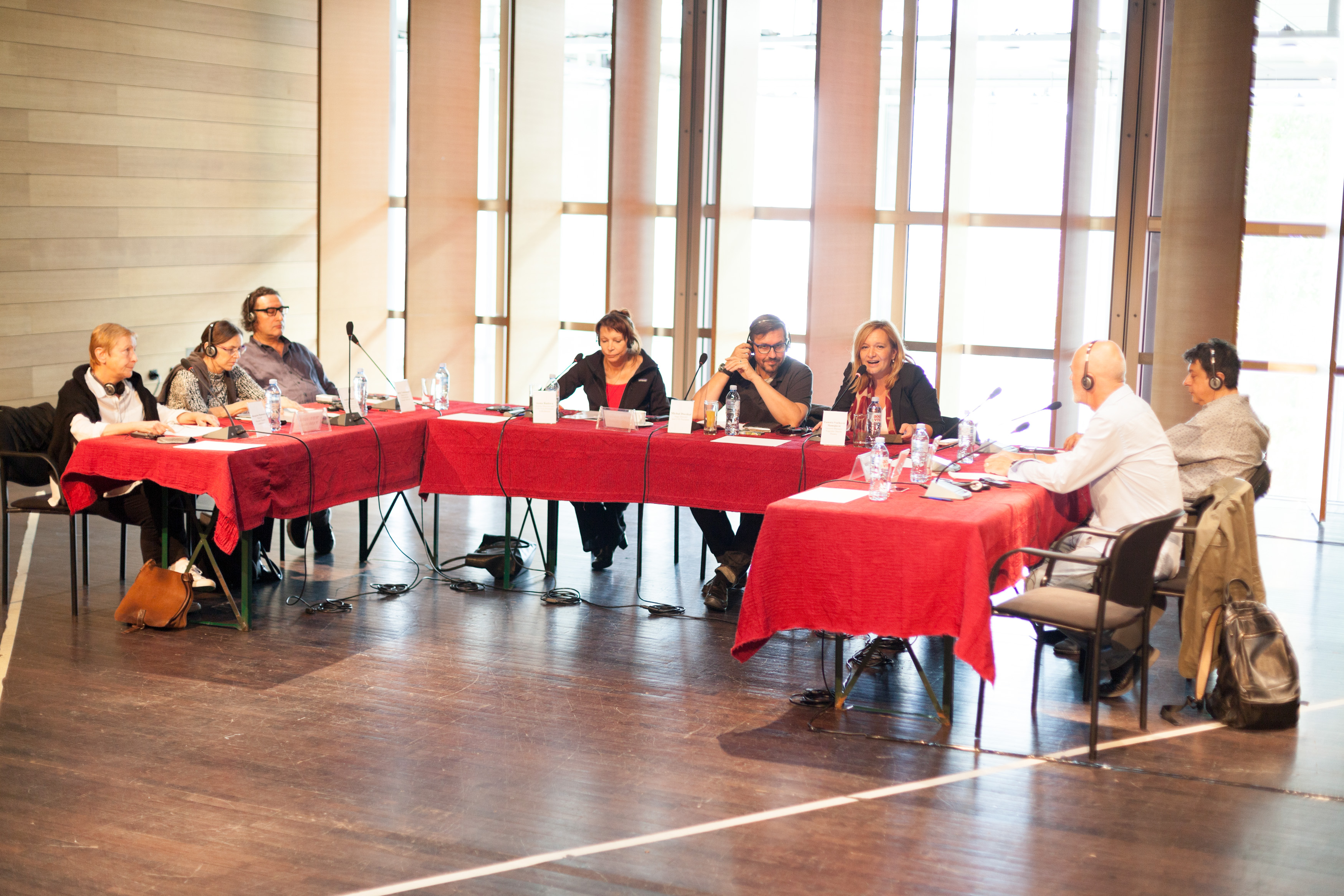
As the peak of the economic and financial crisis that paralyzed Europe during the last decade — to a greater or lesser extent, according to the strength and the resilience of national budgets — seems finally overcome (or so they say…), money is still the elephant in the room when it comes to analyzing the differing (and often conflicting) paradigms that rule the arts, and theatre in particular, in the European context. Indeed that’s how it felt a year ago in Milan, when the Union des Théâtres de l’Europe (UTE) held the first of its conferences on theatre structures, in an event that finally materialized not only the thousands of kilometers but also the thousands of euros that keep the Teatro Nacional de São João, in Porto, apart from co-members such as the Schauspiel Stuttgart or the Piccolo Teatro de Milano (eventually leaving some room for debate on the uncomfortable transit between theatre and politics in turbulent contexts such as Tunisia or Israel). And again, that’s how it felt a week ago in Belgrade, where the impact of the still ongoing shift from Eastern Europe’s hyper-regulated and hyper-centralized systems to a market economy was in the spotlight, framing the more or less converging experiences of Bulgaria’s Sfumato, Romania’s Teatrul Bulandra, Serbia’s Yugoslav Drama Theatre (JDP), Greece’s National Theatre of Greece in Athens, and Russia’s Stanislavsky Electrotheatre.
The price of adjusting to a new environment which is mostly defined by the state’s retreat and the scarcity of available funds is a common feature to most of the theatres working beyond the former Iron Curtain, despite regional differences. “We all face similar problems, but in the Serbian case they’re aggravated by the fact that the system itself is going through changes. Yes, we do need more funds—but we also need a new model”, said Tamara Vučković Manojlović, JDP’s general manager, right at the opening of the conference. “The laws that have recently been approved do not acknowledge the cultural sector’s specific characteristics, and public funds decrease as the idea that theatre must adapt to the principles of a market economy makes its way”, she added. Today, YDT’s ticket sales revenues make up for 18–22% of its total budget and the emphasis on diversifying the theatre’s sources of income has led to the frequent rental of its rooms, a side-activity which already represents a “substantial” cash flow.
Also in Bulgaria, where the State’s investment in the cultural sector remains at 0.5% of the country’s GDP, the funding mechanisms behind its 35 public theatres also began fluctuating according to the laws of the market. “Starting eight years ago, the budget of each and every theatre depends on the ticket sales—we’re now under the market’s Diktat”, Sfumato’s artistic director Margarita Mladenova argued. This new funding system, she explained, pushes theatres towards a serial production approach, eventually compromising long, experimental artistic processes, such as the ones that historically defined the Sfumato: “We’re strongly advised to rehearse less and sell more. Breeding new actors, new poetics and new aesthetics is currently marginalized.” Meanwhile, whole theatrical seasons gravitating around famous, crowd-pleasing TV stars abound, sacrificing the institutions’ long-established artistic identities: “To make sure they make enough money, directors cast ‘dancing bears’ [A/N popular TV actors] in the leading roles, and the remaining actors are forced to gravitate around them so they can be paid. It’s atrocious.”, Mladenova stated, advocating for a new funding system that may replace the “emphasis on consumerism” by highlighting artistic integrity and further regulating the local administrations’ financial contribution to Bulgaria’s theatrical landscape (the current set of rules favours rather arbitrary funding policies).
In Romania, where municipal budgets are a key-element to the survival of the country’s public theatre network (only national theatres are directly State-financed, and less than 0.8% of the GDP is invested in the cultural sector); the paradigm is changing, too. Bucharest is definitely a world apart—three million people, half of the country’s GDP, a billion-euro municipal budget, 28 cultural institutions, 14 city-funded theatres—, but outside the capital city survival is especially hard, Teatrul Bulandra’s Alexandru Darie pointed out. Both the market and the rules defining how to access the municipal funds (about 70–80% of the total budget, in Bulandra’s case) pave the way for an industrial, mass-production model: new productions tend to multiply (seven to ten per year being the current average) as the shows’ careers are downsized (a maximum of 10 to 15 sessions per show).
Meanwhile, on yet another front, the “extraordinary boom” of private theatres which proliferate in alternative venues is reshaping Romania’s theatrical landscape—“for better and for worse”, according to Alexandru Darie. “Private theaters are more likely to forgo legislation or evade their fiscal responsibilities and have lighter structures that tend to be more flexible and free from administrative constraints. So, it’s an unfair competition for public theatres, which only this year were again granted permission to hire new actors and technicians [in the aftermath of the 2008 crisis, this was strictly ruled out]. An actor we recently hired for a new production of Ivanov told us that while we were paying him about 100 euros a night for burning himself out and weighing two kilos less after each performance, a private theatre would pay him twice as much just to sit in a chair and tell jokes”, Bulandra’s artistic director reported. Then again, it’s also true, he admitted, that the freedom of action of the private arena has allowed for the appearance of “emerging talents (actors, directors, etc.) that are now finally permeating the public theatres”, eventually updating their repertoires and their theatrical languages”.
“At the moment, it is a war, but I hope that in the end the clash between these two worlds will benefit the public theatres”, Alexandru Darie summed up, endorsing a new framework in which these institutions “heavily controlled by the State and local administrations” (“We must demand permission for everything!”) can have higher flexibility and autonomy levels.
Just like in Bulgaria, a structural change also seems inevitable in Romania: “Maybe we must follow the examples set by Italy or Germany and redefine the status of our theatres, a move some of my colleagues are afraid of because they suspect change will mean less funding.” Anyway, the current legal framework has also proven insufficient as far as benefactors’ and sponsors’ incentives are concerned: “The system favours investing in festivals, which is where all the rich and nicely dressed people show up; nobody will care for the theatres’ daily activities unless the law is reformed.”
Transitioning
Meanwhile, in Vladimir Putin’s Russia, where State control assumes spookier nuances (as it has recently been underlined by the painful Kyril Serebrennikov’s case), the systemic shock caused by the collapse of the USSR seems far from digested. Part of the “enormous structure” set up by the communist regime in every corner of the country is still on—about 700 theatres are supported either by the State or the local administrations—, but in many cases (including the historical ballet and opera theatres of Moscow and Saint Petersburg, the Bolshoi and the Mariinsky) their dotation doesn’t even cover these institutions’ heavy operating costs (needless to say, fixed ensembles tend to be a sacred rule). In fact, and given the lack of resources, theatres are tangled in complex financial gymnastics, juxtaposing highly volatile public and private funds, said Boris Yukhananov, Stanislavsky Electrotheatre’s artistic director. “Government is very much for the establishment of benefactor councils for every theatre, and that’s how many companies survive. As for the municipal funds, they too tend to fluctuate according to the mayor’s preferences… But Voronezh is a fine example—and there are others—of the renaissance of a contemporary culture”, he mentioned. In this “gradual transitioning context from centralization to decentralization”, theatre is still overwhelmingly non-commercial: “Some commercial theatres try to be self-sufficient, but normally they don’t succeed.”
The Stanislavsky Electrotheatre is one of those examples of cross-pollination between public and private dotation. Established more than a century ago, in 1915, it was one of the first grand cinemas in Moscow before eventually becoming Konstantin Stanislavsky’s studio; since 2013 it’s Boris Yukhananov’s new home, a multidisciplinary venture where theatre, opera and music converge. “In early 2013, the theatre was in a very delicate situation and the city of Moscow ran a public competition for the post of artistic director; I applied and got appointed. In theory, the city would provide all the funding, but I would never choose that kind of slavery to the authorities, if only for the fact that our artistic visions don’t match. Presently, the city feeds our budget with one million euros while the remaining five or six million euros come from benefactors”, the director went into detail. Total investment in the reconstruction of the theatre is in the vicinity of one billion rubles, he added. “If we manage to prove we double as an opera theatre, we may double the current dotation”, Boris Yukhananov said, highlighting “the important work” that the Stanislavsky Electrotheatre has developed with contemporary composers.
The eye of the crisis
Although in the Eastern countries the cumulative effect of the ongoing paradigm shift and the economic crisis has aggravated the inevitable growing pains, no European country has been more deeply affected by the financial decay than Greece. Stathis Livanthinos, National Theatre of Greece’s artistic director, came to Belgrade to tell us about survival in the eye of the crisis, with less than half of the good old days’ budget to manage (the institution’s dotation declined from 12 to six million euros), and no chance of easing the burden of its expensive staff structure (250 workers and a permanent ensemble of one hundred actors), whose salaries currently consume all the available funds—ticket sales are the only source of funding for theatre production itself. “It’s a feature of the National Theatre of Greece Basic Law, which has been approved in the 90s. I tried to change that rule, because, as you can imagine, it’s extremely difficult to survive given these conditions, but the idea is that in times of crisis there should be at least a place where Greek actors can work and get paid”, he explained.
The budget’s drastic downsizing threatens the National Theatre of Greece’s main mission, since its ability to reach beyond the city of Athens and to penetrate the whole country is now weakened: “The National Theatre of Greece is in danger of becoming just the National Theatre of Athens; the current financial situation makes it very hard to be present on a national level.” Besides, the crisis has also undermined the State’s ability to support theatrical activity: “The Ministry of Culture used to subsidize theatres across the country. It’s over now. Only the National Theatre of Greece and the National Theatre of Northern Greece [A/N also a member of the UTE] are State-financed. In fact, the percentage of the national budget that is available for culture is so low that I’m ashamed to quantify it.”
Relying on ticket revenues to finance new productions, and at the same time seriously constrained by the audience’s declining purchasing power (which eventually forced the institution to implement a new reduced price policy, so the common Greek could still afford going to the theatre), the National Theatre of Greece can no longer guarantee its quality standards. And that’s also due to the fact that the legal framework does not suit the attraction of new, alternative sources of income: “A few years ago I started looking for sponsors and benefactors, but we need more adequate legislation. Some companies did give us money because they like what we do, but all that we can give them back is some publicity in our programmes… and so the National Theatre of Greece risks seeing its name being swallowed up by private companies and losing its public character”, Stathis Livanthinos argued.
Not everything is tragic in the country where tragedy was invented, though: the crisis years were also, paradoxically, years of theatrical abundance, with an average of a thousand new shows per year just to mention Athens (even if in many cases the artists did not get paid) and finally, “for the first time in too many years”, the Ministry of Culture could hand out about 100 million euros to independent theatre companies.
Over the rainbow
But there is a parallel universe in this story—and it belongs in Europe, too. A parallel universe where talking about theatre doesn’t necessarily mean “talking about money” (“which, besides being unpleasant, is incorrect”, as Stathis Livanthinos pointed out). Luxembourg, for instance, whose young national theatre was established in 1996 after the overwhelming success of the European Capital of Culture of the preceding year. Frank Hoffmann, director (and founder!) of Théâtre National du Luxembourg, did not come to Belgrade to speak about funding but to discuss issues of mission and identity in a small country of 500 thousand inhabitants where almost half of the population is of foreign origin and speaks another language.
Vienna’s Volkstheater is also a world apart—as is the entire theatrical landscape of Austria, a topic that another article of this online magazine will further develop. So apart from that, somewhere over the rainbow, many million euros away, as Theatre and Dance Unit Chief at the Arts and Culture Department of the Federal Chancellery, Andrea Ruis, and Volkstheater’s artistic director, Anna Badora, described “the best system in the world” (Badora’s words) the remaining speakers finally found the good news they were so desperate to bring back home.
Published on 29 September 2017 (Article originally written in Portuguese)