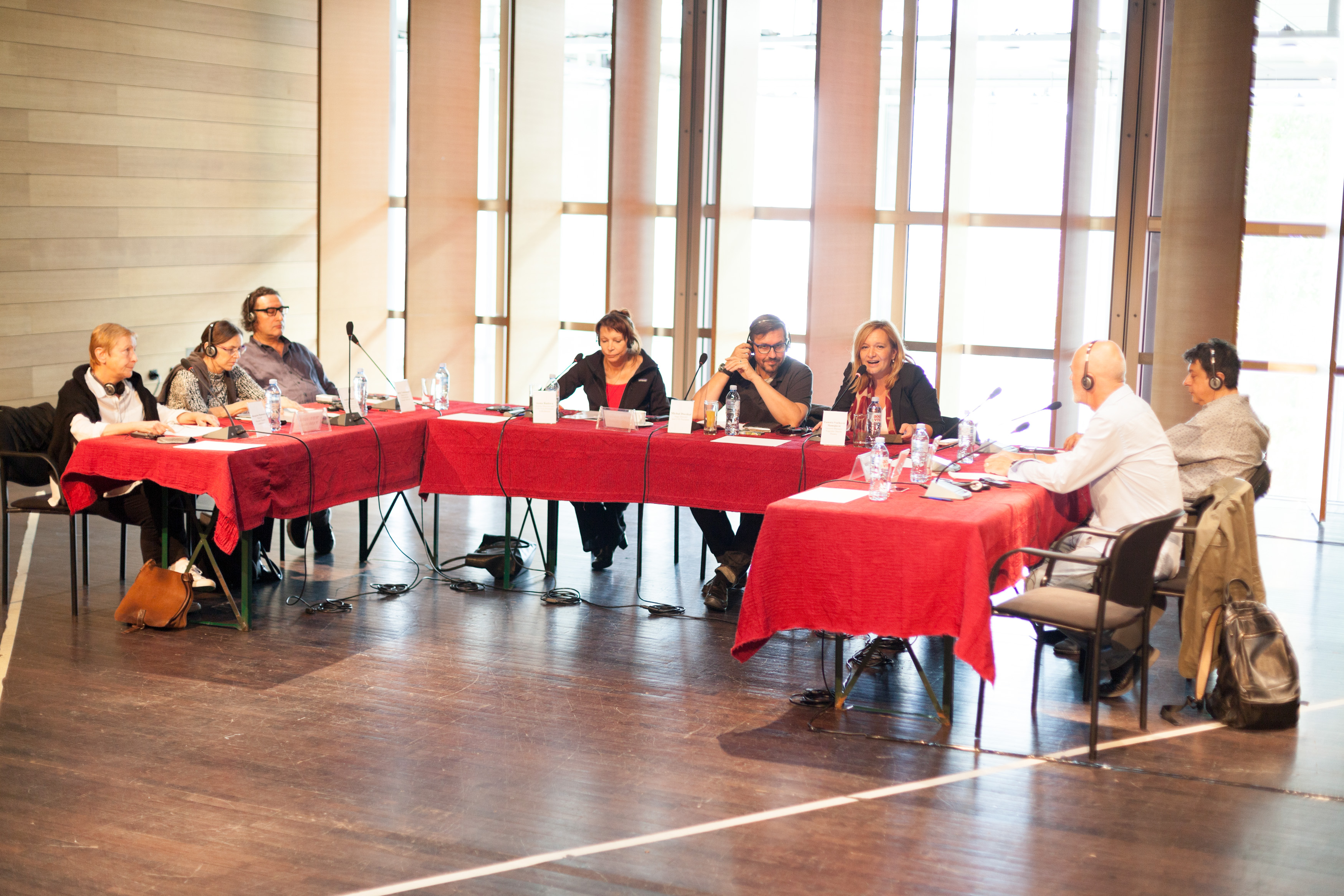
S.O.S. Encapsulation… or the Soul after Victory III
S.O.S. Encapsulation… or the Soul after Victory III

© Herwig Lewy

The riddle of the International Theatre Festival is its name: Interferences. This year’s sixth edition of the biennial tournament for collective representations in Cluj-Napoca, which has been held every two years since 2008, deals with the theme of war. From the 22nd to the 30th November 2018, 16 ensembles from 13 countries met in Transylvania, a cultural interface below the Carpathian Arc since antiquity.

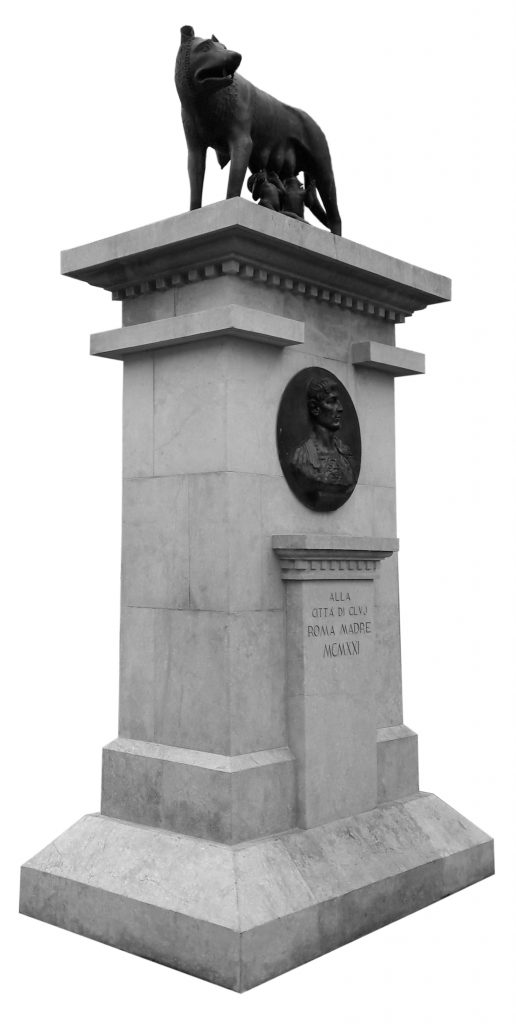
The cultural diversity and multilingualism can be felt at every corner of the city. It is home to various spaces of experience of distant pasts, which in their linguistic expression meets daily today in Hungarian, Romanian and sometimes also in German. The memorial culture of the city with the name triangle amazes and wonders visitors at the everyday overlays, because besides Cluj-Napoca there are also the names Kolozsvár and Klausenburg. Thus, the two city centres, a Hungarian and a Romanian one, are connected with each other by a street on which the sculpture of a myth was placed. It is the myth of the founding history of Rome – a she-wolf feeding Romulus and Remus on a marble-covered pedestal with a portrait of Trajan, including the inscription: Alla Citta di Cluj – Roma Madre – MCMXXI. The visitor is confronted with the question: Is this still young memorial a reminiscence of 1921, staging Rome as a matrilineal origin for the city of Cluj-Napoca?

Time is Convention

Anyone looking at the sculpture from outside looks for words to understand what kind of représentation finds expression here. Judging by everyday political standards, it may well have been the intention to create sense to meet the challenges after the turn of 1989/1992. However, a link to the founding myths of the nation-building process after Romania’s founding one hundred years ago as a result of the Versailles peace negotiations has attracted too much social attention. Festival director Gábor Tompa, at the opening of the festival in the Hungarian theatre of Cluj-Napoca, gives a hint, both in his address in the festival catalogue and in his personal address: the theme of the festival is war. One hundred years has passed since the end of the First World War, whose peace negotiations dramatically and tragically rearranged the map of Europe. At the same time, however, they also prolonged warlike conflicts indefinitely until today. – In his speech, he directly asks the audience the question: “How can we remember war in ways other than that losers remember losers? – Because in a war there are no winners,” says Tompa.

From the spectator’s point of view, his suggestion makes the facets of the festival programme comprehensible much more quickly. The chosen season in the festival calendar is the time of mental heaviness in Europe. Autumn passes into winter and the days become shorter. And outside only fog circulates. Theatre as a festival needs such a stable sacred anchor, which is realized anew in a periodic sequence depending on the season. The word “sacred” floats in my mind as I listen attentively to Tompa’s words in the auditorium as I leaf through the catalogue, creating a certain sense of time and space. I’m thinking of Henri Hubert’s essay on La représentation du temps dans la religion et la magie from 1904, read recently on my tablet. Those who get involved with the festival events leave the normal space-time feeling of everyday life. The sacred space-time order captures a feeling of infinity and immutability. Such a joint search for sense in theatre competes with the fixed memorial culture, which wants to present stability as an unchangeable factor for everyday life as obligatory; a demand that is strived for in everyday life, but rarely fulfilled.

The theatre, which has its origins in magic, has its own unfixed foundation of meaning. It is an open project, a search for sense. If one accepts the festival from the spectator’s point of view, one agrees with sacred space-time. Tompa’s choice of pieces is based on this common search for meaning under the sign of a shared time and a shared space when he writes in his address in the festival catalogue: With the various types of war, it is important to speak of a theatre of fright. The terrible trauma caused by violence would call for an individual and collective “exorcism”. The fixed point of the search for meaning lies in the similarity between war and theatre, for they are the reciprocal actions of two opposing forces.

Scrape That Fiddle More Darkly

The selection of the various directorial manuscripts from different theatre families in Europe stands for the side of change, self-assessment and collective responsibility. Absorbing a few festival days demands a higher level of attention from visitors from outside and the admission that they can’t see everything. The simultaneous presence of English, French, Romanian and Hungarian, the languages of the guest performances, such as German, Greek, Hebrew, Italian, Lithuanian, Polish, Russian and Serbian, will also be added. There is a closely timed main programme in the main hall and in the studio. There is a supporting programme in the Tiff House, in the Tranzit House, in the Paintbrush Factory and in the Quadro Gallery. There are exhibitions and concerts. And for the first time there was a technical interference called Digital Hermits. This conference at the Tranzit House tried to explore the use of digital technologies and their impact on the coexistence of people in our world. A contribution on war that takes into account the consequences of the Cold War, when the Internet was born, to ensure communication between entities after a nuclear fallout. The focus was on user interfaces – also known as new media – and their own spaces of experience in and with time and space. It was seen as problematic that the dialogue between the generations leads to a dichotomy between the group of people who live completely without digital technologies and the group who no longer want to shape life without them. The connection of passions to the filter bubbles and echo chambers of the digital world unfortunately failed to materialize.

One question that has always been virulent for the two-thousand-year history of theatre is: How do people behave in war? – In a collapse crisis, laughter and crying not only alternate, they can also occur simultaneously. One person’s suffering is the other’s only short joy until the perspectives change and the persecutor becomes the persecuted. Milo Raus shows with his work Compassion. The history of the machine gun an impressice teichoscopy, to which the dramatic elements of the Greek tragedy are reduced. In it, this change of perspective is performed in a loop. The actress Ursina Lardi from the ensemble of the Schaubühne am Lehniner Platz in Berlin plays herself as a young development aid worker in Rwanda, where she witnessed the Hutu genocide of the Tutsi. Later she finds out that the person she helped became the perpetrator. The Belgian actress Consolate Sipérus also plays herself. As a baby, she was adopted by a Belgian couple. More than the country of origin, Rwanda, and the catalogue with the baby faces that can be chosen for adoption are not known to her. From the viewer’s point of view, this enormous amount of social facts is hardly bearable. And Lardi tells of the theatres of war with impressive power of speech and physical presence, as if she has just observed this quantity of irrational actions.

By représentation, Hubert means exactly this sacred time level. Just as in the auditorium on my tablet I work on an over one-hundred-year-old text in order to pursue questions of understanding about what is happening on stage, Lardi and Sipérus create a public sphere. Not just a public speech act, that is, one that can be seen by everyone, is performed here, at the same time an understanding of the event opens up for other group members who are not directly involved in the actual action. Now and here we take an insight into the events that took place on another continent in 1994. This is the quality of the festival, with which the riddle of the name, Interferences, is solved: it is the coincidence of all time levels in the concept of humanity. The model upheld in Europe since the Renaissance breaks itself in the face of the horrors of precisely this persistent humanity, no matter what skin colour, language, culture or religion it claims to be right and good for itself. The Greek drama models serve this quality.

Anna Badora of the Volkstheater Wien (Vienna Volkstheater) has created a link between antique representational drama and post-dramatic attempts to cope with the European present in Renaissance style. She stages an Iphigenia in Aulis by Euripides in the format of the Golden Ratio, in which Iphigenia is actually sacrificed at the end of the first part, with which the tragedy of Euripides, which for us has only been handed down as a fragment, ends. The war really begins with Badora. While the battle rages, we spectators go to the toilet or to the fresh air. From the two thousand years in the past we fall in the second part into the Syrian present. Here, Stefano Massini’s text Occident Express serves as the basis for a play for the same actors who are now making their way to Europe as civil society from the war zones in Iraq and Syria.

It is said that waves of crisis lead to a learning process. Gabor Tompa shows in his in-house production of William Shakespeare’s Merchant of Venice that limits are inherent in this learning process. The fact that both actors, Gábor Viola and Zsolt Bogdán, can play both the role of Antonio and that of Shylock as respective double casts bears witness to the deep empathy for the characters that is necessary to represent sacrificial rituals. Antonio, whose sadness at the beginning may not be revealed to the audience until the end of the piece – at the beginning it is not business or love that causes his suffering – it is the quotations of the milieus and their internal morals made by Tompa in his soundscape installation, who let Antonio be as obviously sad as the mirror-inverted despair of Shylock, whose sacrifice in the end – analogous to Iphigenia’s sacrifice – is needed to restore that very internal morality after the group has gone through a common crisis. Antonio, like his alter ego Agamemnon (father of Iphigenia and at the same time commander who sacrifices his daughter), represents in this sense the permanent depression of a human being who knows that it always seeks the good, but at the same time always creates the bad.

Fatherland

The “exorcism” of the festival, which was the goal, took on a physically concrete form collectively and practically with the staging Vaterland in the choreography of Csaba Horváth and the stage design of Csaba Antal. The Forte Company presents text elements from Thomas Bernhard’s The Italians in a rhythmic and sporty sequence of scenes that gesturally play the timbres of Bernhard’s model. Bernhard, who in his will still wanted to ensure that no text, neither novel nor stage text, narrative or poem, would ever appear in Austria, was at war with the eccentric way of his fellow countrymen dealing with National Socialist traditions. The staging succeeds in allowing Bernhard to be regarded as the master of plastic surgery of collective passions that are unquestioned in memorial culture or devotional objects. Whether a geographical space is assigned a patrilineal or matrilineal original character is actually uninteresting.

In this way, the festival creates a concrete link to the themes of past years. Whereas in 2014, for example, it was still necessary to report on the stories of the body, this year the theme of war captures the passions in a way that suggests new approaches to the content of security policy measures, which are often difficult to understand in everyday life. The experiment on the formal side, such as Milo Rau’s, of exclusively exhibiting teichoscopy, seems all too minimalistic. We do not know whether the actress Ursina Lardi was really in Rwanda and whether Consolate Sipérius was really adopted. Here documentary theatre finds its limits in fictionality and has to compete with the classics, the timelessly valid dramas since antiquity. Mere indignation could perhaps have been problematized in connection with the digital filter bubbles and their echo chambers. But then the acting characters, whose limitations and weaknesses in Euripides or Shakespeare were excellently designed and presented in their plot constraints and intentions, would also have had to have been worked out more precisely in Milo Rau’s work. There are no spaces free of experience, even if the widespread contemporary encapsulation à la New Media and the generation conflicts associated with it might suggest it.

When a ship is rescued, the SOS emergency call is made beforehand and the bodies are rescued. The Interferences International Theatre Festival reminds us that the purpose of the SOS emergency call is to save souls. It demands their participation, a shared attention. An encapsulation in technical terms or as usual in analogue memorial culture, on the other hand, leads to isolation with fixed values of collective internal morals and their obligatory victims. By rejecting such tendencies of isolation, the theatre festival leads the search for meaning and sense in Cluj-Napoca.

Contrary to what the sculpture of the founding myth of the city of Rome and its staged history of origin suggests for Cluj-Napoca, the theatre has understood the origo principle. Florence Dupont can read about this punch line on the “monument” to Romulus and Remus: Rome – city without origin. The punchline is: there is no origin. There is only one diversity in mutual respect and recognition. This is what the origo principle stands for. Interferences is also the name for an unfinished search for sense. Theatre is and remains an open project, both in terms of content and form.

Published on 21 January 2019 (Article originally written in German)

Digital Hermits

Digital Hermits

© Valik Chernetskyi

“Digital Hermits”. Quite an oxymoron. Because, nowadays, no one could possibly consider him/herself a “hermit” within the digital realm. We are always tracked, chased, captured by complex calculation systems aimed to define us on the basis of what we like, what we look for, what we would desire to be, instead of what we actually are.

Digitisation I: Digital Hermits was the title of a very dense and compelling conference, the first of four: organized in Cluj-Napoca (Romania) in the frame of Digital Natives, a cooperation project between five of the UTE’s member theatres—Volkstheater Wien, Comédie de Reims, Hungarian Theatre of Cluj, Schauspiel Köln and National Theatre of Northern Greece.
Concord Floral by Jordan Tannahill (which premiered at Schauspiel Köln on 16 November 2018) is “a play about teenage identity and interactions, the power of perception and technology.” Each of the five theatres involved is going to stage a production or use the themes of the play as the basis for workshops with amateur teenage actors. A series of “digital experiments” will be the outcome of such collaboration and three other conferences will take place throughout the course of the project.
During the Interferences Festival 2018, produced by the Hungarian National Theatre in Cluj, three speakers were invited to share their thoughts about being part of this “new” digital turmoil: Mária Bernschütz, Tamás Trunk and Valér Veres. Three very different contributions, able to draw a multi-coloured picture of the numerous ways to approach digital cultures.

We all know our birthday, there’s no doubt about it. And yet, how sure are we about our role in the digital society? How closely are we watching the technological evolution, how aware are we about our influence in establishing a shared model of “living in the digital era”?
Mária Bernschütz presented an executive summary of which are the generations involved in the digitization process. Based on the so-called ‘generational theory’—initiated by two American historians, William Strauss and Neil Howe—Bernschütz’s speech tried to inscribe our “agency” in five categories, through which we should be able to locate our presence in the development of digital culture.

Ms. Bernschütz is Assistant Professor at the Department of Management and Business Economics (Budapest University of Technology and Economic), she teaches marketing media and research methodology. Her vivid contribution was aimed to show how technology influences individuals in their everyday lives. Feeling sorry for a rather rough generalization, Mária Bernschütz presents a sort of rationalistic scheme, that reveals how technological development could be used as a barometer for measuring generational gaps, according to age range.
“Do you know which generation you belong to?”, that’s the basic question of this inquiry, which is based on an in-depth qualitative research conducted on Hungarian society.
According to the results, the “Veterans” were born before 1946; the “baby boomers” were born after the Second World War and are the most involved in the reconstruction of the world after that disastrous event; they are evaluated as “the most technophobic” group. Generation X—between 1965 and 1979—is considered as the one of the “digital immigrants”: they came in touch with technology as adults. Generation Y—between 1980 and 1995—gathers people who were attending secondary school or were just enrolled in university when they have learned about “new media”; they are now quite used to smartphones and tablets. Members of the Generation Z were born between 1996 and 2000: they don’t even use pens or pencils anymore, Internet has been a part of their everyday lives from the very beginning. The latest one is the Alpha Generation—including children born after 2010—who is already in charge of teaching their parents how to deal with technology.
Ms. Bernschütz talks about “tasks” and “advantages”, which seem to be two fundamental categories to distinguish between our personal and private attitudes to technology and our willingness to be part of it.

Beyond any possible kind of generalization, the reality looks much more complicated: we are all addressed by a sort of ‘collective call’: we all hold a special responsibility in translating our own cultural values into comprehensive statements, devised and conveyed through technological tools. A brilliant example is suggested by the way the performing arts are communicated, today, in the frame of the so-called ‘information society’. On the one hand, the good health of the theatrical system could be evaluated through its capacity in engaging audiences and attracting fresh theatregoers; on the other hand, it would be really hard to detach the virtual communities from the physical ones, that, however, prove to be vivid and tenacious. They underline the very essence of theatricality, the fact that artists and spectators share the same space during the same time.

Mária Bernschütz’s speech, even though deriving from a very specific research sample, was crucial in gaining an impartial view of how different generations of ‘users’ currently deal with the digital environment; and yet, everyone in the room was asked to develop personal insights, trying and locate themselves in this or that generation, becoming part of a sort of ‘common sense’ of participation.
If Generation X is labeled as “very enthusiastic”, responsible for initiating “the revolution” and refusing “strict rules within their working space”, the members of Generation Y “don’t respect the leader’s judgmental language” and are not always able to “find what they are looking for”, locate their own values, establish their connections with other colleagues and “understand how one could actually be ‘disconnected’”. They want trust, and, in this quest, they experience a sort of anxiety. The members of Generation Z are already much more “money-oriented”, because they were “born after the global crisis”. And, by now, they only want to succeed.
It’s not very easy to detect which generation we belong to, until a young man, an honest citizen of the ‘Z-realm’, takes the stage.

As he grabs the microphone, Tamás Trunk definitely looks like the ‘minister’ of Generation Z. He speaks a very good English, with a clear and smart American accent; he handles a remote control to show us a brief yet effective gallery of slides on the wide screen at the rear of the stage; which he doesn’t even look at, but he masters beautifully.
His tone is colloquial, fast, high-pitched, rhythmic and captivating. Tamás Trunk is passionate with sneakers and youngsters’ culture, he’s a ‘professional YouTuber.’ As a matter of fact, he’s an ‘influencer’, and he looks like one, although he doesn’t wear sneakers this particular day, but a fashionable and elegant outfit, laced shoes under a big smile on his face.
He refers to the “grown-ups”, as if he wanted to mark a distance; he himself grew up “globally and digitally”, his generation was the first to be “completely connected”. The easiest impression, he reckons, is that Generation Z can “consume, drink, and eat the same food and beverages and use the same products all over the world.”

Is this what being connected means? Are we actually all the same? Do we really look alike?
“No, this doesn’t mean that we are all the same”, says Trunk. “We are probably the most diverse generation ever. And, yeah, we actually love to show that.”
In the map pictured by Tamás Trunk, the digital world is, in a first place, an opportunity to connect with each other. But the most evident feature is that this connection is guaranteed by the choice of ‘to be or not to be’ affiliated with this or that brand.
If the pioneers of media and Internet studies would draw a line between online and offline world, we all saw those borders being rapidly eroded. The advent of social media, integrated with mobile communication, brought the online realm straight to our palms, and we became more and more dependent on the interface, in order to interact with our daily reality.
Immediacy embraced hypermediacy and the combination of the two gradually generated new layers of reality: hardware and software played together in offering the users a new form of virtual
experience which can no longer be distinguished. As Bolter and Grusin wrote in their seminal essay Remediation, today, “digital hypermedia seek the real by multiplying mediation so as to create a feeling of fullness, a satiety of experience, which can be taken as reality.”

In Trunk’s talk, that reality seems to be based on the opportunity of being part of a network. And yet, it’s surprising how, in his vision, such network is essentially shaped on market logic, based on buying and selling, advertising and branding. “Brand” is, in fact, one of the most frequently used words in the young man’s speech.
One of the slides shows a photo of a group of ‘hippies’ from the Seventies. To the speaker, this is a symbol of revolution, to which he compares a contemporary attitude: “Sometimes I hear that my generation doesn’t want to rebel anymore, that we all just want to be the same, and go with the flow. The reality is that, in this digital world, we don’t rebel against the same things, nor using the same symbols, such as alcohol or drugs.” Brands and fashion seem to offer a new way of provoking social attention and promoting “equality and equal treatment for all of us.”

Trunk’s enthusiasm is contagious, and yet it seems to be irresistibly kneeling to the altar of the Market, understanding Internet and the social media as a way to establish a sort of network of consumers. “Brands want all of us to buy their products and we actually like these companies.” These symbols of “a huge consumer’s world” apparently grant a sense of belonging to the younger generations. “Together,” says Trunk, “we can work a lot and create amazing movements and projects that, we feel, are actually ours.”
Thus, these “digital natives” need certain kinds of “movements” and “brands”, to compose “an amazing community”, able to activate a wide “secondary market”, where very young people can start their own business and, reselling items for “way bigger prizes”, make a lot of money. We are suddenly talking about millions of dollars.
Many of these youngsters don’t connect with each other in real life, and yet, in Trunk’s opinion, “online world is an extension of the real world.”

For the question time, moderated by Gergő Mostis from Kreatív Kolozsvár, also the sociologist Valér Veres is invited to the table. It’s the right moment to reconnect the accurate ‘generational study’ conducted by Mária Bernschütz with Tamás Trunk’s passionate storytelling, that some ways presented a case history of his own generation.
In his book The Virtual Communities (1993), Howard Rheingold thinks of cyberspace “as a social petri dish, the Net as the agar medium, and virtual communities, in all their diversity, as the colonies of microorganisms that grow in petri dishes.”
Rheingold’s metaphorical description of cyberspace is proven to be true when one looks at the technological and rhetorical architecture of social networks. Founded as these are on an individual selection of data to be read and written, they represent very complex instruments in charge of managing a large amount of “information as social and cultural objects”. And yet, the development of citizen journalism, net-art and online activism has demonstrated how strong and effective such kind of connections between users can be.

Mária Bernschütz thoroughly summarized how the “generation gap” is still present, and yet, technological development is a process that has no memory and tends to erase the past. In a couple of decades, the so-called “world” (because also this term should be confronted with a still huge ‘digital divide’) is going to be populated by different generations that will have the exact same relation to technology.
Language, so diverse in its references from speaker to speaker, set the tone for a fugitive imagery. In a digitised world, made of weak ties, language and modes of interaction should be considered as a mind-expanding technology; digital media must then be seen as a physical support for the export of language. In the words of Derrick DeKerckhove, in a system of interconnected and composite competences, “the more the discourse gets decentralized, the deeper is the change in the conventional definitions and relations.”
And this could be a good starting point to compose a new view of the “world”. A world defined by connection and relation, in which, really, no one could possibly consider him/herself a “hermit”.

Published on 16 January 2019

The Rich and the Poor: Coming Together and Drifting Apart in the European Theatrical Landscape

The Rich and the Poor: Coming Together and Drifting Apart in the European Theatrical Landscape

Money (or the lack of it) was a recurring issue during the second conference on theatre structures promoted by the Union des Théâtres de l’Europe. Between the State and the market, financial gymnastics tends to be the rule — but there are some exceptions.

Conference on Theatre Structures at the Yugoslav Drama Theatre in Belgrade, Serbia

As the peak of the economic and financial crisis that paralyzed Europe during the last decade — to a greater or lesser extent, according to the strength and the resilience of national budgets — seems finally overcome (or so they say…), money is still the elephant in the room when it comes to analyzing the differing (and often conflicting) paradigms that rule the arts, and theatre in particular, in the European context. Indeed that’s how it felt a year ago in Milan, when the Union des Théâtres de l’Europe (UTE) held the first of its conferences on theatre structures, in an event that finally materialized not only the thousands of kilometers but also the thousands of euros that keep the Teatro Nacional de São João, in Porto, apart from co-members such as the Schauspiel Stuttgart or the Piccolo Teatro de Milano (eventually leaving some room for debate on the uncomfortable transit between theatre and politics in turbulent contexts such as Tunisia or Israel). And again, that’s how it felt a week ago in Belgrade, where the impact of the still ongoing shift from Eastern Europe’s hyper-regulated and hyper-centralized systems to a market economy was in the spotlight, framing the more or less converging experiences of Bulgaria’s Sfumato, Romania’s Teatrul Bulandra, Serbia’s Yugoslav Drama Theatre (JDP), Greece’s National Theatre of Greece in Athens, and Russia’s Stanislavsky Electrotheatre.

The price of adjusting to a new environment which is mostly defined by the state’s retreat and the scarcity of available funds is a common feature to most of the theatres working beyond the former Iron Curtain, despite regional differences. “We all face similar problems, but in the Serbian case they’re aggravated by the fact that the system itself is going through changes. Yes, we do need more funds—but we also need a new model”, said Tamara Vučković Manojlović, JDP’s general manager, right at the opening of the conference. “The laws that have recently been approved do not acknowledge the cultural sector’s specific characteristics, and public funds decrease as the idea that theatre must adapt to the principles of a market economy makes its way”, she added. Today, YDT’s ticket sales revenues make up for 18–22% of its total budget and the emphasis on diversifying the theatre’s sources of income has led to the frequent rental of its rooms, a side-activity which already represents a “substantial” cash flow.

Also in Bulgaria, where the State’s investment in the cultural sector remains at 0.5% of the country’s GDP, the funding mechanisms behind its 35 public theatres also began fluctuating according to the laws of the market. “Starting eight years ago, the budget of each and every theatre depends on the ticket sales—we’re now under the market’s Diktat”, Sfumato’s artistic director Margarita Mladenova argued. This new funding system, she explained, pushes theatres towards a serial production approach, eventually compromising long, experimental artistic processes, such as the ones that historically defined the Sfumato: “We’re strongly advised to rehearse less and sell more. Breeding new actors, new poetics and new aesthetics is currently marginalized.” Meanwhile, whole theatrical seasons gravitating around famous, crowd-pleasing TV stars abound, sacrificing the institutions’ long-established artistic identities: “To make sure they make enough money, directors cast ‘dancing bears’ [A/N popular TV actors] in the leading roles, and the remaining actors are forced to gravitate around them so they can be paid. It’s atrocious.”, Mladenova stated, advocating for a new funding system that may replace the “emphasis on consumerism” by highlighting artistic integrity and further regulating the local administrations’ financial contribution to Bulgaria’s theatrical landscape (the current set of rules favours rather arbitrary funding policies).

In Romania, where municipal budgets are a key-element to the survival of the country’s public theatre network (only national theatres are directly State-financed, and less than 0.8% of the GDP is invested in the cultural sector); the paradigm is changing, too. Bucharest is definitely a world apart—three million people, half of the country’s GDP, a billion-euro municipal budget, 28 cultural institutions, 14 city-funded theatres—, but outside the capital city survival is especially hard, Teatrul Bulandra’s Alexandru Darie pointed out. Both the market and the rules defining how to access the municipal funds (about 70–80% of the total budget, in Bulandra’s case) pave the way for an industrial, mass-production model: new productions tend to multiply (seven to ten per year being the current average) as the shows’ careers are downsized (a maximum of 10 to 15 sessions per show).

Meanwhile, on yet another front, the “extraordinary boom” of private theatres which proliferate in alternative venues is reshaping Romania’s theatrical landscape—“for better and for worse”, according to Alexandru Darie. “Private theaters are more likely to forgo legislation or evade their fiscal responsibilities and have lighter structures that tend to be more flexible and free from administrative constraints. So, it’s an unfair competition for public theatres, which only this year were again granted permission to hire new actors and technicians [in the aftermath of the 2008 crisis, this was strictly ruled out]. An actor we recently hired for a new production of Ivanov told us that while we were paying him about 100 euros a night for burning himself out and weighing two kilos less after each performance, a private theatre would pay him twice as much just to sit in a chair and tell jokes”, Bulandra’s artistic director reported. Then again, it’s also true, he admitted, that the freedom of action of the private arena has allowed for the appearance of “emerging talents (actors, directors, etc.) that are now finally permeating the public theatres”, eventually updating their repertoires and their theatrical languages”. 

“At the moment, it is a war, but I hope that in the end the clash between these two worlds will benefit the public theatres”, Alexandru Darie summed up, endorsing a new framework in which these institutions “heavily controlled by the State and local administrations” (“We must demand permission for everything!”) can have higher flexibility and autonomy levels.

Just like in Bulgaria, a structural change also seems inevitable in Romania: “Maybe we must follow the examples set by Italy or Germany and redefine the status of our theatres, a move some of my colleagues are afraid of because they suspect change will mean less funding.” Anyway, the current legal framework has also proven insufficient as far as benefactors’ and sponsors’ incentives are concerned: “The system favours investing in festivals, which is where all the rich and nicely dressed people show up; nobody will care for the theatres’ daily activities unless the law is reformed.”

Transitioning

Meanwhile, in Vladimir Putin’s Russia, where State control assumes spookier nuances (as it has recently been underlined by the painful Kyril Serebrennikov’s case), the systemic shock caused by the collapse of the USSR seems far from digested. Part of the “enormous structure” set up by the communist regime in every corner of the country is still on—about 700 theatres are supported either by the State or the local administrations—, but in many cases (including the historical ballet and opera theatres of Moscow and Saint Petersburg, the Bolshoi and the Mariinsky) their dotation doesn’t even cover these institutions’ heavy operating costs (needless to say, fixed ensembles tend to be a sacred rule). In fact, and given the lack of resources, theatres are tangled in complex financial gymnastics, juxtaposing highly volatile public and private funds, said Boris Yukhananov, Stanislavsky Electrotheatre’s artistic director. “Government is very much for the establishment of benefactor councils for every theatre, and that’s how many companies survive. As for the municipal funds, they too tend to fluctuate according to the mayor’s preferences… But Voronezh is a fine example—and there are others—of the renaissance of a contemporary culture”, he mentioned. In this “gradual transitioning context from centralization to decentralization”, theatre is still overwhelmingly non-commercial: “Some commercial theatres try to be self-sufficient, but normally they don’t succeed.”

The Stanislavsky Electrotheatre is one of those examples of cross-pollination between public and private dotation. Established more than a century ago, in 1915, it was one of the first grand cinemas in Moscow before eventually becoming Konstantin Stanislavsky’s studio; since 2013 it’s Boris Yukhananov’s new home, a multidisciplinary venture where theatre, opera and music converge. “In early 2013, the theatre was in a very delicate situation and the city of Moscow ran a public competition for the post of artistic director; I applied and got appointed. In theory, the city would provide all the funding, but I would never choose that kind of slavery to the authorities, if only for the fact that our artistic visions don’t match. Presently, the city feeds our budget with one million euros while the remaining five or six million euros come from benefactors”, the director went into detail. Total investment in the reconstruction of the theatre is in the vicinity of one billion rubles, he added. “If we manage to prove we double as an opera theatre, we may double the current dotation”, Boris Yukhananov said, highlighting “the important work” that the Stanislavsky Electrotheatre has developed with contemporary composers.

The eye of the crisis

Although in the Eastern countries the cumulative effect of the ongoing paradigm shift and the economic crisis has aggravated the inevitable growing pains, no European country has been more deeply affected by the financial decay than Greece. Stathis Livanthinos, National Theatre of Greece’s artistic director, came to Belgrade to tell us about survival in the eye of the crisis, with less than half of the good old days’ budget to manage (the institution’s dotation declined from 12 to six million euros), and no chance of easing the burden of its expensive staff structure (250 workers and a permanent ensemble of one hundred actors), whose salaries currently consume all the available funds—ticket sales are the only source of funding for theatre production itself. “It’s a feature of the National Theatre of Greece Basic Law, which has been approved in the 90s. I tried to change that rule, because, as you can imagine, it’s extremely difficult to survive given these conditions, but the idea is that in times of crisis there should be at least a place where Greek actors can work and get paid”, he explained.

The budget’s drastic downsizing threatens the National Theatre of Greece’s main mission, since its ability to reach beyond the city of Athens and to penetrate the whole country is now weakened: “The National Theatre of Greece is in danger of becoming just the National Theatre of Athens; the current financial situation makes it very hard to be present on a national level.” Besides, the crisis has also undermined the State’s ability to support theatrical activity: “The Ministry of Culture used to subsidize theatres across the country. It’s over now. Only the National Theatre of Greece and the National Theatre of Northern Greece [A/N also a member of the UTE] are State-financed. In fact, the percentage of the national budget that is available for culture is so low that I’m ashamed to quantify it.”

Relying on ticket revenues to finance new productions, and at the same time seriously constrained by the audience’s declining purchasing power (which eventually forced the institution to implement a new reduced price policy, so the common Greek could still afford going to the theatre), the National Theatre of Greece can no longer guarantee its quality standards. And that’s also due to the fact that the legal framework does not suit the attraction of new, alternative sources of income: “A few years ago I started looking for sponsors and benefactors, but we need more adequate legislation. Some companies did give us money because they like what we do, but all that we can give them back is some publicity in our programmes… and so the National Theatre of Greece risks seeing its name being swallowed up by private companies and losing its public character”, Stathis Livanthinos argued.

Not everything is tragic in the country where tragedy was invented, though: the crisis years were also, paradoxically, years of theatrical abundance, with an average of a thousand new shows per year just to mention Athens (even if in many cases the artists did not get paid) and finally, “for the first time in too many years”, the Ministry of Culture could hand out about 100 million euros to independent theatre companies.

Over the rainbow

But there is a parallel universe in this story—and it belongs in Europe, too. A parallel universe where talking about theatre doesn’t necessarily mean “talking about money” (“which, besides being unpleasant, is incorrect”, as Stathis Livanthinos pointed out). Luxembourg, for instance, whose young national theatre was established in 1996 after the overwhelming success of the European Capital of Culture of the preceding year. Frank Hoffmann, director (and founder!) of Théâtre National du Luxembourg, did not come to Belgrade to speak about funding but to discuss issues of mission and identity in a small country of 500 thousand inhabitants where almost half of the population is of foreign origin and speaks another language.

Vienna’s Volkstheater is also a world apart—as is the entire theatrical landscape of Austria, a topic that another article of this online magazine will further develop. So apart from that, somewhere over the rainbow, many million euros away, as Theatre and Dance Unit Chief at the Arts and Culture Department of the Federal Chancellery, Andrea Ruis, and Volkstheater’s artistic director, Anna Badora, described “the best system in the world” (Badora’s words) the remaining speakers finally found the good news they were so desperate to bring back home.


Published on 29 September 2017 (Article originally written in Portuguese)