Gaudeamus igitur … or The Soul after Victory

Gaudeamus igitur…
or The Soul after Victory
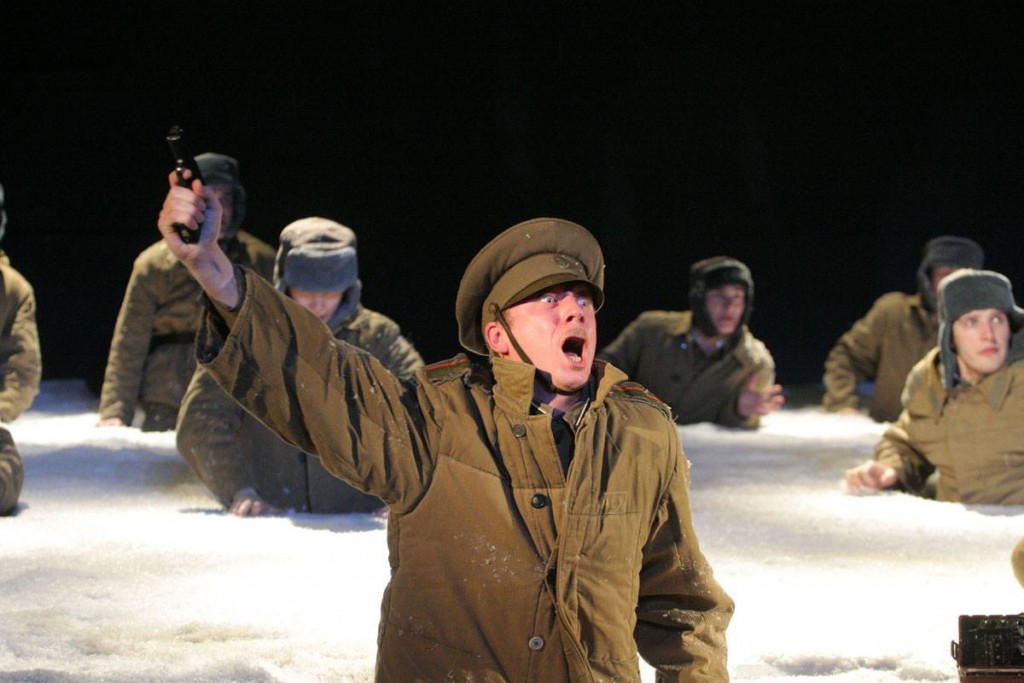
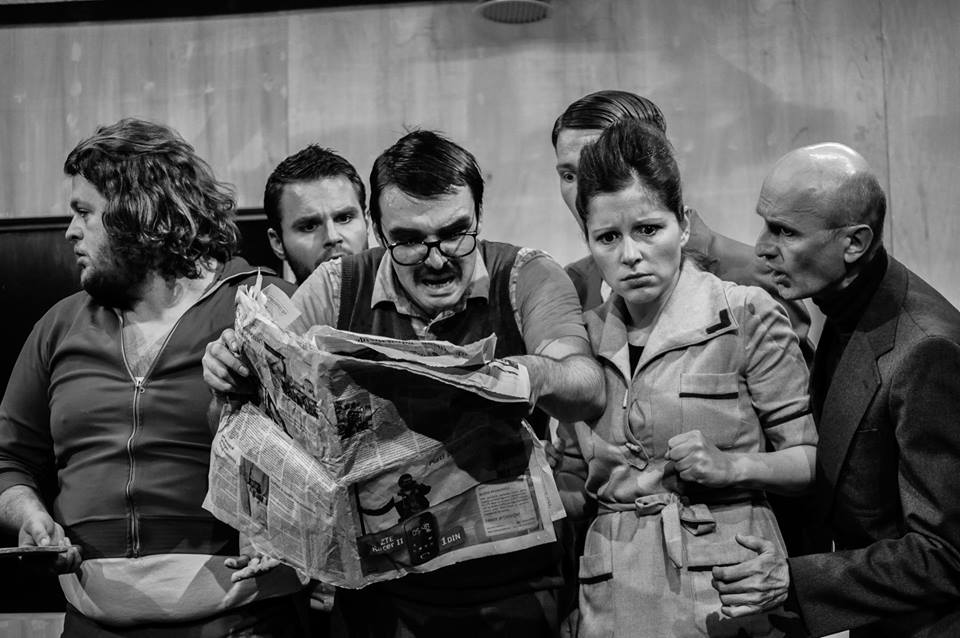
Gaudeamus, directed by Lev Dodin. Maly Drama Theatre, Saint-Petersburg. Photo © ViktorVassiliev

Standing ovations after the opening night of the newly rehearsed award-winning Glasnost classic Gaudeamus on 27 January 2016 at the Piccolo Teatro – Teatro d’Europa in Milan. Based on the story The Construction Battalion by Sergei Kaledin, the world premiere — that successfully prevailed against the military censorship on 11 July 1990 at the Leningrad Maly Drama Theatre (MDT) — courageously tackled the inhuman treatment of young people liable to military service in the Soviet army, which the young actors back then had experienced themselves first hand. 25 years after the end of the Stalinist Papal State, the Saint Petersburg founding member of the Union des Théâtres de l’Europe (UTE) — since 1998 the Maly Drama Theatre – Théâtre de l’Europe — guests with a post-Soviet generation in the parts of their older fellow ensemble members. The Russian director of the play and UTE President of Honour, Lev Dodin, brilliantly masters the transmission of a cultural heritage whose roots are tightly linked to the history of Europe. The idealization of the past — sadly having become so characteristic of our restoration period today — yields the performance of the young graduates who once again bring to life a fruitful memorial site of timeless relevance.

Civilised and natively dressed, they enter, dispersed and to the sound of military marches from all cardinal directions: Kostya (Evgini Sannikov), Bogdan (Aleksei Morozov), Babai (Philip Moglinitsky), Vlad (Leonid Lutchenko), Itskovitch (Aleksandr Bykosvki), Sharaev (Artur Kozin), Bourmistrov (Beka Tculukidze), Milman (Evgeni Serzin) and Popov-Bielotchiski (Stanislav Tkachenko). One after the other they enter the platform that slantingly faces the audience on the stage of the Piccolo Teatro Strehler; it is approximately fifteen metres long and approximately five metres deep (stage design by Alexei Porai-Koshits). A plethora of shredded white plastic strips cover its surface. Bright light aflame, the draftees waddle on the tips of their toes, fumbling forward through the snowy landscape until they — and Bob’s your uncle — go down in a hole in the ground as if they were drowning. Drafted. Descent is the name of the first scene.

On the creation of heroes and swaggering

We find ourselves in the time between the 60s and 80s somewhere in the Soviet Union. Beyond the civilised world there’s a world of the military. It nourishes distinct expectations on the malleable material, the young, manly body with its most intimate desires and thoughts. Dressed in Red Army uniform the young men climb through the hatches back into the snow. Now it’s really getting started. Together with the recruits, we’re riding at a gallop through the basic military training: “Company, attention!”, “Stand at ease”, “Eyes steady” — they exercise everything, also how to ‘make’ a report. The instructors’ unintelligible barking orders on the barrack yards are alike everywhere around the world. The same goes for the harassment performed on rounds. The major (Pavel Gryaznov) cunningly wags a white handkerchief in front the eyes of the recruits. He has found a dust grain on the doorframe above the entrance. There will be repercussions.

The scene Physical Exercise leads to scandal. A flatulence interrupts the athletic showdown from a press-up contest to lifting weights. A brawl starts between the swaggers. In the end, Itskovitch, the contemplative nonathletic Jew, is threshed until he’s unconscious. And Lieutenant Shamtchiev (Stanislav Nikolskii) kicks everyone in the groin who can’t hold the declared position of attention: space between the forward section of the foot in an angle of 20˚, chest out, stomach in, arms bent, fingertips at the hip on the trouser seam, and the greeting altogether! Greeting, walking, standing, sitting, sleeping… natural movements are socially rearranged and normed according to military procedure. Human material is made fit, fit to the service regulation that even Lieutenant Shamtchiev has to check every now and again, much to the laughter of the audience.

Material deficiency or adaptive difficulties?

The first attempt of a Moscow company failed to already stage the six-part story of The Construction Battalion by Sergei Kaledin in 1989 in the theatre of the Soviet Army in Moscow. Throughout the union, officers conferred and decided that The Construction Battalion is backstabbing the Red Army. A public power struggle between the military censorship and the cultural sector preceded the publication. The story was planned for the October edition of the Moscow literature magazine Novy Mir in 1988. The General Directorate of the protection of State Secrets in the Press (Glavlit) did not want to give their assent for printing without the approval of the military censorship. The chief editor, who had previously already enforced manuscripts such as The Foundation Pit by the Andrei Platonov, who had been prohibited for almost 60 years, received a rejection on the grounds of Kaledin’s story demonstrating an extraordinarily low political and moral standard of the relatives of a unit of troops of the Soviet Army. Kaledin is taking the risk himself and begins defending the text across the censorship authorities until its publication in April 1989. Prior to this, reviews are published in the Komsomolka, “there’s nothing worse than barrack yard collectivism of lawless people”, and in the Moskovski novosti “Glasnost isn’t enough — we also need a sense of hearing.” Julian Panitsh read Kaledin’s text on the Radio Svoboda; the latter was surprised that no one came to get him.

Times had changed. Lev Dodin and his troupe had nothing to do with the Moscow controversy, and rehearsed, undisturbed by censoring, for a year until the opening night on 11 July 1990. A class of his acting and directing students at the Leningrad  (Saint Petersburg) University of Theatre, that Dodin has been teaching at since 1967 and where he now chairs the department of stage direction , used Kaledin’s story as a starting point, but mostly used their own experiences as a basis for their performance which they solidified in 19 improvisations, putting the issue on the map. Taking it as a leitmotif, the hole in the ground serves as a latrine that the gypsy Vlad and the Jew Itskovitch shovel faeces in, while the ‘hero’, Kostya, transports the faeces away in a wheelbarrow. On stage Vlad and Itskovitch wear their caps like a food bowl underneath their lower jaw. Matchboxes containing faecal specimen of the recruits fly from these pitfalls in the scene War is War. The filthy curses and the soldiers’ speak of Kaledin’s story influence the dialogues. Everything is relentlessly brought up, from alcohol abuse to deaths in military manoeuvres to the movement of discharge contenders that distinguishes recruits according to term of service into ‘dashers’, ‘badgers’ and ‘grandpas’, and includes the personality-despising duty of ‘dashers’ and ‘grandpas’.
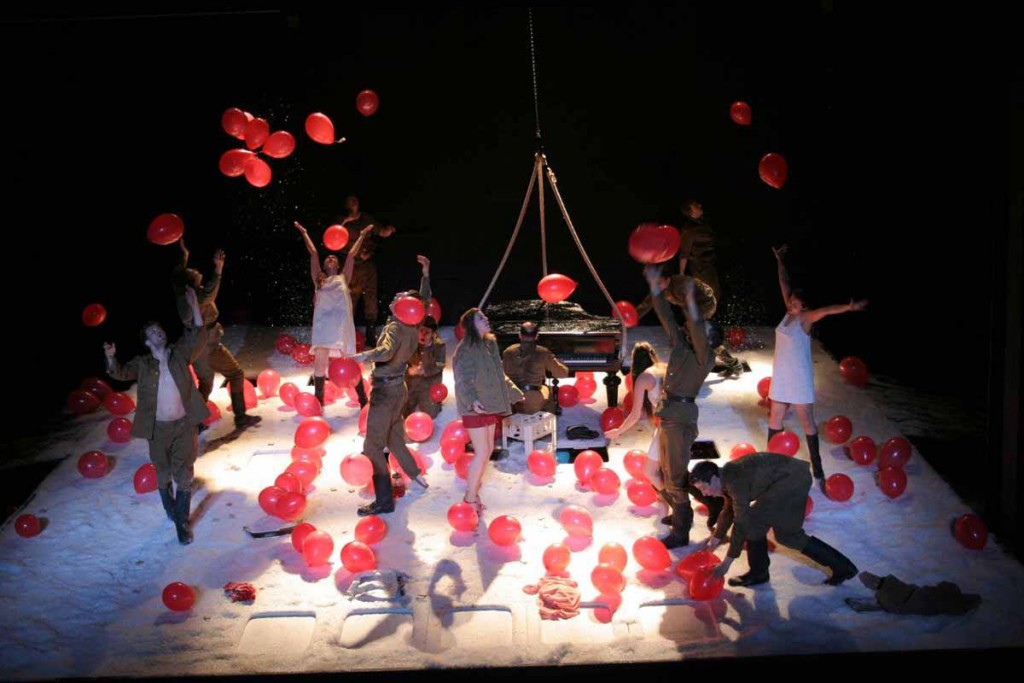
Gaudeamus, directed by Lev Dodin. Maly Drama Theatre, Saint-Petersburg. Photo © Viktor Vassiliev

Happy Fracking

In a conversation with the Italian theatre critic Luca Doninelli about Theatre and Freedom Lev Dodin, when asked about the human soul, responded, “The human memory tends to erase tragic memories. Our human memory does away with uncomfortable memories and uncomfortable thoughts and tries to eradicate the pain. And one of the most important qualities of theatre is to identify this pain, to interpret it, and to talk about it.” — The son of a geologist, born in 1944 in Siberia, has proven this three-part working method in numerous productions at the Maly Theatre in Saint Petersburg, amongst which The House and Brothers and Sisters based on Fyodor Abramov, Demons by Fyodor Dostoyevsky, Chevengur by Andrei Platonov, Stars in the Morning Sky by Alexander Galin or Life and Fate by Wassily Grossman. The basic conflicts of the Papal State are envisioned in these plays by Stalinism force collectivising the dream of the new human or the Soviet Civilisation (Andrei Sinyavsky) starting in the mid-20s.

This construction is cheered. This construction is cursed. The cheering is faced towards victory. The paid price is cursed. Dodin’s interpretation of the pain of young people in Gaudeamus resembles fracking, through which gases in low-lying rock layers are released. These gases are the dreams, the yearnings, the wishes and hopes of young bodies. This Let’s be happy! gives a premonition of unused sources of youthful zest for action: the civil side is the convincing performance by full-of-life acting graduates. The military side is the ironically funny exaggeration of the going-to-waste soul in every day life of young recruits in basic military training. Both sides of the same coin clank together with a cheer when Dodin gives this Stalinist construction a surreal chemical cocktail that comes up with a visual and acoustic colourfulness of poetry, opening up rooms for association across the memory of the ‘Russian Soul’ and literature.

There’s the big hang-out-the-laundry babushka (Mariya Nikiforova), who becomes the sexual adventure for the recruit Babai. At the same time, she’s also the lieutenant’s wife and represents Mother Russia. Whoever gets involved with her will be loved to death and left on the ground like Babai. She’s the character of the reaper that force collectivises Wostchew in Platonov’s The Construction Pit who commands death and donates food. She’s an invisible power that unexpectedly dives into fellow human beings. This power lets Itskovitch cover Kostya’s mouth when the latter drunkenly brags about going to America and screams, “America, I love you!” — this Kostya, who’s only dressed in briefs, whose athletic body makes him look remarkably like a Soviet hero’s memorial, when with a craving chest voice full of yearning he’s dictating his love letter to Tatiana (Danna Abyzova) — who’s looking for pleasure in the casern to the Beatles’ song Girl — to Vlad who’s standing in the cesspit up to his belly button.

First Love wasn’t missing either. There’s a girl (Daria Rumiantseva) standing at a lake, washing her hair. The man who sees her doesn’t stay alone for long. The other recruits immediately accompany his imagined wedding night with her with a dance. In another scene there’s a piano swinging in the heights of the stage area on which the couple Bogdan and Ludmila (Ekaterina Kleopina) play the beginning bars of Mozart’s symphony in G minor as a sign of love with their toes. It’s this far-away certainty that these projections would express this unrequited desire that let us enjoy folk song qualities with the grossed adaptation of the US song One way ticket to the blues (Neil Sedaka) in a de-jazzed Russian version Blue Song („Синий-синий иней лёг на провода…“), and lets our heart wallow in nostalgic but also blurred memories.

The source of the “Russian Soul” with Dodin is a peculiar symbiosis of nature experience, fertility mysticism and keen judgement. In search of the truth, he invites the audience as well as the actors to follow the simultaneous processing of different rationalities. The thus parallel existing competition of sacralities creates consistently new breaks that make you laugh or give you food for thought; when Ludmila, Tatiana, the girl at the lake, or the lady (Arina von Ribben) dance ballet on the tips of their toes in their nightgown around the latrines, but then sit on the ground in their cotton jackets, smoking, singing about the beauty of the body, using words from the church Slavic with which they direct their voices from a perspective of creation to us. Maybe this is the divine moment of the evening.

Theatre — a memorial site

An essential element of Dodin’s rehearsal process is the physical visit to the original locations. After the table reading of Grossman’s novel Life and Fate, the troupe travelled to a Stalinist GULAG and Auschwitz-Birkenau, where they stayed for a few nights. Rehearsals for the Abramov-Trilogy lead the troupe into the village Pekashino. This was repeated with younger ensemble members so that the thread between the generations wouldn’t rip. In the conversation with Doninelli, Dodin points out that theatre expresses the real meaning of life. No human existence can exist without the exchange of emotions. Interpersonal relationship only makes sense when seen in relation to our behaviour. Artists can share the search for truth here much better than can politicians or historians.

When everyone joins into the eponymic students’ song Gaudeamus igitiur… in the last scene, Academy, the tie between the first acting generation and the post-Soviet graduation class is ritually renewed 25 years after the world premiere. In this renewed production, which had its opening night at the Maly Theatre on 16 September 2014, only Mariya Nikiforova is still on board. Next to acting techniques that Dodin imparts in the tradition of the artist theatre based on Stanislavski’s and Meyerhold’s methods, the young actors penetrate the world of the basic military training in the Stalinist construction that brought pain to their predecessors. Now, it is them who keep Dodin’s interpretation alive and who talk about this pain. It is them who, 25 years after Glasnost and Perestroika, still transmit that the pantheon of the hero’s memorial doesn’t fit into the pre-cut stencils of the service regulations and doesn’t at all go with the well of adolescent curiosity, and that no nostalgia can cover up the true adaptive difficulties, even if the intonated music — civil or military — devoid of any kind of ideas contains a cheering promise, and throws the body into clanking excitement, which is more topical than ever, not just in Russia.

This is what distinguishes recollection and memory. Dodin’s theatre, which has its home in the Small Drama Theatre (MDT) in Saint Petersburg founded in 1944, has cultural techniques ready that can always revive earlier experiences and once acquired knowledge. This makes the works of the repertoire of this theatre ambassadors of those cultures whose peoples have suffered true hardship. Lev Dodin also imparts these cultural techniques in his masterclass that founded the ISO theatre of the Union des Théâtres de l’Europe (UTE), whose President of Honour is Dodin and whose founding member is the Maly Theatre. Lev Dodin is the patron of the Decentralized Academy. He was awarded numerous prizes, amongst which the Golden Mask, the Lawrence Olivier Award, the Russian Presidential Award and the European Theatre Prize for his lifetime achievement.


Published on 24 February 2016 (Article originally written in German)
Postcards from Vienna… in a Serbian November

Postcards from Vienna…
in a Serbian November

Walking the streets of Vienna in late November is like hanging out in a huge jewellery store. With help from the Christmas lights, every angle shines brightly, shaping the frame for a peculiar “urban-crossing” experience in which the smallest detail seems to be meticulously staged.

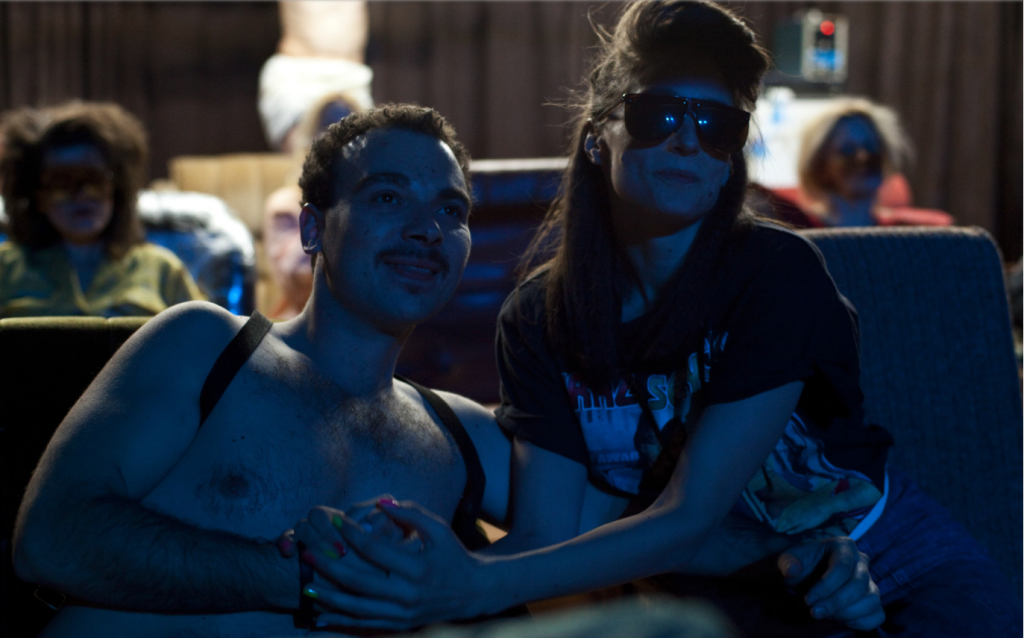
Scene from 'Katzelmacher'. Photo © Andrej Jovanović / Narodno pozorište Pirot
Scene from ‘Katzelmacher’. Photo © Andrej Jovanović / Narodno pozorište Pirot

Nevertheless, before becoming one of the most stimulating and vibrant European metropolises, Vienna used to be the centre of a wide empire, made unique by its stunning variety of cultures and ethnic melting pots. Though these very features played a role in the Empire’s fall, they indeed are the root of a surprising cultural heritage. Now, the Austrian capital dedicates a showcase to the Serbian part of such heritage that has remained active and relevant throughout the years in the Central European and, generally, in the Western culture.

The Serbian November was organized in the context of the Austrian-Serbian Culture Year, in synergy with the Volkstheater in Vienna that offers two venues, the main playhouse and the Volx/Margareten.

Branislav Nušić was the author of Pokojnik (The Deceased), a 1937 classic comedy staged by young director Igor Vuk Torbica, produced by Yugoslav Drama Theatre with members of the Faculty of Dramatic Arts of Belgrade, where Torbica graduated. Unexpectedly returning to life, the deceased mentioned in the title finds no celebrations but a feud between the members of the family that have portioned his heritage, stepping over every rule of respect. On the huge stage of Volkstheater, the visual and textual structure brings us back to a classical early nineteenth century imagery, though the events are set in the late 70s, casting a light on the communist approach to the creation of a selected ruling class during Tito’s dictatorship. A high pace and a very good synergy between the young actors bring the director to fill the texture of acting and stage movement with perhaps too many tricks that tickle the audience’s laughter, making the political subtext hard to follow, at least for the ones who must rely on the surtitles. The result is an entertaining piece of well-staged theatre that collects a warm round of applause, especially from the Serbian spectators. And yet, the tight bond between the translation and the non-Serbian speakers in order to understand the text prevented that part of the audience from fully comprehending the historical thread that is certainly crucial in such critical operations.

Another production of the Serbian November was  able to complete three different, and equally important, tasks: To represent a credible excerpt of the current theatrical trends in Serbia; to give an example of the clash between former Yugoslav and Central European cultures; and to discuss the themes of immigration and integration, so pressing in international political discourse.

The new staging of Rainer Werner Fassbinder’s Katzelmacher (Žabar in Serbian) by Bojana Lazić flows like an impetuous river through such contemporary issues, lying on a simple yet ingenuous set design and a group of strong and wild performers. The small space, circumscribed by a perimeter of black curtains, is entirely filled with old-fashioned armchairs, lined up to stare back at the audience.

Marie, Helga, Rosy, Gunda, Paul and Eric are the quintessential of the exclusive gangs from the outskirts of a contemporary metropolis: dirty, lascivious, lazy and totally closed to any contact with the “others”. They work for a factory in rural Germany at the service of a scowling boss, Elizabeth, a gangly woman with electrified hair and puppet-like movements. Such a squalid routine, deeply rooted in a genetic xenophobia and apparently impossible to be shaken, will find its balance-breaking element in Yorgos, a new worker from Greece. Though ignorant, barely able to articulate a sentence and initially open to being manipulated by the group, Yorgos learns to take advantage of one peculiar feature: being well-hung.

As in many Fassbinder’s plays and films, the sexual tension is the catalyst of social representation, misrepresentation, and, eventually, achievement. The language of the play is fragmented, dry, raw, and ironically artificial; the lines are continuously interrupted by flashy movements and sexual poses that weave an intricate web of allusions. Lazić keeps the actors in perpetual motion through repetitive acts – they continuously switch seats, take turns grabbing beers from a fridge and playing songs on the radio — creating a representation of the depraved rituals of contemporary intolerance.

The audience peeks at the activities of this absurd anthill of degradation, switching from being a spectator to being an unconscious accomplice. And this proves to be a successful way of portraying the responsibility of society not only in discriminating strangers, but also in keeping themselves away from the construction of a democratic environment. In other words, violence breeds violence, and the orgiastic lynching that puts an end to this apologue is even more chilling as it’s not enough to stop our giggling.


Published on 2 December 2015 (Article originally written in Italian)

From Serbia to Syria

From Serbia to Syria

With the open wound of the refugee crisis itching in the background, Vienna’s Volkstheater has clearly come forward as a place halfway between East and West in its first gesture as a member of the Union des Théâtres de l’Europe. There will be no borders here, says artistic director Anna Badora.

Scene from POKOJNIK / THE DECEASED. A guest performance of the JDP at the Volkstheater Wien. Photo © Jelena Veljković
Scene from POKOJNIK / THE DECEASED. Guest-performance in context of the Serbian November at the Volkstheater Wien. Photo © Jelena Veljković

A spectre — the spectre of a refugee wave that is apparently out of control — was haunting Europe the evening the Volkstheater opened its flash-season exclusively devoted to the home country of one the biggest expat communities in Vienna (about 156,000 people, of which 70,000 still keep a Serbian passport, disembarked in Austria’s capital city looking for shelter from historic poverty and unemployment, the claustrophobic socialist regime led by Tito or, up until quite recently, the on-going wars that stormed the Balkans).

Yet another spectre — the spectre of terrorism as an epidemic of unprecedented proportions — haunted Europe one day later, in the painful aftermath of a terrorist attack that mortally wounded both the Western way of life, shooting at close range at some of its core representations (football, the entertainment industry, the good life).

Caught between the two crises, a theatre institution operating right in the centre of Europe, right at the crossroads where East and West have for centuries been coming together and drifting apart, kept doing what it has always done — and let the show go on. Still, “show” may not be the best term when it comes to the Serbischer November (Serbian November) festival — an event that took over several stages of the Volkstheater for four days. Yes, there was a party, and a time to eat, drink and dance the pain away, but then again there was also a time to confront — albeit in a comedy-cushioned mood —  Yugoslavian socialism’s nepotistic record (Branišlav Nusić’s Pokojnic, directed by Igor Vuk Torbica), the tragic body count of the last Balkan Wars (Olivier Frljić’s Aleksandra Zec, directed by Olivier Frljić) and the more and more acute European cultural shock (which by now you’d expect to have become more and more obsolete) between the rich and labour-importing North and the impoverished and fatally emigrant South (Rainer Werner Fassbinder’s Katzelmacher, directed by Bojana Lazić).

These are traumatic issues, weighing on a country where democracy is still quite a new experience. Traumatic issues for Serbia, and, though on a different level, also for Vienna, considering that it was a Serbian nationalist, Gavrilo Princip (1894-1918), who unleashed the First World War — putting an unappealing end to the Austro-Hungarian Empire — through the assassination of Archduke Franz Ferdinand on 28 June 1914. But that was just the beginning of the 20th century; once it was over, Vienna had again become one of the biggest cities of the Serbian diaspora (or rather: one of the biggest Serbian cities). In the meantime, psychoanalysis came forward to help digest that and some other traumas.

So why pick the subject now that one hundred years have gone by since Austria and Serbia’s most violent and bloody confrontations took place in the battlefields of the First World War? Well, precisely because it’s about time to go past the trauma. And also because, as the Volstheater’s new artistic director Anna Badora pragmatically puts it, the Foreign Affairs Ministry wanted to promote 2015 as the Cultural Year Austria-Serbia: “Each and every season the Volkstheater must have an international focus. Since the Serbian community is extremely big in Vienna, even compared to the German one, I thought that this programme could perfectly combine all the interests at stake: the Ministry’s, the city’s and of course the theatre’s.”

Sold out performances and a “The Serbian community, just like other communities in Vienna, must be brought into the theatre — as a topic and as an audience. In Vienna, the majority of the people you will meet behind the shops’ counters don’t have German as their mother tongue. The Volkstheater, which is by definition ‘the people’s theatre’, must go out and look for them.

In fact — and although the programme has clearly stated its intention was to outline and give visibility to the new generation of Serbian theatremakers, and the topics it has been able to freely deal with, after Tito, the war and Milošević —, other conflict zones, and not strictly Serbian ones, did stand out in this Serbischer November. First of all, the big North-South divide which the European sovereign debt crisis, and especially the bailout programmes imposed on Greece and Portugal, lately aggravated — an irresistible way of reading this almost 50-year-old play where Fassbinder staged the social and sexual tension induced by the arrival of the Gastarbeiter in post-war Germany (after all, emigrants from those two and other “peripheral” countries did write part of the German Economic Miracle story…). Secondly, the terminal disagreement among the members of the European Union over the refugee wave that the war in Syria and the struggle for survival in territories such as Sudan or Eritrea have exacerbated these past few months — a dangerously dividing topic even before made this new appearance in Paris that now risks dooming any foreseeable deal concerning the European borders.

With no dénouement in sight — and up until then eventually threatening to break Europe in two conflicting halves —, the refugee crisis was the topic the Volkstheater decided to address in a roundtable at the Rote Bar (a joint effort with the Union des Théâtres de l’Europe in the context of its Conflict Zones network program). It would be hard to ignore it anyway, in a city that just saw thousands of migrants being pushed into special trains by Austria’s neighbouring countries and flooding its main stations. The summer crowds have now vanished, but for hundreds of stranded refugees the Westbahnhof and the Hauptbahnhof still remain some kind of limbo halfway between asylum and repatriation — a limbo where at least they can find shelter, food, medical assistance and other support (translators, for instance, a basic necessity for many) provided by individual volunteers and organizations like Caritas and Train of Hope. It’s easy to spot them: they’re the boys reloading their SIM cards and aimlessly wandering around the Hauptbahnhof’s wide and desolate corridors, the little kids feeding the pigeons in the plaza just outside the station, and the fathers smoking at the entrance of the Westbahnhof’s executive lounge, now a temporary kindergarten for Syrian, Iraqi and Afghan babies and children. Not too far from here, in Spielfeld, on the border with Slovenia, Austria seems ready to build a 3.7 kilometre fence to “help manage” — i.e. “to slow and discourage” — the flow of thousands of migrants that demand its territory on a daily basis.

In a political landscape where the far right had already gained a very significant terrain (reaching 20.5% of the vote in the 2013 general election), the on-going refugee crisis further strengthened the Freiheitliche Partei (Freedom Party). In September, it doubled its score in the country’s third-largest state of Upper Austria; a month later, it reached a record result and nearly won the city election in Vienna, a long-standing social-democrat bastion — so is the audience of the Volkstheater, Anna Badora says “An old and old-fashioned audience”, she adds, and one she would love to “enlarge and diversify”, making way for “younger and more open” spectators to attend the theatre too. Still, the audience that filled the Rote Bar to take part in the roundtable dedicated to the dangerous liaisons between The refugee movement and right-wing populism — featuring political scientists Chantal Mouffe (University of Westminster) and Anton Pelinka (Central-European University, Budapest), anthropologist and Vienna Museum director Matti Bunzl, International Amnesty Austria’s spokesperson Daniela Pichler, chairman of the NGO Asyl in Not Michael Genner, and Kurdish-Syrian playwright Ibrahim Amir, a resident of Vienna since 2002 — seemed neither old nor old-fashioned. And the event that Anna Badora marketed as an effort to “raise the issues and find solutions” eventually became a strong statement for the emergence of an alternative (and therefore left-wing) narrative about the migration wave and what to do with it.

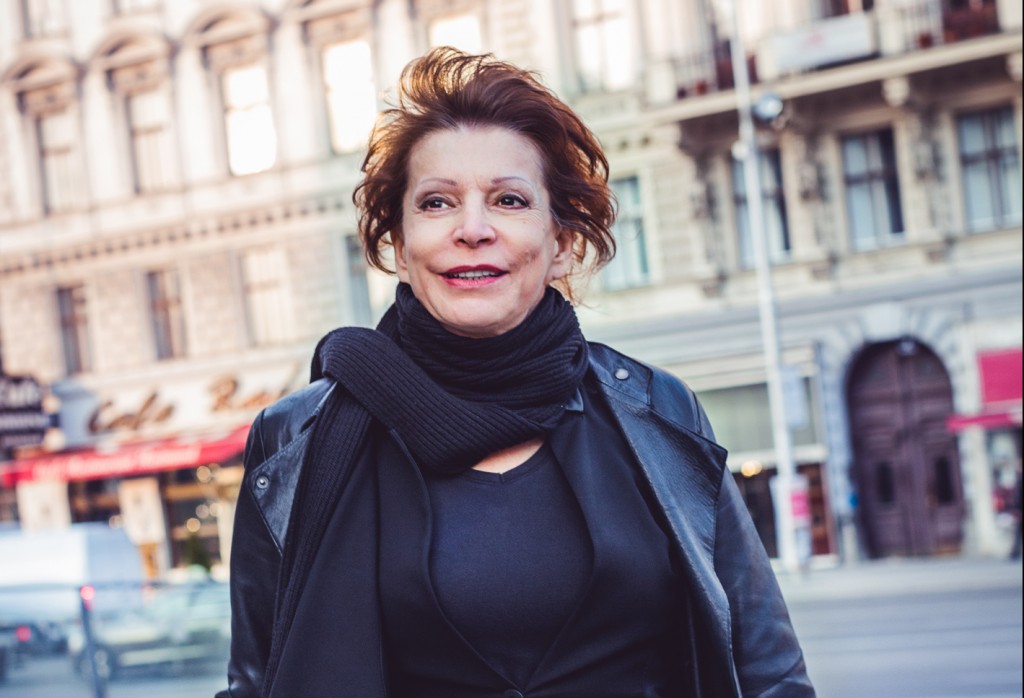
Anna Badora, artistic director of the Volkstheater Wien. Photo © www.lupispuma.com
Anna Badora, artistic director of the Volkstheater Wien. Photo © www.lupispuma.com/Volkstheater

Is it rightfully part of a theatre’s mission — namely one of the main theatres of a city that has historically been a destination for migrants and refugees — to make such a political stand? “Indeed”, says Anna Badora. “Particularly in times like these, it’s important to work explicitly against the right-wing prejudices and propaganda, so that the audience will refuse to be manipulated by them.” The Volkstheater’s artistic director then quotes one of the speakers at the roundtable, Chantal Mouffe, to emphasize theatre’s own ability to generate the positive emotions that so far the left-wing parties haven’t been able to oppose to the “narrative of fear” (placing the immigrant as “the enemy”) the far-right is insisting upon.

Anyway, the Serbischer November’s roundtable is far from being the only approach the Volkstheater is taking on the refugee issue. The institution has also been working on other fronts, one of them being the Ausblick nach oben programme developed by the educational service, which is bringing together Austrian, Syrian and Afghan teenagers (some of which are not even German-speaking) and challenging them into forging a common language out of shared experiences of socioeconomic frailty. Homohalal, one of the current season’s productions, was yet another take on the topic: it is based on a play written by Ibrahim Amir together with some of the refugees who promoted the Sigmund Freud Park’s mediatized Refugee Protest Camp back in November 2012, claiming the right to remain and to work in Austria, along with improved living conditions.

We therefore ask Anna Badora if we should expect a Syrian November to follow this Serbian November in 2016. “I’d love it personally, but these programmes must be articulated with the Foreign Affairs Ministry, which has already stated its intention of focusing on Bosnia-Herzegovina in the coming year. It was once Austro-Hungarian territory, so there’s a relevant common history.” The Volkstheater director, herself an outsider in Austria (she was born and grew up in Poland), vividly underlines that the first season she created for the Viennese theatre is overwhelmingly “international”. Foreign-directed productions by directors coming from different countries of the European and Mediterranean space (Israel, Czech Republic, Germany, Hungary, Greece, Switzerland) clearly outnumber the shows being staged by Austrian directors. But the Volkstheater will eventually reach Syria sooner or later. Maybe later: “At this stage, it would be very difficult to organize such an event with war-stricken Syria; it would definitely be impossible to bring local productions to Vienna, which is actually what the programme stands for. But we can find alternative lines of work.


Published on 26 November 2015 (Article originally written in Portuguese)