Carmen Wolfram:
Katastrophe als Chance. In: Theater heute. Jahrbuch 2013.
Fritz Kater:
Über 5 morgen. In: Theater heute Nr. 10 / 2013.
Roland Barthes: Nautilus und Trunkenes Schiff.
In: Mythen des Alltags. Frankfurt am Main: Suhrkamp, 2012.
IMPRINT
Programmheft Nr. 5 Spielzeit 2013 / 2014 Fritz Kater: 5 morgen
Herausgeber Schauspiel Stuttgart Intendant Armin Petras Künstlerischer Direktor Klaus Dörr Redaktion Carmen Wolfram Corporate Design Spector Bureau Leipzig Gestaltung Anna Busdiecker
A contagious story: How a Fritz Kater play contaminated a whole festival
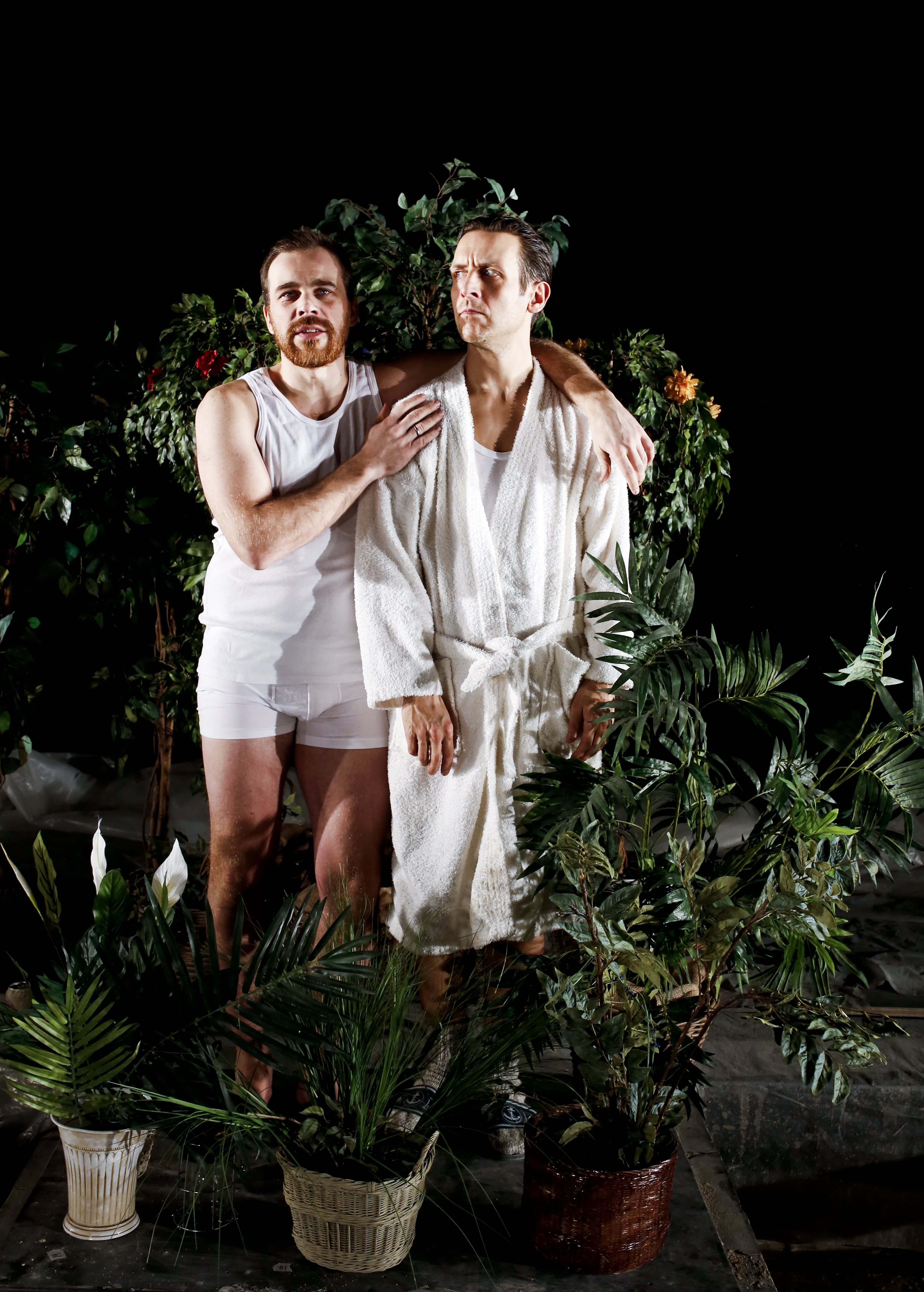
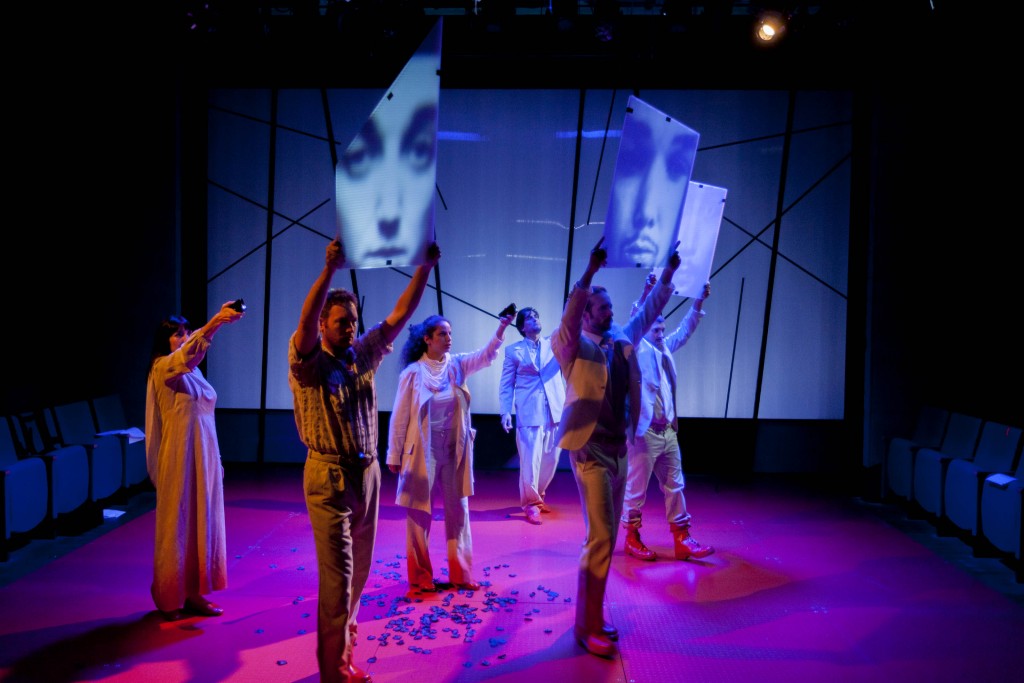
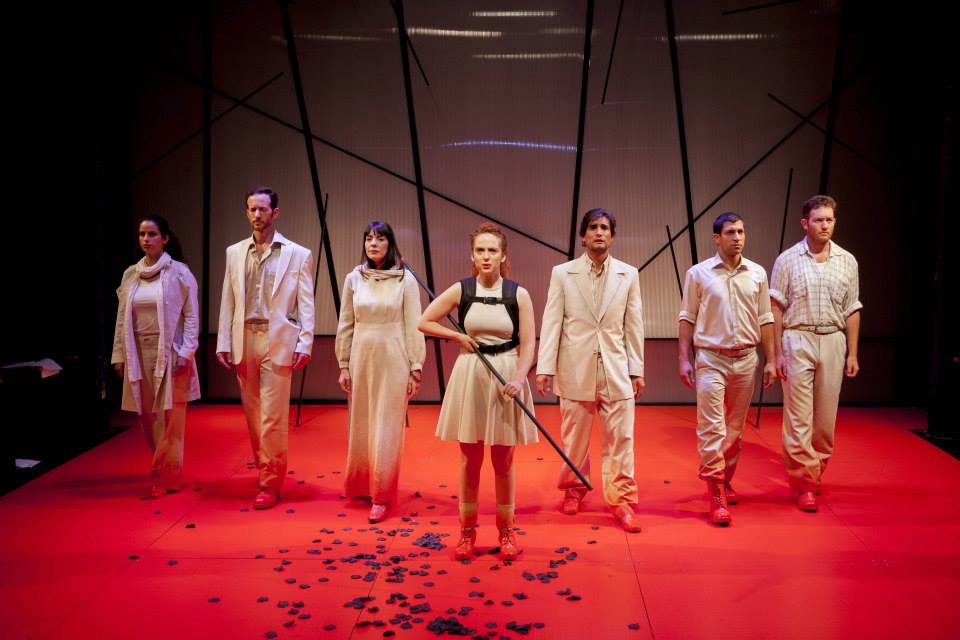
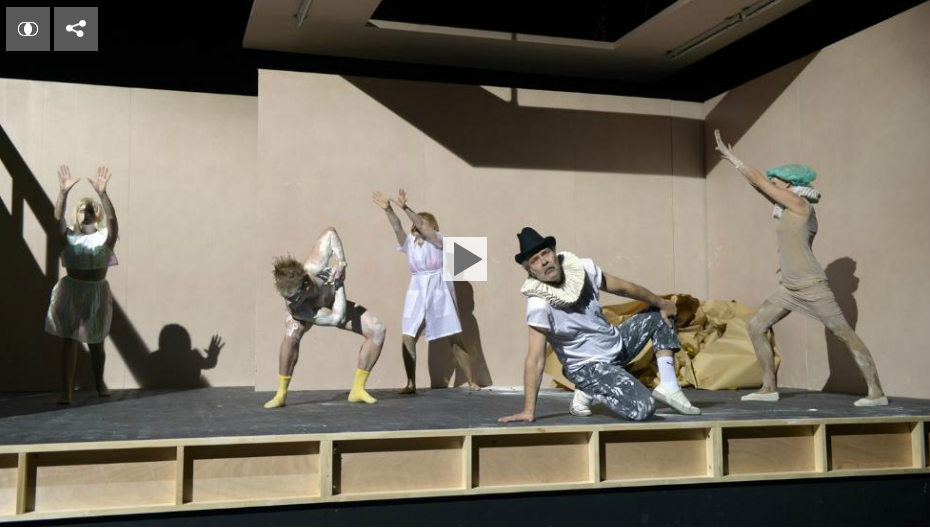
The iconography is very 70s Germany, the interaction with the world is very 21st century no-man’s-land, as if you could make reality, even at its harshest versions, go back and forth the way things go back and forth on an iPhone touchscreen. The five characters in 5 Morgen may well point to an indefinite time, but whether it comes from the past, the future or the present— this is an impossible place to live in: the place of paranoia, the place of apocalypse, the place of disease, the place of an unstoppable contamination chain (in short: the world as an ultimately viral phenomenon).
A parade of zombies, a parade of survivors, Fritz Kater’s play was the final act of a festival built around an idea that is impossible to live with: the idea of terrorism as a perfectly established, and no longer exceptional, way of getting things done. But it was also the first of these five productions especially commissioned by the TERRORisms project to find its way to the stage — back in October 2013, as the opening performance of Armin Petras’ first season as the Schauspiel Stuttgart’s newly appointed director. In a way, it contaminated the theme festival that Armin Petras hosted in Stuttgart more than a year later — not without some public commotion —, finally getting his and the four associated productions together for a last brainstorm (Nationaltheatret Oslo’s We chew on the bones of time; Jugoslovenko dramsko pozoriste’s TheDragonslayers; Habima National Theater’s God Waits at the Station; and Comédie de Reims’ La Baraque, by order of appearance).
But how do you tell a city, how do you tell an audience, that of all the themes in the world this is the one you’ve decided to talk about? Plus, how do you tell this to a city that had been bruised by a terrorist experience itself, the Baader-Meinhof one? “Well, that’s why they brought me all the way from Berlin [before heading the Schauspiel Stuttgart, he was the director of the Maxim-Gorki Theater there]: to shake things up around here”, Armin Petras explains a couple of minutes after 5Morgen’s last performance. “Let’s say it was not a problem. Although the reaction of the political authorities at our announcement was not exactly ‘wow, cool, let’s go’.” The artistic team was guaranteed full freedom in its tackling of the issue — aside from some special procedures, Petras says, “We had to get in touch with the city’s police department; they gave us a phone number and told us which groups were likely to show up and what to do in case they did. They did not.” Even gags, such as the installation of a fake metal detector in the main entrance, or the appearance of a fake policewoman at the bar were allowed: “Our stage designer came up with that idea. We agreed that it was interesting to explore the different ways of dealing with the subject of terrorism, today, as artists.”
It was a learning opportunity for Armin Petras himself: “Staging the terrorist attacks makes it easier for us to live with them: suddenly we’re not alone with those problems and fears anymore, there are 500 other people in the room. For me this was the most important lesson.” The festival’s director singles out God Waits at the Station — the anatomy of a suicide bomber who blows herself up in Israel — as a demonstration that it is definitely possible to go way beyond paranoia in a theater room. “I could understand the social, economic, political and religious circumstances behind the Palestinian suicide bombers’ phenomenon. Now I can deal with it in better ways.” Maybe there’s not much more we can do, as suggested by the performance staged by the Nationaltheatret Oslo for this TERRORisms cycle while recovering from the founding trauma of the Utoya massacre, in which 69 people lost their lives at the hands of a seemingly normal Norwegian citizen, Anders Breivik. That’s the lesson to be learnt, Armin Petras insists: “Terrorrism lives with us.”
In Stuttgart, no matter how many years have gone by since the neighbouring Stammheim Trials — Stammheim being the prison where several members of the Baader-Meinhof group were found dead between 1972 and 1977 —, that statement is particularly true. The name is deeply inscribed in the city’s collective memory, and in its public space, too. But is it still alive? “Not too much”, says the director at the Schauspiel Stuttgart, who came to town more than 30 years after the Stammheim events. “Older people know about the history, but I don’t believe the younger ones do. Other issues have become more urgent: the NSA violations, salafi terrorism… That’s why I wanted this festival to be called TERRORisms, in the plural form. But of course it is peculiar to organize such a festival in a city where there’s a metro line going to Stammheim. I knew the word from the movies Fassbinder had made in the 70s, but I only realized how close it is to Stuttgart when I first came here.”
Perspectives
Like a self-fulfilling prophecy, a terrorist attack in the Tunisian resort of Sousse — 38 victims, mostly Europeans — interrupted the festival from a distance. “That’s how it has been since the beginning of this process: while we were writing these plays, while we were rehearsing them, hundreds, thousands of people died in terrorist attacks. There’s a growing number of such attacks, so, unfortunately, the occurrence of the Sousse events right in the middle of the festival was not a big surprise”, says Armin Petras. But was that the reason why spectators didn’t want to come and face — inside a theatre room — the same lousy show they’re confronted with day after day in every newscast? “Different reasons explain why the festival was not that crowded: it’s summer, the topic is difficult and tough, and, generally speaking, Southern Germans prefer to have fun when they have some free time. But I’m not bitter or angry about that. We proposed a very intense schedule, and the city’s just not that big.”
As far as 5 Morgen is concerned, the city was big enough. “The reviews weren’t too good, but still we showed the performance 27 times in four different countries, and it became a success. A lot of the shows were sold out, despite the fact that we chose a secondary stage far from the city center in a not so lively neighbourhood.” Armin Petras witnessed as the performance grew and changed in the course of these past two years: “In Oslo, people laughed up until ten minutes before the end; in Sibiu, it was the opposite. In Stuttgart, it was a mixture of both. And I heard people say, ‘They’re so good with their bodies’. Because here nobody works with the body, people work only with their laptop and their mouse.”
It’s a matter of perspective. So were the five plays that the festival assembled: “Both the Norwegian show and the German show illustrate how our lack of faith in God and ourselves constitutes a problem for the western society. The Serbian show illustrates how terrorism is a 500-year-old battle. The Israeli show illustrates that there are places in the world where people are so close to one another but at the same time have so many conflicting purposes that terrorism must occur. These kids who volunteer for the terrorist attacks have no work, no home, no water. In the North of Africa, 45% of the male population aged between 18 and 28 years old is unemployed. A social worker from Essen stated that 95% of the volunteers leaving Germany to join the ISIS grew up without a father. For them, terrorism comes as a life project.”
It’s a terrible conclusion to come to, after five days of reflection on the topic. A conclusion, Armin Petras says, he will be considering for projects in the near future. “Theatrically, this idea of a terrorist organization becoming the father you never had is very strong. I guess I will be working on this story in one of my next shows.”
And so the contamination continues.
Published on 13 November 2015 (Article originally written in Portuguese)
We Chew on the Bones of Time: Terrorism beyond any representation
During eight years of active practice and research on the innumerable cells exploded out of the so-called “contemporary theatre”, almost all the preconceived ideas I had had as a spectator, and later as a critic, deformed and changed completely as I was challenged by an adventurous journey through such a shifting landscape. Over the last few months, the products of all the participants of the Young Journalists Online project have tried to explain national situations and systems, underlining and letting emerge an astonishing variety of trends, drifts and – sometimes – agendas.
In 2006, Routledge published a very interesting collection of essays under the title of Contemporary Theatres in Europe: A Critical Companion. The intention of the editors Joe Kelleher and Nicholas Ridout, according to their introduction to the book, was “to offer a range of different ways of thinking and writing about the kinds of encounters that take place, these days, in the theatre”. One could summarize the methodology followed in that book as an investigation based on two core concepts: mobility and collection. Trying to, on the one hand, preserve the inner plurality of the contemporary discourse on performing arts, and, on the other hand “a sense of a cultural and institutional tradition of theatre making in Europe”, a group of theatre critics was encouraged to travel to other countries to see and report on plays not directly connected to their cultural and historical background. As a matter of fact, in such faraway context a clear detachmenta common line of attention to be oriented to certain common weightier topics would appear. If we project the linguistic root of the word collection on a double layer of the discourse (the action of gathering objects and the attempt to complete a certain task pursuing a plural approach), the association of those two keywords seems to address the fundamental assignment of the whole YJOL group. We are in fact encouraged to challenge our way of seeing and thinking theatre — made competent and reliable by an intensive territorial practice — within an encounter with faraway contexts.
I believe that the same attitude as the one of the contributors to the Kelleher/Ridout survey was adopted by this group in confronting an established event such as the Terrorisms Festival in Stuttgart.
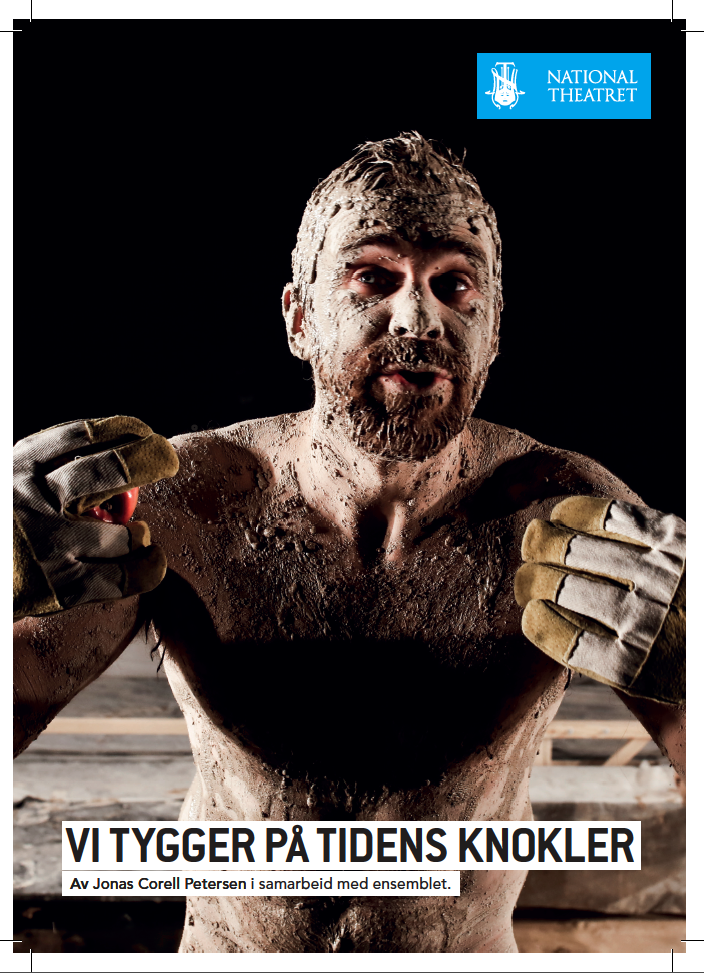
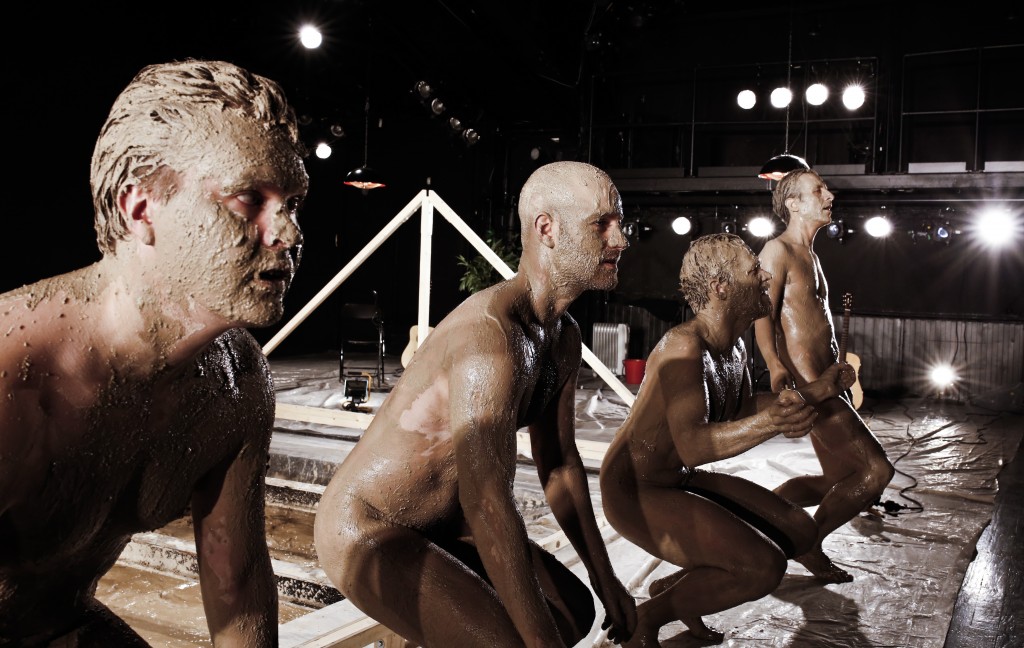
As a matter of fact, the play We Chew on the Bones of Time, written (together with the Norwegian dramaturg Olav Torbjørn Skare) and staged by the Danish director Jonas Corell Petersen, featuring cast and crew from the Nationalteatret Oslo, can be accounted as evidence of how the term “terrorism” can be transferred into a broader discourse about history, about memory, about war and peace considered both as external and internal conditions. “Four people, a guitar, some mud and some melancholy”, this is the claim, this is in fact the opening scene, with four men wearing underpants sitting at the angles of a square that delimits the stage, clumsily picking on four guitars. In the centre, a partly hidden construction site, with spare pieces of woods, a little pool of mud and a cement mixer on the left. An absurd atmosphere will also be the cornerstone of the whole performance, in terms of language (crazily mixing English, Norwegian and German), structure of dialogues and reasoning. After enumerating a list of 158 “Ideas for Leisure Activities” — projected on the back wall — the situation evolves into the hilarious account of a group seminar that involved the four people on stage, sort of a motivational training camp for employees. No clues are given about the contest or the background of these non-characters, rather figured as four angles of the same archetypal being.
The absurd and humourous tone helps the audience to embark on a wild-eyed trip, back to the very origins of social behaviour, rolling down through the jungle of religious phenomena and ending up into the representation of a distorted future in which the human being is forced to order the reality in a new set of rules, totally ungovernable.
There may be no point in going through the numerous allusions and references of the text, able to support a two-hour- and-45-minute-long performance of pure and naked presence. It is instead compelling to analyse the interaction with an audience gathered around a thematic festival. Functional and successful was the choice of writers to create a new language from scratch, sprinkling a major topic on the potential power of interaction between the performers and between them and the spectators, treated here as a bunch of expectations to be eaten grape by grape. The quest is to find “a sense of direction” because “it’s difficult to find your way when there are no landmarks”. “So you need a smile”. That smile sets the tune for the entire first act of the show, to the extent that during the intermission the audience in the foyer seemed confused about the very nature of their presence, and about their active participation in this exchange of ultimate hope. The second part was far more serious, crumbling down in a desperate deconstruction of the performer’s inner self, made even more cruel by the contrast of watching them actually build a concrete structure on stage. Thus, the quest for direction becomes a quest for individuality, a fatiguing search for a safe place to imagine a new way of living.
Such a delicate dialectic balance between representation and presentation brings up some very subtle definitions coming from semiotics of theatre as a (still) evolving science: in the text, the characters have the same name as the performers; from the post-show discussion we learn how the writing has been going hand by hand with all the other elements and media of the show; the progression of the whole narrative and philosophical lines continuously builds up and smacks down the conventional structure of a ‘character’ as something separated from the actors appointed to embody it. Here, the distance between a ‘theatre of representation’ — where a separate reality is organized on stage — and a ‘theatre of presentation’ — led by plain self-reference — is “chewed” by a montage of frames characterized by a total slipperiness in meaning, reference and even in the very nature of the relationship to be kept with the spectators. This is a kind of theatre that is a “production” rather than a “product”, and is a “process” rather than a “result”.
In this sense, keeping the texture of dramaturgy at this level of openness encourages the spectator to grasp the meaningful elements for themselves, to be balanced on their individual background and idea of the themes generated by the text and the action themselves. The show was commissioned by the UTE Conflict Zones project, and through this line of work it replies perfectly to the initial question, which appeared to be to investigate terrorism and the related fear as endemic features of our society. The solution found by We Chew On the Bones of timeis to address the spectators with a clever and successful application of “free will”: they were actually allowed to bring home a meaning of their own. Successfully honouring the contract of a thematic festival, this play models the idea of “terrorism” on the representation of a general urgency of stability, the general search for individuality that affects the present European society. Through such a charming theatrical code, such themes are turned into a field of experience that each spectator has to cross, being constantly aware of a personal background, which suddenly becomes an active part.
Going back to the beginning, there is another definition proposed by Kelleher and Ridout in the foreword of their book: “On the one hand, the contemporary might bethought of as the time of the encounter; the time around a particular theatrical experience in which you might be enfolded. […] It could be thought of as a longer time, however — the time of thought and research around a particular event or, indeed, a particular theatrical practice. The different temporalities of the performer and the spectator might be worth thinking about”. And that’s exactly what this production does, highlighting our special (and most likely non-objective) idea of the real world as a place to pose our personal struggle between history and memory, and our reflections on fear and social responsibility, a form of collective conscience here seen as something productive and destructive at the very same time.
Published on 31 August 2015 (Article originally written in Italian)
Suddenly, three almost simultaneously occurring terrorist attacks trigger a theatre festival fully dedicated to questions regarding terrorism: What do we do when fiction becomes reality?
Even if this scenario didn’t actually happen, it most certainly could have: Stuttgart airport, June 23rd, a border control officer asks an Israeli actor what brings him to Germany. In response, the actor waves his invitation to an international theatre festival — and here he pauses to decide how, in a post-9/11 world, he could, without taking the risk of staying under interrogation, diplomatically formulate this — called TERRORisms. The same festival that, three days later, observes what was supposed to be fiction becoming a reality in Tunisia, Kuwait, and also, so close to us, in France; and with many — too many to be ignored — European victims (judging by the international community’s paralysis regarding Syria, other victims have been ignored more easily).
It is not a dark comedy, even if the peculiar, and rightfully celebrated, Jewish humour is on stage, therefore: applause. In the last two years, five members of the Union of Theatres of Europe (UTE) — Nationaltheatret Oslo (Norway), Jugoslovenko dramsko pozoriste (Serbia), the Habima – National Theater of Israel, Schauspiel Stuttgart (Germany), Comédie de Reims (France) — have been willing to show that the same word, terrorism, can lead to many different places, so much so that it no longer looks like one but several words, sometimes doomed to get lost in translation. In German, for example, terrorism means an alternative history of the seventies — or a rather murderous way of dealing with immigration. (The trial of the far-right group Nationalsozialistischer Untergrund that killed eight citizens of Turkish nationality between 2000 and 2006 is still going on. Meanwhile, the Austrian Elfriede Jelinek has written a play about this subject matter, Das Schweigende Mädchen, which was also shown at the TERRORisms festival). In Norwegian it is a synonym for Utoya, the place where a seemingly normal man, Anders Breivik, killed sixty-nine people in 2011. In Serbian it has another name, Gavrilo Princip, as well as another victim, Archduke Franz Ferdinand (and, with him, an idea that for many intellectuals seemed unusually promising — Mitteleuropa). In French, at least in the last few months, all terrorisms have been Charlie. And in Hebrew it is a word that swallows the entire nation, in addition to the official violence — from the years that preceded the foundation of the state of Israel up to the 21st century, when it became Paradise Now to a whole generation of suicide bombers.
We could go on and on, even without leaving Europe — Spain, Italy, Ireland, England, Austria, Denmark, Sweden, Russia, etc. But sometimes there’s a need to stop and bring order to the conversation. That’s what a festival in Stuttgart — dangerously close to Stammheim prison, where several members of the Rote Armee Fraktion, or Baader-Meinhof group, were found dead under highly disputable circumstances between 1972 and 1977 — did in the last few days, closing a project that had been launched in 2013 by the UTE to map the multiplicity of manifestations and reactions that the phenomenon of terrorism has taken on within the European space (or in one of the most irrepressible territories of its diaspora, Israel, where the UTE has one of its members outside the European Union). Two years have passed since the first drafting of the programme dedicated to this topic — an idea which occurred right in the aftermath of the terrorist attacks in Oslo and Utoya — and the final festival that should, at least in theory, put an end to this ultimately inexhaustible subject. These two years happened to be of particular relevance to the debate on terrorism, its media effects and artistic representation. No wonder other UTE members are considering further expanding this debate through additional productions.
The festival organized by the Schauspiel Stuttgart wanted to bring a system to precisely this debate. An overwhelming programme not only compiled the five plays specifically commissioned by the participating theatres for the TERRORisms project (and the publication of the respective texts) but also a series of debates, round-tables, installations, expositions, book launches, publications and simultaneous presentations that all sought to demonstrate to what extent terrorism, in its staging of violence and search for a general audience, is also a show. And, if so, to which extent we are all spectators, even if we don’t want to see the play.
Love and Hate
Is a festival enough to shorten the distance between fiction and reality? Hard to say considering that a triple terrorist attack unexpectedly stole the show after two days of theoretically discussing the very subject of terrorism in the Schauspiel Stuttgart. Some of the discussions were actually quite tangible — a guided tour through town, for example, debated the wounds that the Stammheim trials had opened in Stuttgart, and how easily some of the top Nazi figures found their important positions in supposedly regenerated post-war Germany. Or a play, Wir Sind Nicht das Ende, that highlighted the subliminal connection between Germany and the 9/11 events; the Lebanese Ziad Jarrah, one of the hijackers of Flight 93, had studied aeronautics in Hamburg, and his last girlfriend, who used to live in Stuttgart, is still in the country, under police protection.
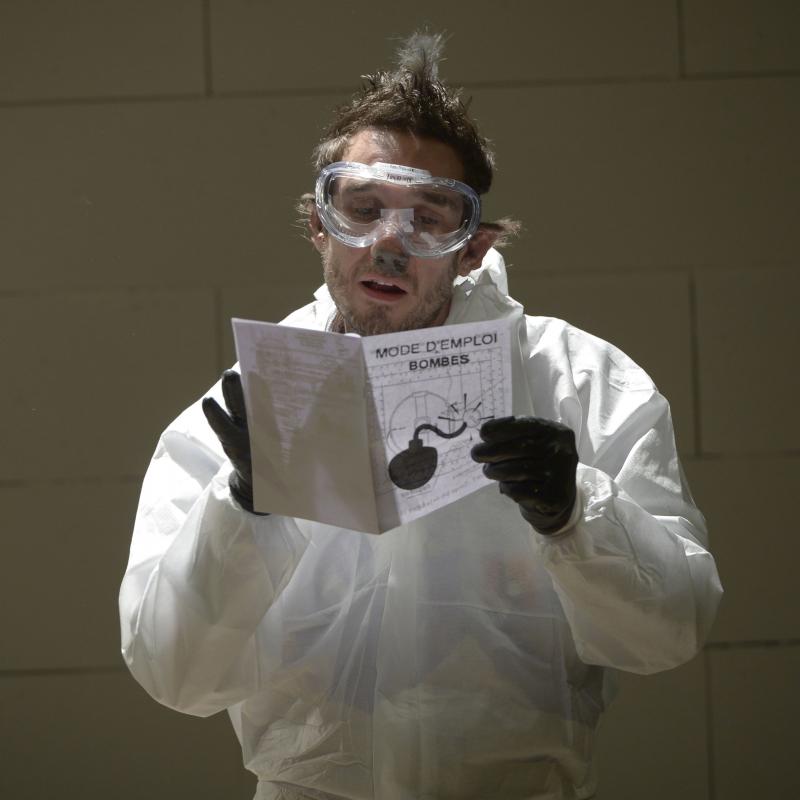
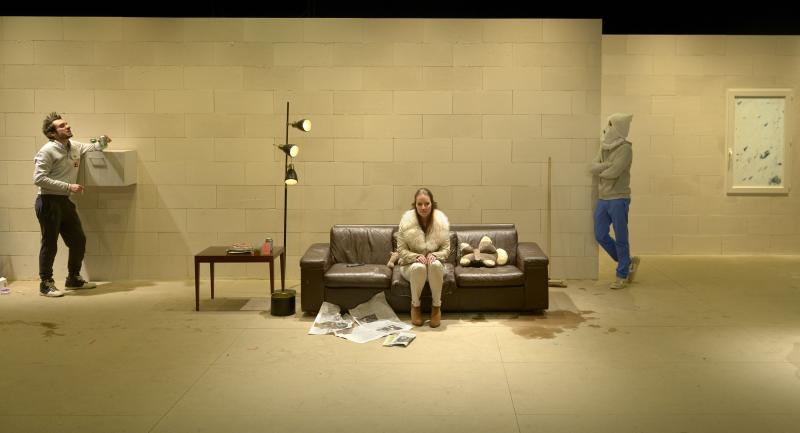
But the terrorist attacks of the last week weren’t the first reality check for the five plays that came together in Stuttgart after the opening nights in their respective countries of origin. The rehearsals of La Baraque, the comedy of the Iranian Aiat Fayez, with which the Comédie de Reims entered the operation TERRORisms, were suddenly interrupted by the Charlie Hebdo attack, the director Ludovic Lagarde explained. Faced with real terror, the artistic crew had to stop and think whether the show about the unexpected wealth of two go-getting makers of homemade bombs could — or should — continue. “We did an open rehearsal a few days after the terrorist attack and the spectators, disturbed, asked us if we were really going to do the scene where the protagonists make a bomb in their house. We ended up keeping the scene, and that rehearsal turned out to be most valuable for us in terms of establishing the boundaries of the play: how far we could go, how much we could laugh…” Even with a bomb on stage — or because of a bomb on stage —, the opening of La Baraque, four weeks after the massacre, worked as “a strange experience of catharsis” in the end.
In Tel Aviv, the phenomenon of suicide bombers appeared to be a subject of the past by the time the Habima started working on God Waits at the Station, where, as in Akira Kurosawa’s Rashomon, there is more than one truth about the fictitious Palestinian woman who blows herself up in a restaurant in Haifa. It became a subject of the present again (without suicide bombers but with missiles instead) the moment Israel launched the summer 2014 campaign against Gaza. By then, the show had already been in rehearsals. “When we started this project, neither the public nor the press cared that much. Israel was going through a peaceful period; there wasn’t much terrorist activity. Meanwhile, however, the Israeli army entered Gaza and the Hamas responded. We heard the sirens in the rehearsals rooms, the actors had to run to the shelters, no one was thinking about work because the priority was hearing from family and friends… At some point, several members of the team said that with the country at war they couldn’t identify with the story of a suicide bomber and that they wanted to take their names from the technical file”, the director of the Habima, and current president of the UTE, Ilan Ronen said. The opening night got postponed several times because, even after the cease-fire, the administration of the theatre still believed it wasn’t the right time. And, Ronen admitted, they would have continued believing so if a UTE general assembly in Tel Aviv in November hadn’t forced the Habima to show the play, “Only international pressure allowed us to open: the play was part of a UTE project and the administration realised they couldn’t keep hiding it.” Reactions? Love, hate, and very few other things in between. “In Israel it is always difficult to tackle ‘the situation’. Everyone is openly far-left or far-right, everyone has gone through military service…”, the stage director Shay Pitowsky responded.
Even if theatre is always politics, — all five directors of the theatres present at the round-table dedicated to the subject agreed on this — some places are more political than others: Israel, obviously, where the new Minister of Culture, appointed by the most right-wing government ever, has announced that artists may continue saying whatever they want to but that there won’t be any public funding to help those who “disparage the country or the army”. But also Serbia, where it’s not completely safe for a theatre to announce its participation in an international project about terrorism with a show like The Dragonslayers — a sort of alternative, and quite poetical, biography of Gavrilo Princip, the Bosnian Serbian that murdered Archduke Franz Ferdinand 101 years ago (the festival ended precisely on 28 June) and that, as the main actor Nikola Rakocevic pointed out, “isn’t referred to in history books.” In Stuttgart, it’s possible to say manifestly that “Gavrilo Princip is a hero” and watch half a room applaud enthusiastically; but in Graz, Austria, where the play was also staged, the audience saw a manifestation of Serbian nationalism in The Dragonslayers — the same view that the director of the Serbian theatre Gorcin Stojanovic wants to avoid in what is “basically the story of a boy who never kissed a girl” and found himself killing “the regrettable oppressor whose miserable fate was really naming a pop band.”
Yes, looking at it from Stuttgart there are several, and not always obvious, paths that lead to terrorism — one only has to take a look at the Norwegian UFO that opened the festival with We Chew on the Bones of Time, an ironic meditation about the meaning of life, from the big bang to the apocalypse, that left many spectators wondering if they were at the wrong festival. There isn’t exactly terrorism in the play but there is the existential anguish, paranoia and acute atheism that we picture exploding in the face of an apparently perfect democracy when, in the blink of an eye, a normal citizen shoots and kills dozens of people at a summer camp. About the topic, “We are not the theatre one would expect, we are the theatre one wouldn’t image a national theatre could be”, the director of the Nationaltheatret Oslo, Hanne Tomta, underlined in a different context.
So, what else can we say about the theatre that organized this festival — and of Armin Petras, the director who had the idea of creating it when witnessing a demonstration in Oslo against the presence of the Habima – National Theatre of Israel in a European network? “We talked with the government, of course, but not because we were making a festival about terrorism, we have these kinds of conversations all the time”, he assured. Besides, the Schauspiel Stuttgart is the theatre where a director — the historical Claus Peymann — was once forced to quit his position because of his fundraising for subsidising the dental treatment of Gundrun Ensslin, a Baader-Meinhof member serving time in Stammheim prison; and it’s also the theatre where a play was made about that very event, Offending Peymann – A Training, by Rimini Protokoll in 2007. Many years, almost forty, have passed since. Today, this is the theatre where the freedom to deal with terrorism goes so far as to have a fake policewoman, fully armed, speaking with the spectators at the bar. The same spectators who have to go through a fake metal detector to get in, the same spectators who see a crowd of firemen invading the room that a Norwegian company has just filled with smoke, not knowing if this has actually happened, or if it just could have.
This article was originally published in the Portuguese print and online journal PÚBLICO the 29th/30th June 2015
Published on 31 August 2015 (Article originally written in Portuguese)