ISO MASTERCLASS IN SOFIA.
AFTER BECKETT, TOWARDS A GENETICS OF TRUTH
The stage is dark, silent, empty. An indistinguishable figure (Nadia Keranova) stands still against the background wall tinged with blue. One foot bare and the other wearing an oversize hiking shoe, she walks towards the center, under the amber backlight, then a sound explodes and she falls on the ground of the right corner. She takes a small mirror from her pocket, and, with incredibly slow movements, she slots the mirror in the shoelaces: what a surprise to see her own image…
In the context of the Small Season Festival 2016 at the Sfumato Theatre-Laboratory in Sofia, Bulgaria, Margarita Mladenova and Ivan Dobchev directed a four-day masterclass with eight members of the International Super Objective (ISO) Theatre, a group of young European actors from nine different countries developed in the context of the 2012 UTE Decentralized Academy.
In the view of Mladenova and Dobchev, who during the masterclass were helped by a brilliant Bulgarian to English interpreter, Sava Dragunchev, “the idea is through the garment to resurrect the human, his unique personal being and so to form his monologue.” Petya Alabozova, Sophie Lewisch, Aglaia Katsiki, Benjamin-Lew Klon, Luís Puto, Angélique Zaini, Bilyana Georgieva and Boris Krastev joined Ivan Barnev, Hristo Petkov, Boyko Krastanov, Catalin Stareishinska and Nadia Keranova (all from Bulgaria) working each one on an excerpt of the 1972 Samuel Beckett short play Not I.
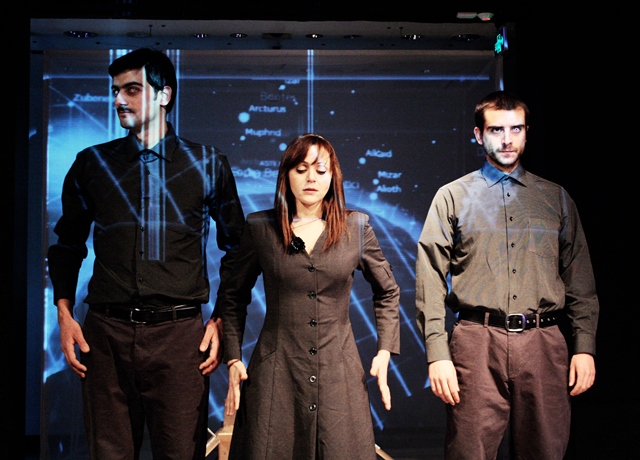
The author’s indications fix a single spotlight on an actress’s mouth, “about eight feet above the stage,” and a second silent character named Auditor, who performs movements “of helpless compassion”. In the two directors’ idea, the role of Mouth is played by the actors in thirteen five-minute long solo scenes that follow the same structure. A blue light on the back wall, a central spotlight: when the actors reach the centre, a breaking sound smashes them down in the dark. A ringing recovers them and obliges them to speak the text, somehow against their own will. Thus, Mouth is not an actual character, rather an outside presence, “a small girl who is speaking from an outer world”, as it is whispering the lines in the actors’ ears.
The speech is fragmented and mechanical, the pauses and the punctuation almost nonsensical. The pause, the intermission between one thought and the other, in the hiatus there’s the very essence of Beckett’s writing. “You talk but you don’t know how, it’s not a physical process.”, says Dobchev, who is smoking a cigarette sitting in the dark of the first row. “You feel exhausted, as if something mysterious happened to you and crushed you down. And now you are slowly waking up.”
Under the title of Second Hand, the masterclass accompanied the group through an initial session of improvisation work, to be later used to shape the sense (or the nonsense) of the text. In the first two days, the actors were also invited to choose their “second hand” costumes and props, previously used in other productions of the Sfumato.
When mingled with the Irish author’s writing, ragged coats, misshapen trousers, beggar-style hats, broken umbrellas and walking canes look so “Beckettian”, in the way they suggest a post-human imagery. And yet, the route of this work heads towards a “pre-human” condition, a sort of biblical archeology that tries to investigate the original sin from a Sartre-like perspective: everyone was condemned to be born, and living is just a way to endure that heavy duty.
Dobchev talks about the word of God and its “inexplicable miracle, pure, from the very beginning”, about “the need for love”, but also about Prometheus and his attempt to replicate the sacred fire, to give birth to life, to imitate the Gods.
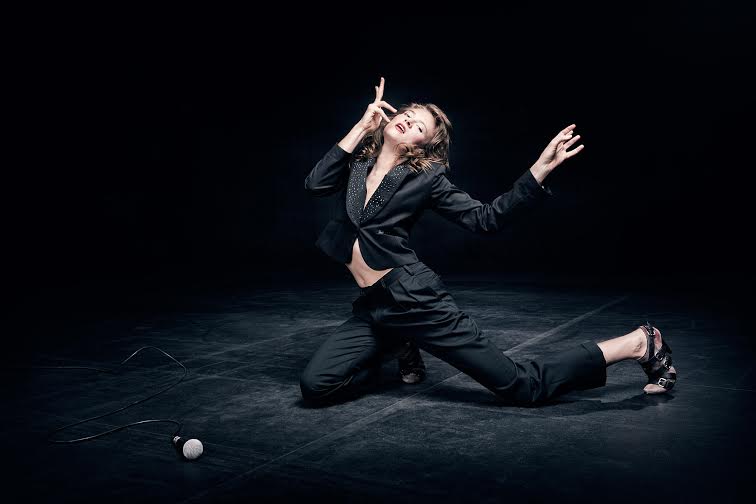
Benjamin walks and dances on high heels, falls on the floor spreading legs in front of the audience: he delivers his lines assuming the position of a woman who’s delivering a baby. “Every word must be a surprise for you,” Dobchev and Mladenova insist. In fact, the vocal cords of the actors are transformed into a mere tool at the mercy of someone (or something?) else’s will.
The actor’s key to such a primordial speech is in keeping totally detached from the idea of impersonating a character, by using body and voice as instruments that let such speech be louder in the spectator’s ears.
Without necessarily being a theatre or literature expert, reading Samuel Beckett means engaging a never-ending conflict, standing in front of a castle made of doubts with no entry doors: “This female voice that you hear in your minds”, says Mladenova, “may be your own attempt to decipher a code and find your own place. It’s the experience of every single man that tries to find his place.”
Imprisoned as they are in their small space centre stage, the actors found a way to be powerful, leaning on a very accurate and original physical work that marks the peculiarities of a rich bunch of styles and training backgrounds.
“We don’t have a memory from our birth because our eyes couldn’t see”, suggest the directors. This idea, mixed with the extraordinary capacity of Beckett’s words to gain a second, a third, and an umpteenth meaning, guarantees a variety of images and attitudes, from rage to sensuality, from childish muttering to clumsy dance, from lyrical tones to beastly growls. In such a jungle of languages, Dobchev and Mladenova invite the actor to flee any psychological research, rather pointing out as many metaphors and external references as possible, provoking new approaches by associating each sentence to a physical experience, like: “You are getting closer to this truth, but this truth is very hot, like a stove; when you reach it, it will burn your fingers.”
Thus, according to Dobchev, “speech means truth; when you are speaking, you are trying to make things real, you speak just in order to verbalize. The truth is for salvation, not for consolation, because Beckett is not a moralist, he pities the humanity. With this sort of speaking corpse we want to reach the truth, this is the adventure. To reach ‘the country from which no visitor returns’, as Hamlet says.”
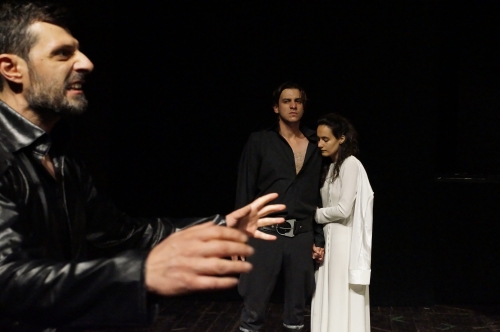
By watching them work, loneliness is the most evident feeling. Nevertheless, Not I also poses a second character next to Mouth: the Auditor. In the view of the two Bulgarian directors, the Auditor must be seen as a symbol for the spectators. Barefoot under a long black mantle, Boris Krastev marks a constant silent presence on stage, listening and provoking the speech at the same time. Judging with his blind look (he wears eyeglasses with red lenses), the Auditor is the personification of the audience, he “stands for the multiplied listener.”
A listener to which question? The main question of Beckett, but also of any other form of theatre: who are we? Under the pressure of the lights, the ringing, the short time and the Auditor, the token performer seems to try out a personal way to address that very question, confronting a sense of panic, or the threat of an unknown punishment, or an inner sorrow, in a paradoxical situation in which not pain nor happiness can be felt because they were deprived of their meaning in the very first place. It’s not a journey to the knowledge of a character, but to the opportunity for the actor to arrange an individual position toward the voice that hits the senses of a mysterious character (Mouth), who inhabits a slightly distant dimension.
It’s hard to find an answer when the questions don’t come out. “Let yourselves be explorers”, the directors suggest, “be scientists. Let yourselves cast a glance into a microscope and accept to see a mysterious creature as it dies.” In such a detachment lies the basic nature of acting; to experiment the feeling of being someone else, of living someone else’s life. “It’s about getting closer and closer to a scream that is not going to come out. Because you need to be alive in order to scream. And you’re not.”
Thus, the only possible way to make any sense, is by getting deeper and deeper into the very essence of each word, to unveil the most intimate layer, the one that resonates in everybody’s most inner and common impulse. It’s a quest for humanity, that basic plateau on which every soul slips, on the journey to knowledge.
Published on 3 July 2016 (Article originally written in Italian)