THE PRICE OF THE DREAMS OF JUSTICE
In her play THE DRAGONSLAYERS Milena Marković addresses Princip, the war…
Everyone has the right to take sides or to remain on the sidelines, but there are some great pressures involved. We are small and irrelevant, a bloody change in the exchange between the great powers, to paraphrase Andric.
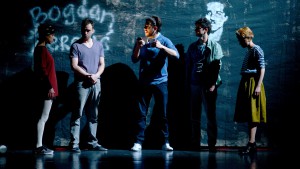
At the Yugoslav Drama Theatre, Iva Milošević is directing THE DRAGONSLAYERS, a new play by the renowned playwright Milena Marković, a play with the subject of the centenary of the beginning of World War I, the Young Bosnians, Gavrilo Princip… When asked about her reasons for writing this play, Milena Marković says, “My personal motivation stems from my value system that is primarily anti-authoritarian and freedom-loving. And—’
T.N: And?
M.M.: And it is like that even when it is about an authority coming from the value system I myself have been formed on, which is the so-called modern Western world. The title comes for The Birth of Tragedy by Friedrich Nietzsche, where he dreams of a generation that would change the world. At the time when Nietzsche was writing his book, imperial forces have come to their end, and this unsustainable system in which a minority was doing better and better, and the majority was having unbearable conditions, fell apart. Of course, a whole wonderful world disappeared, and another one emerged. Many writers of the day, writers of decadent or accursed movements, sense the threat and the delight of this unavoidable change.
T.N.: The central theme?
M.M.: The central theme is the suffering of noble young men with class and social and national awareness who feel the injustice and realise they must perish, and at the same time, some of them love life so much and question whether they are right or not.
T.N.: You personal stance on Gavrilo Princip, Young Bosnia, the centenary of the beginning of World War I?
M.M.: We currently live in the age of the great war of economics and propaganda. Everyone has the right to take sides, or to remain on the sidelines, but there are some great pressures involved. We are small and irrelevant, a bloody change in the exchange between the great powers, to paraphrase Andric. I want no part in this feast of various wardens and satraps where bones of dead heroes are rolled over back and forth as anyone sees fit. The Young Bosnians were heroes of that age. The world they fought for no longer exists, if it ever has.
T.N.: You see this as separate from the play itself?
M.M.: It should be seen separately from the play, everyone is entitled to experiencing the play in their own way. A work of art is such a thing that it should not only suit one particular day and age and one particular political group. It should be such a thing that, if someone likes to think the play is about his grandfather, let it be about his grandfather, if the play is about himself, let it be a play about himself, if someone merely wants to enjoy the verse or the performance, let them. Our provincialising, among other things, consists of there being a constant pressure to justify every single thing politically, which is often done in very vulgar and banal ways, and before the eyes of the bosses, from various sides.
Go back to: The Serbian Press about “The Dragonslayers”
Published on 27 November 2015